With a focus on actionable insights and strategic value, The Business Research Company’s 2026 market reports include market attractiveness scoring, total addressable market sizing, company benchmarking matrices, interactive Excel dashboards, deeper supply chain intelligence, emerging startup tracking, and granular product-level insights.
Television Station Market Size Snapshot: 2026 Valuation, 2030 Projection And Key Growth Factors
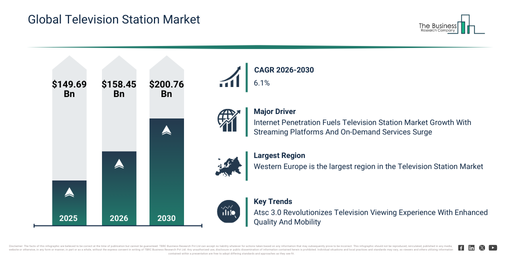
The television station market size has demonstrated strong growth in recent years. This market is anticipated to expand from $149.69 billion in 2025 to $158.45 billion in 2026, achieving a compound annual growth rate (CAGR) of 5.9%. The historical period’s growth can be attributed to factors such as the increasing adoption of cable and satellite TV, an upturn in advertising revenue, the expansion of broadcasting infrastructure, a rising number of TV households, and the emergence of pay-per-view services.
The television station market size is anticipated to demonstrate significant expansion in the next few years. It will grow to $200.76 billion in 2030 at a compound annual growth rate (CAGR) of 6.1%. This growth during the forecast period can be attributed to the shift towards IPTV and OTT platforms, the integration of AI-driven content analytics, an increase in the adoption of immersive technologies, rising demand for interactive and on-demand content, and the expansion of regional broadcasting networks. Prominent trends expected in the forecast period encompass personalized content delivery, multi-platform broadcasting, interactive viewer engagement, cloud-based content management, and social media integration.
Get A No-Cost Sample Of The Television Station Market Study:
Major Factor Fueling The Television Station Market Through 2030
The expanding prevalence of internet access is a key factor driving growth in the television station market. Internet penetration, which can also be referred to as the internet penetration rate or internet adoption rate, serves as a metric indicating the percentage of a total population within a specific geographic area, demographic group, or organization that both has access to and uses the internet. This increase in internet availability broadens the scope of streaming platforms, thereby fostering the creation of online content and video-on-demand services. Consequently, this development significantly boosts the television station market by providing a wider audience with enhanced access to TV shows, live events, and on-demand programming. Therefore, the ongoing increase in internet penetration continues to propel the television station market.
Television Station Market Segment Landscape: Main Categories And Subcategories Covered
The television station market covered in this report is segmented –
1) By Platform: Digital Terrestrial Broadcast, Satellite Broadcast, Cable Television Broadcasting Services, Internet Protocol Television (IPTV), Over-The-Top Television (OTT)
2) By Revenue Model: Subscription, Pay-per View, On Demand, Advertisement
3) By Broadcaster Type: Public, Commercial
Subsegments:
1) By Digital Terrestrial Broadcast: Free-To-Air Digital Channels, Subscription-Based Digital Channels
2) By Satellite Broadcast: Direct Broadcast Satellite (DBS), Satellite Television Channels
3) By Cable Television Broadcasting Services: Standard Cable Services, Premium Cable Services, Hybrid Cable Or IPTV Services
4) By Internet Protocol Television (IPTV): Live IPTV Services, On-Demand IPTV Services
5) By Over-The-Top Television (OTT): Subscription Video on Demand (SVOD), Advertising-Based Video On Demand (AVOD), Transactional Video On Demand (TVOD)
How Are Emerging Trends Influencing The Television Station Market’s Growth Path?
Leading companies within the television station market are increasingly prioritizing the integration of advanced broadcasting technologies, such as ATSC 3.0, to elevate viewing quality, expand device compatibility, and deliver more immersive consumer experiences. ATSC 3.0, the latest standard developed by the Advanced Television Systems Committee, enables superior picture quality through capabilities like high dynamic range (HDR), wide color gamut (WCG), and high frame rate (HFR), while also enhancing audio performance and transmission efficiency.
Television Station Market Leading Players And Key Industry Participants In 2026
Major companies operating in the television station market are Comcast Corporation, British Broadcasting Corporation, The Walt Disney Company, Cox Media Group, Fox Corporation, Hearst Television Inc., TEGNA Inc., RTL Group, CANAL+ Group, Nexstar Media Group Inc., National Amusements Inc., Univision Communications Inc., Graham Media Group, Sinclair Broadcast Group, Gray Television Inc., E.W. Scripps Company, Channel Four Television Corporation, Entravision Communications Corporation, Canadian Broadcasting Corporation, Sun Broadcasting Inc., Heartland Media, Weigel Broadcasting Co.
Check Out The Full Television Station Market Report 2026:
Television Station Market By Geography: Revenue Leaders Among Global Regions
Western Europe was the largest region in the content streaming market in 2025. Eastern Europe is expected to be the fastest-growing region in the global television station market during the forecast period. The regions covered in the television station market report are Asia-Pacific, South East Asia, Western Europe, Eastern Europe, North America, South America, Middle East, Africa.
Reach Out To Our Team:
The Business Research Company: https://www.thebusinessresearchcompany.com/
Americas: +1 310-496-7795
Asia: +44 7882 955267 & +91 8897263534
Europe: +44 7882 955267
Email us at: marketing@tbrc.info
Follow us on:
LinkedIn: https://in.linkedin.com/company/the-business-research-company
YouTube: https://www.youtube.com/channel/UC24_fI0rV8cR5DxlCpgmyFQ
Global Market Model: https://www.thebusinessresearchcompany.com/global-market-model

Wasay has over a decade of experience in market research, data modelling, and analytics, with prior experience at GlobalData and Decision Tree Consulting Services. At The Business Research Company , he leads research operations across syndicated studies, customized consulting engagements, and the Global Market Model platform. His professional experience includes supporting organizations such as Boston Consulting Group, KPMG, and Ernst & Young. Wasay holds a degree in Electronics and Communications Engineering, postgraduate management qualifications from International Management Institute Belgium and Indian School of Business and Entrepreneurship, and completed the Integrated Program in Business Analytics from Indian Institute of Management Indore.