
Backed by market attractiveness analysis, total addressable market sizing, company benchmarking matrices, interactive Excel dashboards, wider supply chain intelligence, emerging startup coverage, and detailed product-level insights, The Business Research Company’s 2026 market reports are designed to offer research that is more actionable and strategically valuable than ever.
#Television Station Market Size Forecast: How Big Could The Market Get By 2030?#_x000D_
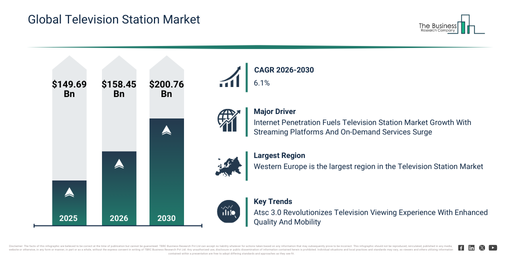
The television station market size has experienced significant expansion recently. It is forecast to rise from $149.69 billion in 2025 to $158.45 billion in 2026, achieving a compound annual growth rate (CAGR) of 5.9%. The growth observed in the past period is attributable to the increasing embrace of cable and satellite television, a surge in advertising revenue, the development of broadcasting infrastructure, a growing count of television households, and the advent of pay-per-view services._x000D_
_x000D_
The television station market is anticipated to experience substantial expansion in the coming years. This market is projected to reach $200.76 billion by 2030, exhibiting a compound annual growth rate (CAGR) of 6.1%. Factors contributing to this projected growth include the transition to IPTV and OTT platforms, the incorporation of AI-driven content analytics, increased adoption of immersive technologies, rising consumer demand for interactive and on-demand content, and the broadening of regional broadcasting networks. Key trends anticipated during this period encompass personalized content delivery, multi-platform broadcasting strategies, enhanced interactive viewer engagement, the use of cloud-based content management, and the integration of social media._x000D_
_x000D_
#Get A Free Sample Report With In-Depth Market Insights:#_x000D_
_x000D_
#Television Station Market Industry Drivers: What’s Behind The Revenue Growth?#_x000D_
The television station market’s expansion is fundamentally driven by increasing internet penetration. This metric, often referred to as the internet penetration rate or internet adoption rate, quantifies the proportion of the total population within a particular geographic area, demographic group, or organization that possesses and uses internet access. A rise in internet penetration broadens the audience for streaming platforms, which in turn stimulates the creation of online content and video-on-demand services. This development provides a significant boost to the television station market, making TV shows, live events, and on-demand programming more accessible to a wider public. For instance, in June 2024, according to the SAMENA Telecommunications Council, UAE-Based non-profit, tri-regional association, the global number of Internet users reached 5.4 billion in 2023 and is projected to rise to 5.5 billion by the end of 2024. Therefore, growing internet penetration actively propels the television station market._x000D_
_x000D_
#Television Station Market Segments: Where Is Growth Concentrated?#_x000D_
The television station market covered in this report is segmented – _x000D_
_x000D_
1) By Platform: Digital Terrestrial Broadcast, Satellite Broadcast, Cable Television Broadcasting Services, Internet Protocol Television (IPTV), Over-The-Top Television (OTT) _x000D_
2) By Revenue Model: Subscription, Pay-per View, On Demand, Advertisement _x000D_
3) By Broadcaster Type: Public, Commercial _x000D_
_x000D_
Subsegments:_x000D_
1) By Digital Terrestrial Broadcast: Free-To-Air Digital Channels, Subscription-Based Digital Channels _x000D_
2) By Satellite Broadcast: Direct Broadcast Satellite (DBS), Satellite Television Channels_x000D_
3) By Cable Television Broadcasting Services: Standard Cable Services, Premium Cable Services, Hybrid Cable Or IPTV Services _x000D_
4) By Internet Protocol Television (IPTV): Live IPTV Services, On-Demand IPTV Services _x000D_
5) By Over-The-Top Television (OTT): Subscription Video on Demand (SVOD), Advertising-Based Video On Demand (AVOD), Transactional Video On Demand (TVOD) _x000D_
_x000D_
#Television Station Market Growth Trends: What’s Shaping The Future Outlook?_x000D_
Leading companies in the television station market are increasingly concentrating on implementing advanced broadcasting technologies, specifically ATSC 3.0, to upgrade viewing quality, extend compatibility across devices, and deliver more immersive consumer interactions. ATSC 3.0, which is the most recent standard developed by the Advanced Television Systems Committee, enables superior image quality via features like high dynamic range (HDR), wide color gamut (WCG), and high frame rate (HFR), concurrently improving audio performance and transmission effectiveness. For example, in January 2023, Samsung, a South Korea-based electronics firm, launched its 2023 Neo QLED, Micro LED, and Samsung OLED lineup, demonstrating next-generation display technologies crafted to provide robust performance, secure connectivity, and tailored viewing experiences in line with evolving broadcast standards. These innovations support seamless content distribution across a broad array of devices, including smartphones, tablets, and in-vehicle entertainment setups, allowing broadcasters to reach audiences beyond traditional television platforms. As a result, the integration of ATSC 3.0 and complementary display technologies is expected to foster greater audience engagement and create fresh monetization avenues for television stations through interactive and data-enabled services._x000D_
_x000D_
#Television Station Market Competitive Overview And Top Companies#_x000D_
Major companies operating in the television station market are Comcast Corporation, British Broadcasting Corporation, The Walt Disney Company, Cox Media Group, Fox Corporation, Hearst Television Inc., TEGNA Inc., RTL Group, CANAL+ Group, Nexstar Media Group Inc., National Amusements Inc., Univision Communications Inc., Graham Media Group, Sinclair Broadcast Group, Gray Television Inc., E.W. Scripps Company, Channel Four Television Corporation, Entravision Communications Corporation, Canadian Broadcasting Corporation, Sun Broadcasting Inc., Heartland Media, Weigel Broadcasting Co. _x000D_
_x000D_
#View The Full Television Station Market Report:#_x000D_
_x000D_
#Television Station Market Top Region: Where Does Most Revenue Come From?#_x000D_
Western Europe was the largest region in the content streaming market in 2025. Eastern Europe is expected to be the fastest-growing region in the global television station market during the forecast period. The regions covered in the television station market report are Asia-Pacific, South East Asia, Western Europe, Eastern Europe, North America, South America, Middle East, Africa._x000D_
_x000D_
#Reach Out To Our Team:#_x000D_
_x000D_
The Business Research Company: https://www.thebusinessresearchcompany.com/_x000D_
Americas: +1 310-496-7795_x000D_
Asia: +44 7882 955267 & +91 8897263534_x000D_
Europe: +44 7882 955267_x000D_
Email us at: marketing@tbrc.info_x000D_
_x000D_
#Follow us on:#_x000D_
_x000D_
LinkedIn: https://in.linkedin.com/company/the-business-research-company_x000D_
YouTube: https://www.youtube.com/channel/UC24_fI0rV8cR5DxlCpgmyFQ_x000D_
Global Market Model: https://www.thebusinessresearchcompany.com/global-market-model

Wasay has over a decade of experience in market research, data modelling, and analytics, with prior experience at GlobalData and Decision Tree Consulting Services. At The Business Research Company , he leads research operations across syndicated studies, customized consulting engagements, and the Global Market Model platform. His professional experience includes supporting organizations such as Boston Consulting Group, KPMG, and Ernst & Young. Wasay holds a degree in Electronics and Communications Engineering, postgraduate management qualifications from International Management Institute Belgium and Indian School of Business and Entrepreneurship, and completed the Integrated Program in Business Analytics from Indian Institute of Management Indore.