
With a focus on actionable insights and strategic value, The Business Research Company’s 2026 market reports include market attractiveness scoring, total addressable market sizing, company benchmarking matrices, interactive Excel dashboards, deeper supply chain intelligence, emerging startup tracking, and granular product-level insights.
Active Phased Array Radar Market Size Analysis: Historical Growth And Future Revenue Projections
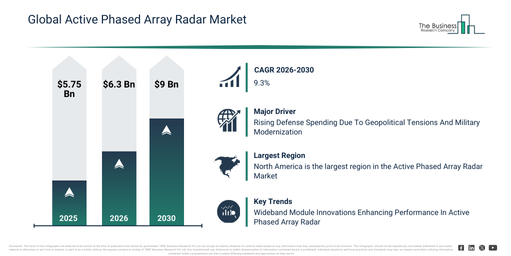
The active phased array radar market size has experienced significant growth in recent years. This market is expected to expand from $5.75 billion in 2025 to $6.3 billion in 2026, registering a compound annual growth rate (CAGR) of 9.6%. Historically, this expansion can be attributed to the rising integration of active phased array radars within military defense systems, ongoing advancements in electronically scanned array and multifunction radar technologies, increasing demand for high-precision target detection and tracking, the growth of surveillance, reconnaissance, and air traffic control applications, and the development of gallium nitride-based radar modules for improved performance.
The active phased array radar market is projected to experience substantial expansion in the coming years, reaching $9 billion in 2030 with a compound annual growth rate (CAGR) of 9.3%. This expansion is driven by factors such as the incorporation of AI and machine learning for predictive target tracking and threat analysis, increased use in missile defense and advanced naval and air platforms, the creation of compact and energy-efficient phased array radar systems, greater implementation in developing markets with updated defense infrastructure, and the broadening of multifunction and networked radar systems for comprehensive situational awareness. Key developments anticipated during this period encompass a rising need for multi-function phased array radar in missile defense, enhanced uptake of GaN-based radar modules for improved efficiency, greater utilization of electronically scanned arrays in maritime surveillance, an expansion of radar applications for extreme-weather observation, and more extensive integration of active phased array radars into future aircraft.
Preview The Active Phased Array Radar Market Report With A Free Sample:
Active Phased Array Radar Market Drivers: What Is Fueling Demand Through 2030?
The active phased array radar market is projected to expand due to increasing defense spending. Defense spending is defined as the financial resources governments allocate to maintain and improve armed forces, military infrastructure, weapon acquisition, personnel wages, research and development, and national security operations. This rise in defense expenditure is occurring amidst escalating geopolitical tensions and the modernization of military technologies, as nations prioritize security, invest in advanced solutions to counter emerging threats, and aim to maintain strategic superiority. Active phased array radar systems support defense budgets by facilitating more efficient surveillance, target tracking, and threat detection with reduced personnel and maintenance costs, thereby enhancing military operational effectiveness. For illustration, as reported by France 24 S.A., a France-based international news broadcasting company, Russia’s military spending surged to $149 billion in 2024, representing a 38 percent increase compared to 2023. Consequently, the increasing defense spending is a key factor driving the growth of the active phased array radar market.
Active Phased Array Radar Market Segmentation Analysis: Core Categories And Subcategories
The active phased array radar market covered in this report is segmented –
1) By Technology Type: Analog Phased Array, Digital Phased Array, Hybrid Phased Array, Vector Phased Array
2) By Component: Transmitter, Receiver, Antenna, Digital Signal Processor, Other Components
3) By Frequency Band: Low Band, Super Band, Communication Band, Extended Band, Kurtz Band, Other Frequency Bands
4) By Application: Defense Systems, Aerospace And Air Traffic Management, Maritime Surveillance, Weather Monitoring, Automotive Industry
5) By End User Industry: Aerospace And Defense, Maritime, Environmental Monitoring, Automotive Advanced Driver Assistance Systems, Telecommunications
Subsegments:
1) By Analog Phased Array: Ground-Based Analog Surveillance Radars, Analog Beamforming Air-Defense Radars, Legacy-Platform Analog Phased Array Upgrade Kits
2) By Digital Phased Array: Software-Defined Digital Beamforming Radars, Multi-Function Active Electronically Scanned Array (AESA) Systems, High-Resolution Digital Imaging Radars for Target Tracking
3) By Hybrid Phased Array: Hybrid Analog-Digital Beamforming Surveillance Radars, Cost-Optimized Multi-Mode Hybrid AESA Systems, Adaptive Beam-Control Hybrid Radar Architectures
4) By Vector Phased Array: Polarization-Controlled Phased Array Radars, Precision Vector-Beam Targeting Radars, Electronic Warfare Vector-Steered Radar Systems
Which Trends Will Define The Active Phased Array Radar Market Through 2030?
Leading companies operating in the active phased array radar market are focusing on developing technological advancements, specifically wideband front-end modules, to improve radar performance, reduce system complexity, and support multi-mission capabilities. These wideband front-end modules are compact, integrated components that combine transmit and receive functions, enabling efficient signal amplification and low-noise reception across a broad frequency range. For instance, in June 2025, MACOM Technology Solutions Inc., a US-based semiconductor company, launched the ENGSD00088 Transmit or Receive Module. This product operates from 2 to 18 GHz, integrating a high-power GaN amplifier, GaAs low noise amplifier, and T/R switch in a compact form. It delivers 2.5W output, 25 dB transmit gain, and 27 dB receive gain, ensuring reliable performance for electronic countermeasures and phased array radar. The module aims to simplify system design while enhancing power efficiency and signal clarity.
Active Phased Array Radar Market Major Companies And Industry Participants
Major companies operating in the active phased array radar market are Rheinmetall AG , Mitsubishi Electric Corporation , Raytheon Technologies Corporation , Lockheed Martin Corporation , BAE Systems plc, Northrop Grumman Corporation , Thales Group , L3Harris Technologies Inc. , General Atomics Aeronautical Systems Inc. , Elbit Systems Ltd., Kongsberg Gruppen ASA , Aselsan A.S., Hensoldt AG , Hanwha Systems Co Ltd., Leonardo S.p.A. , Indra Sistemas S.A. , Saab AB , CesiumAstro Inc., CEA Technologies Pty Limited, China Electronics Technology Group Corporation
Buy The Full Active Phased Array Radar Global Market Report 2026:
Active Phased Array Radar Market Geographic Analysis: Which Region Accounts For The Biggest Share?
North America was the largest region in the active phased array radar market in 2025. Asia-Pacific is expected to be the fastest-growing region in the forecast period. The regions covered in the active phased array radar market report are Asia-Pacific, South East Asia, Western Europe, Eastern Europe, North America, South America, Middle East, Africa.
Reach Out To Our Team:
The Business Research Company: https://www.thebusinessresearchcompany.com/
Americas: +1 310-496-7795
Asia: +44 7882 955267 & +91 8897263534
Europe: +44 7882 955267
Email us at: marketing@tbrc.info
Follow us on:
LinkedIn: https://in.linkedin.com/company/the-business-research-company
YouTube: https://www.youtube.com/channel/UC24_fI0rV8cR5DxlCpgmyFQ
Global Market Model: https://www.thebusinessresearchcompany.com/global-market-model

Wasay has over a decade of experience in market research, data modelling, and analytics, with prior experience at GlobalData and Decision Tree Consulting Services. At The Business Research Company , he leads research operations across syndicated studies, customized consulting engagements, and the Global Market Model platform. His professional experience includes supporting organizations such as Boston Consulting Group, KPMG, and Ernst & Young. Wasay holds a degree in Electronics and Communications Engineering, postgraduate management qualifications from International Management Institute Belgium and Indian School of Business and Entrepreneurship, and completed the Integrated Program in Business Analytics from Indian Institute of Management Indore.

