
Backed by market attractiveness analysis, total addressable market sizing, company benchmarking matrices, interactive Excel dashboards, wider supply chain intelligence, emerging startup coverage, and detailed product-level insights, The Business Research Company’s 2026 market reports are designed to offer research that is more actionable and strategically valuable than ever.
Aerial Refueling Systems Market Value Analysis: What Growth Lies Ahead Over The Forecast Period?
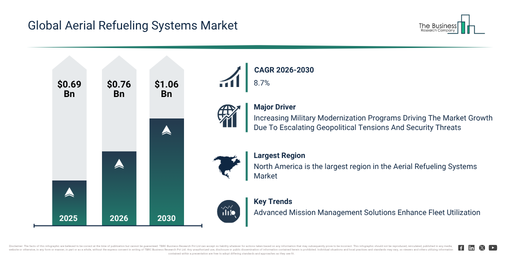
The aerial refueling systems market size has seen substantial growth in recent years. It is projected to expand from $0.69 billion in 2025 to $0.76 billion in 2026, achieving a compound annual growth rate (CAGR) of 9.2%. The historical market expansion is attributable to factors such as advancing military modernization programs, an increase in long-range combat missions, elevated defense spending, evolving strategic air mobility requirements, and the rising acquisition of tanker aircraft.
The aerial refueling systems market is anticipated to experience substantial expansion in the coming years. This market is projected to reach $1.06 billion by 2030, exhibiting a compound annual growth rate (CAGR) of 8.7%. The expansion during this period stems from factors such as the greater deployment of unmanned aerial vehicles, increased investment in advanced tanker fleets, the rising need for autonomous aerial refueling, broader joint military operations, and a heightened emphasis on rapid force projection. Key developments expected over the forecast period involve a greater uptake of multi-mission aerial refueling platforms, an increasing need for prolonged aircraft mission endurance, the ongoing modernization of air refueling fleets, wider deployment of high-capacity refueling systems, and enhanced integration of advanced fuel transfer and safety mechanisms.
Get A Free Sample Report With In-Depth Market Insights:
Aerial Refueling Systems Market Growth Backed By Core Demand Fundamentals
Growing military modernization initiatives are anticipated to fuel the expansion of the aerial refueling systems market in the future. These programs represent extensive efforts by armed forces to update and improve their defense prowess using sophisticated weapon systems and cutting-edge technologies. The surge in military modernization stems from intensifying geopolitical tensions and threats to national sovereignty and regional stability, prompting countries to bolster their defense capacities, deter rivals, and protect their strategic interests. Enhanced military modernization initiatives are accelerating the creation and deployment of aerial refueling systems by increasing funding for advanced tanker aircraft, improving mission longevity, and reinforcing long-range operational effectiveness. As an illustration, in March 2023, the European Security and Defence College, an autonomous institution located in Belgium, reported that by 2030, the current US Army modernization program plans to deploy 35 new future force systems, which will be central to over 500 ongoing development, acquisition, or upgrade efforts. Consequently, the expanding military modernization programs are fostering the growth of the aerial refueling systems market.
Aerial Refueling Systems Market Segment Trends And Revenue Contributors
The aerial refueling systems market covered in this report is segmented –
1) By Component: Refueling Pods, Refueling Booms, Hoses And Drogues, Pumps And Valves, Software And Control Systems
2) By Aircraft Type: Fighter Aircraft, Transport Aircraft, Tanker Aircraft, Military Helicopters, Unmanned Aerial Vehicles
3) By System Type: Probe And Drogue Systems, Boom And Receptacle Systems, Autonomous Aerial Refueling Systems
4) By Distribution Channel: Original Equipment Manufacturer (OEM), Aftermarket
5) By End User: Air Force, Navy, Other Defense Organizations
Subsegments:
1) By Refueling Pods: Wing Mounted Refueling Pods, Fuselage Mounted Refueling Pods, High Capacity Refueling Pods, Modular Refueling Pods, Multi Point Refueling Pods
2) By Refueling Booms: Fly By Wire Refueling Booms, Telescopic Refueling Booms, Rigid Refueling Booms, Advanced Vision Refueling Booms, Remote Operated Refueling Booms
3) By Hoses And Drogues: Wing Mounted Hose And Drogue Systems, Centerline Hose And Drogue Systems, High Speed Hose And Drogue Systems, Retractable Hose And Drogue Systems, Flexible Hose And Drogue Assemblies
4) By Pumps And Valves: Fuel Transfer Pumps, Booster Pumps, Pressure Control Valves, Flow Control Valves, Shut Off Valves
5) By Software And Control Systems: Refueling Mission Management Software, Boom Control Software, Fuel Monitoring Software, Flight Control Integration Software, Operator Interface Systems
Aerial Refueling Systems Market Growth Trends Reshaping The Competitive Landscape
Major companies in the aerial refueling systems market are focusing on developing advanced solutions, such as intelligent aerial refueling mission management systems, to enhance operational efficiency, optimize tanker allocation, and improve mission readiness. Intelligent aerial refueling mission management systems are sophisticated software platforms that leverage artificial intelligence, real-time operational data, and mission planning tools to streamline tanker scheduling, aircraft assignment, fuel distribution, and the entirety of aerial refueling operations. For instance, in March 2026, the People’s Liberation Army Air Force (PLAAF), a China-based aerial warfare services provider, launched an AI-powered aerial refueling dispatcher system designed to improve the effectiveness and speed of tanker operations. The system utilizes artificial intelligence to optimize aerial refueling task assignments, coordinate tanker aircraft deployment, and facilitate dynamic mission planning based on operational requirements. By automating scheduling and dispatch functions, the platform significantly enhances mission responsiveness while improving the utilization of aerial refueling assets across multiple flight operations.
Aerial Refueling Systems Market Leading Players And Competitive Positioning
Major companies operating in the aerial refueling systems market are AAR CORP., Airbus SE, BAE Systems plc, Dassault Aviation SA, Eaton Corporation plc, Elbit Systems Ltd., Embraer S.A., GKN Aerospace Services Limited, Israel Aerospace Industries Ltd., Leonardo S.p.A., Lockheed Martin Corporation, Marshall of Cambridge (Aerospace) Limited, Northrop Grumman Corporation, Omega Aerial Refueling Services Inc., Parker-Hannifin Corporation, PJSC United Aircraft Corporation, RTX Corporation, Safran Aerosystems SAS, The Boeing Company, Triumph Group Inc.
View The Full Aerial Refueling Systems Market Report:
Aerial Refueling Systems Market Regional Distribution: Which Areas Power Market Growth?
North America was the largest region in the aerial refueling systems market in 2025. Asia-Pacific is expected to be the fastest-growing region in the forecast period. The regions covered in the aerial refueling systems market report are Asia-Pacific, South East Asia, Western Europe, Eastern Europe, North America, South America, Middle East, Africa.
Reach Out To Our Team:
The Business Research Company: https://www.thebusinessresearchcompany.com/
Americas: +1 310-496-7795
Asia: +44 7882 955267 & +91 8897263534
Europe: +44 7882 955267
Email us at: marketing@tbrc.info
Follow us on:
LinkedIn: https://in.linkedin.com/company/the-business-research-company
YouTube: https://www.youtube.com/channel/UC24_fI0rV8cR5DxlCpgmyFQ
Global Market Model: https://www.thebusinessresearchcompany.com/global-market-model

Wasay has over a decade of experience in market research, data modelling, and analytics, with prior experience at GlobalData and Decision Tree Consulting Services. At The Business Research Company , he leads research operations across syndicated studies, customized consulting engagements, and the Global Market Model platform. His professional experience includes supporting organizations such as Boston Consulting Group, KPMG, and Ernst & Young. Wasay holds a degree in Electronics and Communications Engineering, postgraduate management qualifications from International Management Institute Belgium and Indian School of Business and Entrepreneurship, and completed the Integrated Program in Business Analytics from Indian Institute of Management Indore.