
Delivering more actionable and strategically valuable research, The Business Research Company’s 2026 market reports feature market attractiveness analysis, total addressable market evaluation, company benchmarking matrices, interactive Excel dashboards, expanded supply chain intelligence, emerging startup coverage, and detailed product insights.
Aerospace 3D Printing Market Forecast Highlighting Growth From $5.36 Billion To $14.65 Billion
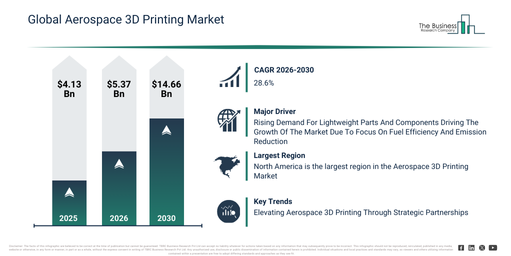
The aerospace 3d printing market has experienced rapid expansion recently. Projections indicate a rise from $4.13 billion in 2025 to $5.37 billion by 2026, demonstrating a compound annual growth rate (CAGR) of 30.0%. Historically, this expansion has been driven by several factors, including the greater use of rapid prototyping for developing aerospace components, the early incorporation of additive manufacturing to decrease aircraft part weight, an escalating need for economical manufacturing of intricate shapes, the increasing application of 3D printing to condense aerospace research and development timelines, and the broadening of metal additive manufacturing capacities across aerospace supply networks.
The aerospace 3D printing market is anticipated to exhibit substantial growth over the next few years, with projections indicating it will reach $14.66 billion by 2030, driven by a compound annual growth rate (CAGR) of 28.6%. This expansion during the projection period stems from several factors, including a greater embrace of distributed digital manufacturing to alleviate supply-chain issues, the expanded application of 3D printing for certified flight-ready parts, continuous progress in advanced aerospace materials like titanium and inconel powders, the increasing integration of additive manufacturing in supporting future aircraft and satellite initiatives, and heightened investment in large-scale industrial 3D printers for aerospace manufacturing. Key trends anticipated for this forecast period encompass a move from prototyping to the serial production of aerospace components, greater utilization of lightweight, high-performance alloys for flight-critical elements, an increase in on-demand manufacturing for spare and replacement parts, heightened focus on the qualification and certification of 3D-printed flight hardware, and the customization of cabin interiors and low-volume structural components.
Download A Free Sample Report For Comprehensive Market Insights:
Aerospace 3D Printing Market Demand Drivers: What Is Fueling Industry Growth?
The expanding need for lightweight components and parts within the aerospace industry is fueling the expansion of the aerospace 3D printing market. These lightweight elements are structural and functional pieces specifically engineered to lower the total mass of aircraft, spacecraft, and associated systems, all without sacrificing strength, safety, or operational capability. This heightened demand stems from an increasing emphasis on enhancing fuel efficiency and decreasing carbon emissions. Aerospace 3D printing empowers the aerospace industry to produce these lightweight components by optimizing intricate designs and minimizing material waste, all while preserving structural integrity. A notable illustration occurred in August 2024 when, as reported by the National Aeronautics and Space Administration (NASA), a US-based space agency, the Marshall additive-manufacturing project successfully produced composite materials that showed a 40% weight savings compared to traditional bimetallic combustion chambers. Consequently, the increasing requirement for lightweight parts and components from the aerospace industry is a significant factor in the growth of the aerospace 3D printing market.
Aerospace 3D Printing Market Segmentation: How Is The Market Structured Across Key Categories?
The aerospace 3d printing market covered in this report is segmented –
1) By Material Type: Metals, Plastics, Ceramics
2) By Industry Type: Aircraft, Spacecraft, Unmanned Aerial Vehicles
3) By Printer Technology Type: Direct Metal Laser Sintering (DMLS), Fused Deposition Modeling (FDM), Continuous Liquid Interface Production (CLIP), Stereolithography (SLA), Selective Laser Sintering (SLS)
4) By Process Type: Material Extrusion, Powder Bed Fusion, Direct Energy Deposition, Material Jetting, Binder Jetting, Sheet Lamination, Vat Photo-Polymerization
5) By Application: Structural Components, Engine Components, Space Components
Subsegments:
1) By Metals: Aluminum Alloys, Titanium Alloys, Stainless Steel, Inconel
2) By Plastics: Thermoplastics, Thermosetting Plastics, Composites, Other Plastic Materials
3) By Ceramics: Oxide Ceramics, Non-Oxide Ceramics, Composite Ceramics, Other Ceramic Materials
Aerospace 3D Printing Market Innovation Trends: Which Developments Are Transforming The Industry?
Leading companies in the aerospace 3D printing market are employing a strategic partnership strategy to secure various benefits, including access to novel technologies, enhanced capabilities, and a wider market reach. These collaborations involve businesses leveraging each other’s strengths and resources to attain mutual advantages and success. For example, in April 2023, Handddle, a France-based developer of additive manufacturing smart production cells, and markforged formed a partnership with the French Air and Space Force, a France-based Armed Forces. This alliance aims to further develop and deploy 3D printing capabilities for the French Air and Space Force, address the increasing demand for 3D-printed parts in the defense sector, and solidify the relationship between Handddle and the French Air and Space Force.
Aerospace 3D Printing Market Competitive Landscape And Leading Companies
Major companies operating in the aerospace 3d printing market are Norsk Titanium AS, Materialise NV, EOS GmbH Electro Optical Systems, Arcam AB, 3D Systems Corporation, Ultimaker B.V., Stratasys Ltd., General Electric Company, Airbus SE, Safran SA, Raytheon Technologies Corporation, The ExOne Company, MTU Aero Engines AG, Höganäs AB, Oerlikon Group AG, Renishaw plc, TRUMPF GmbH + Co. KG, Made In Space Inc., Markforged Inc., Liebherr-International AG, EnvisionTEC GmbH, Optomec Inc., XYZprinting Inc., SLM Solutions Group AG, Concept Laser GmbH, Sciaky Inc., Additive Industries B.V., Carpenter Technology Corporation, GKN plc, Aerojet Rocketdyne Holdings Inc.
Access The Complete Aerospace 3D Printing Market Report:
Aerospace 3D Printing Market Geographic Landscape: Which Region Dominates Industry Growth?
North America was the largest region in the aerospace 3D printing market in 2025. Asia-Pacific is expected to be the fastest-growing region in the 3D printing market share during the forecast period. The regions covered in the aerospace 3d printing market report are Asia-Pacific, South East Asia, Western Europe, Eastern Europe, North America, South America, Middle East, Africa.
Access a Customized Aerospace 3D Printing Market Report for Deeper Competitive Insights
https://www.thebusinessresearchcompany.com/customise?id=10050&type=smp
Get in touch with us:
The Business Research Company: https://www.thebusinessresearchcompany.com/
Americas: +1 310-496-7795
Asia: +44 7882 955267 & +91 8897263534
Europe: +44 7882 955267
Email us at: marketing@tbrc.info
Follow us on:
LinkedIn: https://in.linkedin.com/company/the-business-research-company
YouTube: https://www.youtube.com/channel/UC24_fI0rV8cR5DxlCpgmyFQ
Global Market Model: https://www.thebusinessresearchcompany.com/global-market-model

Wasay has over a decade of experience in market research, data modelling, and analytics, with prior experience at GlobalData and Decision Tree Consulting Services. At The Business Research Company , he leads research operations across syndicated studies, customized consulting engagements, and the Global Market Model platform. His professional experience includes supporting organizations such as Boston Consulting Group, KPMG, and Ernst & Young. Wasay holds a degree in Electronics and Communications Engineering, postgraduate management qualifications from International Management Institute Belgium and Indian School of Business and Entrepreneurship, and completed the Integrated Program in Business Analytics from Indian Institute of Management Indore.
