Enhanced with market attractiveness analysis, total addressable market evaluation, company benchmarking matrices, interactive Excel dashboards, expanded supply chain intelligence, emerging startup coverage, and detailed product insights, The Business Research Company’s 2026 market reports deliver more actionable and strategically valuable research.
Aerospace Composites Market Forecast Highlighting Growth From $47.22 Billion To $77.48 Billion
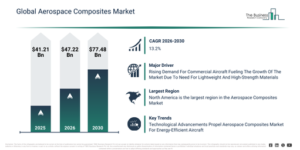
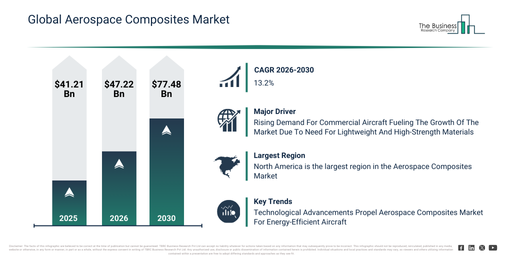
The aerospace composites market has experienced significant expansion recently. This market is projected to expand from $41.21 billion in 2025 to $47.22 billion by 2026, exhibiting a compound annual growth rate (CAGR) of 14.6%. Historically, this growth has stemmed from several factors, including the increasing use of lightweight composite materials to enhance aircraft fuel efficiency, the growing application of high-strength composite structures in commercial aircraft initiatives, the modernization of military aircraft boosting the need for advanced composites, the increasing imperative to mitigate corrosion and prolong aircraft service life through composite solutions, and improvements in composite fabrication methods that minimize material waste and manufacturing expenses.
The aerospace composites market size is anticipated to experience significant growth over the next few years, with projections indicating an expansion to $77.48 billion by 2030, at a compound annual growth rate (CAGR) of 13.2%. This projected increase is driven by several factors, including the expected surge in next-generation aircraft platforms requiring more composite content, the increasing need for high-performance aramid-reinforced and boron-reinforced composites, and a heightened focus on sustainability encouraging the use of recyclable and lower-waste composite materials. Furthermore, expanding global fleet replacement cycles are boosting the consumption of composite components, complemented by technological advancements in automated composite manufacturing that improve scalability and consistency. Noteworthy trends during this period encompass the growing adoption of lightweight composite structures, an increased integration of high-temperature-resistant composite materials, a rising demand for corrosion-resistant composite components, enhancements in composite molding and fabrication processes, and the expanding utilization of composite materials in future aircraft interiors.
Download A Free Sample Report For Comprehensive Market Insights:
Aerospace Composites Market Growth Momentum: Which Factors Are Influencing Demand?
The rising need for commercial aircraft is projected to stimulate the expansion of the aerospace composites market. Commercial aircraft, often termed airliners, are vehicles specifically engineered for carrying passengers and freight as part of commercial aviation. The global increase in passenger travel is leading to an expansion of the commercial aircraft fleet, prompting airlines to enlarge their fleets and establish new routes to manage higher volumes. Aerospace composites enhance the capabilities of commercial aircraft by providing materials that are both lightweight and high-strength, thereby improving fuel efficiency and overall structural durability. For instance, in January 2025, Airbus, a France-based aircraft manufacturing company, announced it delivered 766 commercial aircraft in 2024, an increase from 735 deliveries in 2023. Thus, the growing demand for commercial aircraft is a primary driver for the aircraft composites market’s growth.
Aerospace Composites Market Segment Landscape: Which Areas Lead Market Development?
The aerospace composites market covered in this report is segmented –
1) By Fiber Type: Carbon Fiber Composites, Ceramic Fiber Composites, Glass Fiber Composites, Others
2) By Aircraft Type: Commercial Aircraft, Business And General Aviation, Civil Helicopter, Military Aircraft, Others
3) By Manufacturing Process: AFP/ATL, Lay-Up Process, Resin Transfer Molding Process, Filament Winding Process, Others
4) By Resin Type: Benzoxazine, Cyanate Ester, Bismaleimide, Ceramic and Metal Matrix, Thermosetting Resins, Polyester, Others
5) By Application: Interior, Exterior
Subsegments:
1) By Carbon Fiber Composites: Continuous Carbon Fiber Composites, Short Carbon Fiber Composites, Carbon Fiber Reinforced Polymers (CFRP)
2) By Ceramic Fiber Composites: Oxide Ceramic Composites, Non-Oxide Ceramic Composites, Ceramic Matrix Composites (CMC)
3) By Glass Fiber Composites: E-glass Fiber Composites, S-glass Fiber Composites, Glass Fiber Reinforced Plastics (GFRP)
4) By Others: Aramid Fiber Composites, Natural Fiber Composites, Hybrid Fiber Composites, Specialty Fiber Composites
Aerospace Composites Market Trends Reshaping Industry Growth
Businesses within the aerospace composites market are prioritizing technological advancements to expedite the development of composite materials and processing technologies for MRO structural film adhesives, thereby addressing various crucial industry demands. An MRO structural film adhesive is a robust and durable adhesive utilized for bonding components during maintenance and repair, particularly in aerospace contexts. For instance, in July 2023, Park Aerospace Corp, a US-based corporation, launched Aeroadhere FAE-350-1, a high-performance structural film adhesive specifically crafted for aerospace applications, especially in maintenance, repair, and overhaul (MRO) environments. This epoxy-based adhesive is formulated to cure at 350°F and delivers exceptional bonding capabilities for composite, metal, and honeycomb materials. With features such as superior temperature resistance, versatility across bonding applications, and a substantial shelf life, FAE-350-1 aims to fulfill the stringent needs of the aerospace industry. Produced at Park’s recently expanded AS9100 and Nadcap-certified facility, this innovative adhesive is expected to boost the reliability and efficiency of aerospace structures.
Aerospace Composites Market Industry Leaders And Market Competition
Major companies operating in the aerospace composites market are Solvay SA, Toray Industries Inc., Mitsubishi Chemical Holdings Corporation, Hexcel Corporation, Teijin Limited, SGL Carbon SE, Materion Corporation, Owens Corning, Spirit AeroSystems Inc., LEE Aerospace Inc., Gurit Holding AG, General Electric Corporation, Kineco-Kaman Composites, Nippon Graphite Fiber Corporation, Lockheed Martin Corporation, Raytheon Technologies Corporation, The Boeing Company, Airbus SE, Northrop Grumman Corporation, Safran SA, Leonardo S.p.A., Honeywell International Inc., L3Harris Technologies Inc., Dassault Aviation SA, Aviation Industry Corporation of China, Triumph Group Inc., Harris Corporation
Access The Complete Aerospace Composites Market Report:
Aerospace Composites Market Regional Analysis And Leading Geography
North America was the largest region in the aerospace composites market in 2025. Asia-Pacific is expected to be the fastest-growing region in the aerospace composites market share during the forecast period. The regions covered in the aerospace composites market report are Asia-Pacific, South East Asia, Western Europe, Eastern Europe, North America, South America, Middle East, Africa.
Access a Customized Aerospace Composites Market Report for Deeper Competitive Insights
https://www.thebusinessresearchcompany.com/customise?id=10103&type=smp
Get in touch with us:
The Business Research Company: https://www.thebusinessresearchcompany.com/
Americas: +1 310-496-7795
Asia: +44 7882 955267 & +91 8897263534
Europe: +44 7882 955267
Email us at: marketing@tbrc.info
Follow us on:
LinkedIn: https://in.linkedin.com/company/the-business-research-company
YouTube: https://www.youtube.com/channel/UC24_fI0rV8cR5DxlCpgmyFQ
Global Market Model: https://www.thebusinessresearchcompany.com/global-market-model

Wasay has over a decade of experience in market research, data modelling, and analytics, with prior experience at GlobalData and Decision Tree Consulting Services. At The Business Research Company , he leads research operations across syndicated studies, customized consulting engagements, and the Global Market Model platform. His professional experience includes supporting organizations such as Boston Consulting Group, KPMG, and Ernst & Young. Wasay holds a degree in Electronics and Communications Engineering, postgraduate management qualifications from International Management Institute Belgium and Indian School of Business and Entrepreneurship, and completed the Integrated Program in Business Analytics from Indian Institute of Management Indore.