
Market attractiveness scoring, total addressable market sizing, company benchmarking matrices, interactive Excel dashboards, deeper supply chain intelligence, emerging startup tracking, and granular product-level insights are among the key offerings featured in The Business Research Company’s 2026 market reports, designed to deliver more actionable and strategically valuable research.
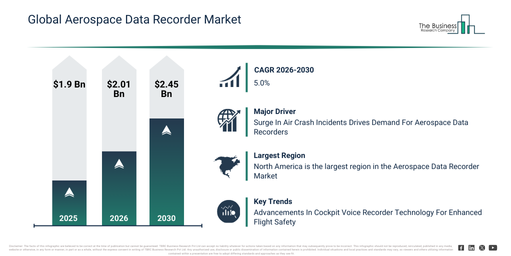
Aerospace Data Recorder Market Valued At $2.01 Billion In 2026, Projected To Reach $2.45 Billion By 2030
The aerospace data recorder market has experienced robust growth recently. Its value is anticipated to rise from $1.9 billion in 2025 to $2.01 billion in 2026, demonstrating a compound annual growth rate (CAGR) of 5.9%. This market’s historical expansion can be attributed to several factors, including the increased uptake of cockpit voice and flight data recorders driven by global aviation safety regulations, a rise in the installation of voyage data recorders in commercial fleets to aid incident investigation, the growth in aircraft production leading to expanded demand for factory-installed data recording systems, advancements in sensor integration enabling more comprehensive data capture for operational analysis, and an increasing emphasis on durable recorder designs capable of enduring high-impact and extreme environmental conditions.
The aerospace data recorder market is projected to experience substantial growth in the coming years, reaching a valuation of $2.45 billion by 2030, driven by a compound annual growth rate (CAGR) of 5.0%. This expansion is primarily fueled by an escalating regulatory push for real-time or deployable flight data streaming systems, an increasing demand for next-generation combined recorders offering greater memory capacity and improved survivability, and a rise in aircraft modernization and retrofit programs necessitating upgraded data recording solutions. Additionally, the expanding use of analytics and AI-based tools is increasing the need for richer in-flight data capture, alongside a higher adoption of lightweight and compact recorder designs to support advanced and unmanned aircraft platforms. Key trends anticipated during this period include the growing adoption of next-generation crash-survivable memory units, increasing use of integrated CVFDR systems, rising demand for lightweight and compact data recorders, a shift toward expanded data-parameter recording requirements, and growth in advanced sensor-based aircraft monitoring.
Request A Complimentary Aerospace Data Recorder Market Research Sample:
Key Factor Propelling The Aerospace Data Recorder Market Forward
An increase in air crashes is anticipated to boost demand within the aerospace data recorder market. Air crashes are defined as aviation accidents or incidents, especially those causing considerable damage, injuries, or fatalities. These devices, often called black boxes, are vital during air crash events because they record and preserve flight data and cockpit voice communications, providing crucial information for accident investigations and for enhancing aviation safety. For example, data from the International Air Transport Association (IATA), a Canada-based trade association, indicated that by February 2025, the year 2024 saw seven fatal accidents among 40.6 million flights. This figure exceeded both the single fatal accident reported in 2023 and the five-year average of five fatal accidents per year. Consequently, the growing frequency of air crashes is projected to fuel the aerospace data recorder market in the foreseeable future.
Aerospace Data Recorder Market Segments And Subsegments Explained
The aerospace data recorder market covered in this report is segmented –
1) By Product: Cockpit Voice Recorder, Flight Data Recorder, Quick Access Recorder, Data Logger
2) By Aircraft Type: Wide Body, Narrow Body, Turboprop, General Aviation And Business Jets, Rotorcrafts
3) By Application: Commercial, Defense
Subsegments:
1) By Cockpit Voice Recorder: Digital Cockpit Voice Recorders, Analog Cockpit Voice Recorders, Integrated Voice Recorders
2) By Flight Data Recorder: Solid-State Flight Data Recorders, Analog Flight Data Recorders, Next-Generation Flight Data Recorders
3) By Quick Access Recorder: Data Retrieval Systems, Interface Systems For Flight Data, Ruggedized Quick Access Recorders
4) By Data Logger: Aircraft Performance Data Loggers, Environmental Data Loggers, Maintenance Data Loggers
Emerging Trends Transforming The Aerospace Data Recorder Market
Key players within the aerospace data recorder market are concentrating on creating advanced products, like the cockpit voice recorder, with the goals of improving flight safety, facilitating real-time data flow, and adhering to changing regulatory mandates. This onboard device, known as a cockpit voice recorder, continuously records pilot discussions, radio exchanges, and various sounds from the cockpit, aiding investigators in incident analysis, boosting flight safety, and ensuring compliance with regulations. As an illustration, in October 2025, Acron Aviation, a US-based provider of commercial aviation solutions, collaborated with Airbus, a France-based commercial aircraft manufacturing company, to introduce the SRVIVR25, which is a 25-hour cockpit voice recorder (CVR) enhancement specifically for Airbus operators worldwide. The SRVIVR25 stands as the sole 25-hour CVR currently approved and qualified by Airbus, fully meeting the requirements of the FAA Reauthorization Act and EASA CVR regulations. It functions as a direct fit-form-function substitute for older 2-hour CVRs, irrespective of their initial manufacturer, allowing for straightforward installation with very little aircraft downtime. The implementation of this upgrade is managed via an Airbus service bulletin, guaranteeing its compatibility with existing cockpit systems, utilization of standard components, simplified maintenance, and adherence to upcoming audio standards.
Aerospace Data Recorder Market Key Players: Major Companies In The 2026 Report
Major companies operating in the aerospace data recorder market are L3 Technologies, Teledyne Technologies, Curtiss-Wright, AstroNova, Universal Avionics, FLYHT Aerospace Solutions, Leonardo DRS, Honeywell International, Flight Data Systems, HR Smith Group, ACR Electronics, Phoenix International, MadgeTech, SLN Technologies, DAC International, Captec Ltd., Safran, Raytheon / RTX, Northrop Grumman, Airbus, Boeing.
Explore The Full Aerospace Data Recorder Market Report With Forecasts To 2030:
Aerospace Data Recorder Market By Region: Where Is Demand Strongest?
North America was the largest region in the aerospace data recorder market in 2025. The regions covered in the aerospace data recorder market report are Asia-Pacific, South East Asia, Western Europe, Eastern Europe, North America, South America, Middle East, Africa.
Reach Out To Our Team:
The Business Research Company: https://www.thebusinessresearchcompany.com/
Americas: +1 310-496-7795
Asia: +44 7882 955267 & +91 8897263534
Europe: +44 7882 955267
Email us at: marketing@tbrc.info
Follow us on:
LinkedIn: https://in.linkedin.com/company/the-business-research-company
YouTube: https://www.youtube.com/channel/UC24_fI0rV8cR5DxlCpgmyFQ
Global Market Model: https://www.thebusinessresearchcompany.com/global-market-model

Wasay has over a decade of experience in market research, data modelling, and analytics, with prior experience at GlobalData and Decision Tree Consulting Services. At The Business Research Company , he leads research operations across syndicated studies, customized consulting engagements, and the Global Market Model platform. His professional experience includes supporting organizations such as Boston Consulting Group, KPMG, and Ernst & Young. Wasay holds a degree in Electronics and Communications Engineering, postgraduate management qualifications from International Management Institute Belgium and Indian School of Business and Entrepreneurship, and completed the Integrated Program in Business Analytics from Indian Institute of Management Indore.

