
With a focus on actionable insights and strategic value, The Business Research Company’s 2026 market reports include market attractiveness scoring, total addressable market sizing, company benchmarking matrices, interactive Excel dashboards, deeper supply chain intelligence, emerging startup tracking, and granular product-level insights.
Aerospace Energy Storage Market Size Analysis: Historical Growth And Future Revenue Projections
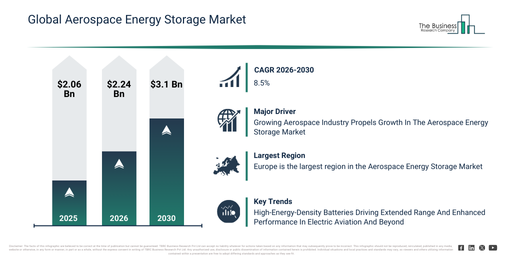
The aerospace energy storage market has experienced significant growth in recent years, with its size projected to increase from $2.06 billion in 2025 to $2.24 billion in 2026, demonstrating a compound annual growth rate (CAGR) of 8.6%. The historical growth of this market can be attributed to the early adoption of onboard energy storage systems supporting essential aerospace functions, a rising demand for lightweight power solutions driven by strict weight and space constraints, the initial development of energy conversion systems to stabilize power supply in aircraft, an increasing use of advanced materials to enhance storage efficiency and safety, and the expansion of electrical subsystem requirements in modern aerospace platforms.
The aerospace energy storage market is projected for significant expansion over the coming years, with its size expected to reach $3.1 billion in 2030 at a compound annual growth rate (CAGR) of 8.5%. This anticipated growth is primarily driven by the increasing integration of high-density storage technologies to support electric and hybrid aircraft, the ongoing development of advanced materials for improved storage performance and sustainability, the expanding incorporation of energy storage systems into next-generation avionics and propulsion architectures, the widespread aerospace electrification initiatives demanding more efficient power management, and technological breakthroughs enabling safer and longer-duration energy storage solutions. Furthermore, key trends during this forecast period include advancements in lightweight aerospace battery systems, the growing integration of high-density energy storage for spacecraft, the creation of thermal-resilient power storage materials, a surge in the use of hybrid energy storage architectures, and a rising demand for aerospace batteries that are safe, compact, and resistant to vibrations.
Preview The Aerospace Energy Storage Market Report With A Free Sample:
Aerospace Energy Storage Market Drivers: What Is Fueling Demand Through 2030?
The expanding aerospace sector is anticipated to drive the aerospace energy storage market going forward. This industry encompasses the design, development, production, and maintenance of aircraft and spacecraft, utilizing aerospace energy storage systems, such as advanced batteries and other storage solutions, to power electrical components. These systems facilitate the integration of electrification technologies, leading to enhanced performance, efficiency, and sustainability. For instance, in September 2024, figures from the Aerospace Industries Association (AIA), a US-based trade association, indicated that the U.S. aerospace and defense industry reached a significant milestone in 2023, with sales exceeding $955 billion, which represented a 7.1% increase compared to the previous year. Consequently, the growth of the aerospace industry is propelling the aerospace energy storage market.
Aerospace Energy Storage Market Driver: Rising Adoption Of Unmanned Aerial Vehicles (Uavs) Driving The Market Growth Due To Increasing Demand For Advanced Aerospace Energy Storage
Aerospace Energy Storage Market Segmentation Analysis: Core Categories And Subcategories
The aerospace energy storage market covered in this report is segmented –
1) By Type: Lead Acid Battery, Lithium Battery, Other Types
2) By Technology: Batteries, Flywheels, Fuel Cells, Other Technology
3) By Application: Aircraft, Spacecraft
Subsegments:
1) By Lead Acid Battery: Flooded Lead Acid Battery, Valve-Regulated Lead Acid (VRLA) Battery
2) By Lithium Battery: Lithium-Ion Battery, Lithium Polymer Battery, Lithium Iron Phosphate (LiFePO4) Battery
3) By Other Types: Nickel-Cadmium (NiCd) Battery, Nickel-Metal Hydride (NiMH) Battery, Solid-State Batteries, Ultracapacitors
Which Trends Will Define The Aerospace Energy Storage Market Through 2030?
Major companies operating in the aerospace energy storage market are focused on developing innovative products like high-energy-density batteries to extend aircraft range and enhance performance. High-energy-density batteries are those capable of storing a large amount of energy relative to their mass or volume, which helps expand range, increase payload, and improve efficiency in electric aircraft and other transport uses. As an illustration, in June 2025, MAGNIX TECHNOLOGIES PTY LTD., a US-based manufacturing company, introduced its new Samson battery, powered by a 400 Wh/kg cell. This advanced high-energy-density battery is designed to boost the range and payload of electric aircraft, encompassing airplanes, helicopters, and eVTOLs, while also supporting applications in defense, industry, energy storage, and marine sectors. The Samson battery features a long cycle life, advanced safety mechanisms, and simple integration, making it appropriate for both commercial and military operations. Its versatility also permits its use in non-aerospace areas such as stationary energy storage and marine propulsion, emphasizing the growing movement towards innovative batteries that improve performance, reduce environmental impact, and advance the future of electric mobility.
Aerospace Energy Storage Market Major Companies And Industry Participants
Major companies operating in the aerospace energy storage market are Tesla Inc, GE Energy, Raytheon Technologies, The Boeing Company, Lockheed Martin, BYD Co. Ltd, Northrop Grumman, Honeywell Aerospace, Jabil Energy Storage, Siemens Energy AG, NextEra Energy Resources, Eaton Corporation plc, Rolls-Royce PLC, Parker Hannifin, Sichuan Changhong Battery Co. Ltd., GreenSmith Energy Management Systems, Sungrow Power Supply Co.Ltd, Samsung SDI, Fluence Energy Inc., Saft Batteries, LG Energy Solution Ltd, Meggitt PLC, Invenergy LLC, Enphase Energy, A123 Systems LLC, Eagle-Picher Technologies LLC, ComEd, Electric Power Systems Inc, NEC Energy Solutions, EAS Batteries GmbH, Kokam Co. Ltd, Xtreme Power, Custom Cells, EEnovate Technology, nanoFlowcell Holdings plc, Cuberg Inc., Gnanomat S.L., Electroflight Ltd., Nsure Reliable Power Solutions
Buy The Full Aerospace Energy Storage Global Market Report 2026:
Aerospace Energy Storage Market Geographic Analysis: Which Region Accounts For The Biggest Share?
Europe was the largest region in the aerospace energy storage market in 2025. Asia-Pacific is expected to be the fastest-growing region in the forecast period. The regions covered in the aerospace energy storage market report are Asia-Pacific, South East Asia, Western Europe, Eastern Europe, North America, South America, Middle East, Africa.
Reach Out To Our Team:
The Business Research Company: https://www.thebusinessresearchcompany.com/
Americas: +1 310-496-7795
Asia: +44 7882 955267 & +91 8897263534
Europe: +44 7882 955267
Email us at: marketing@tbrc.info
Follow us on:
LinkedIn: https://in.linkedin.com/company/the-business-research-company
YouTube: https://www.youtube.com/channel/UC24_fI0rV8cR5DxlCpgmyFQ
Global Market Model: https://www.thebusinessresearchcompany.com/global-market-model

Wasay has over a decade of experience in market research, data modelling, and analytics, with prior experience at GlobalData and Decision Tree Consulting Services. At The Business Research Company , he leads research operations across syndicated studies, customized consulting engagements, and the Global Market Model platform. His professional experience includes supporting organizations such as Boston Consulting Group, KPMG, and Ernst & Young. Wasay holds a degree in Electronics and Communications Engineering, postgraduate management qualifications from International Management Institute Belgium and Indian School of Business and Entrepreneurship, and completed the Integrated Program in Business Analytics from Indian Institute of Management Indore.

