Designed to make market research more actionable and strategically valuable, The Business Research Company’s 2026 market reports feature market attractiveness scoring, total addressable market sizing, company benchmarking matrices, interactive Excel dashboards, deeper supply chain intelligence, emerging startup tracking, and granular product-level insights.
Aerospace Tester Market Revenue Expansion Outlook For The 2026–2030 Forecast Period
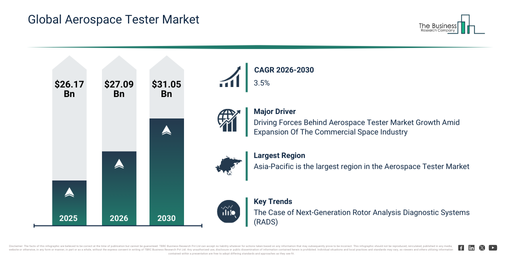
The aerospace tester market size has experienced steady growth in recent years. It is forecast to increase from $26.17 billion in 2025 to $27.09 billion in 2026, achieving a compound annual growth rate (CAGR) of 3.5%. This historical expansion can be attributed to various factors, such as increasing aircraft production, which fuels the demand for engine test stands and ndt equipment, and rising regulatory requirements for the safety and performance testing of aircraft components. Other contributors include advancements in environmental test chamber technologies that facilitate more accurate simulation of extreme conditions, the expansion of manufacturer-provided warranty-period testing and calibration services, and the growth in maintenance, repair, and overhaul activities requiring specialized aerospace testers.
The aerospace tester market size is projected to experience consistent expansion over the upcoming years, reaching $31.05 billion by 2030, demonstrating a compound annual growth rate (CAGR) of 3.5%. This anticipated growth during the forecast period is primarily driven by several factors: a rising demand for sophisticated testers to validate new aircraft systems, including electric and hybrid propulsion; the greater integration of automated and digital non-destructive testing (NDT) solutions aimed at enhancing testing efficiency; an increasing requirement for electromagnetic interference and compatibility testing for contemporary avionics; the expansion of aircraft fleets in developing economies boosting the purchase of aerospace testers; and an expected rise in integrated lifecycle testing services offered with new aerospace tester equipment. Key trends identified for this period encompass the creation of high-precision engine test stands, the utilization of advanced non-destructive testing (NDT) techniques, the incorporation of environmental simulation chambers for challenging conditions, increased automation within aerospace testing processes, and the broadening of testing solutions designed for future aircraft and spacecraft.
Download A Free Sample For In-Depth Aerospace Tester Market Intelligence:
Aerospace Tester Market Demand Driver: How It Is Shaping Industry Growth
The burgeoning commercial space industry is anticipated to fuel the expansion of the aerospace tester market moving forward. This industry encompasses economic activities linked to manufacturing and delivering components destined for Earth’s orbit or beyond, along with providing services that originate from these components. The commercial space sector is undergoing rapid development due to several elements, including increasing demand for satellite services, the rise of space tourism, asteroid mining, and a surge in private capital flowing into this domain. Aerospace testers play a critical role in conducting exhaustive testing and validation procedures to guarantee that spacecraft, satellites, propulsion systems, avionics, and other aerospace technologies adhere to stringent quality benchmarks and regulatory mandates before their deployment in commercial space operations. For example, according to the Space Foundation, a US-based nonprofit organization, the global space economy saw an 8% increase in January 2023, reaching a total of $546 billion, with the commercial segment of the space industry alone growing by nearly 8% to $427.6 billion. Therefore, the significant growth of the commercial space industry is acting as a primary driver for the aerospace tester market’s expansion.
Aerospace Tester Market Segmentation Overview: Detailed Category Analysis
The aerospace tester market covered in this report is segmented –
1) By Product Type: Avionics Testers, Communication Testers, Structural Testers, Propulsion System Testers
2) By Application: Flight Control System Testing, Communication System Testing, Engine Testing, Structural Testing, Environmental Testing
3) By End User: Commercial Aviation, Defense And Military, Space And Satellite
Subsegments:
1) By Avionics Testers: Flight Control Testers, Navigation Testers, Display Testers, Communication Testers
2) By Communication Testers: Radio Frequency Testers, Satellite Communication Testers, Ground Support Communication Testers
3) By Structural Testers: Vibration Testers, Fatigue Testers, Load Testers
4) By Propulsion System Testers: Engine Testers, Fuel System Testers, Thrust Measurement Testers
Top Aerospace Tester Market Trends And Recent Industry Developments
Companies operating in the aerospace tester market are driving profitability by innovating new technological products, such as next-generation Rotor Analysis Diagnostic Systems (RADS). The next-generation Rotor Analysis Diagnostic System (RADS) serves as a portable vibration diagnostics solution, enabling operators to conclude rotor track and balance operations and diagnostics in fewer flights. As an illustration, in March 2023, GE Aerospace, a US-based aerospace company, unveiled next-generation Rotor Analysis Diagnostic Systems (RADS), an aerospace tester engineered to minimize pilot time and save fuel by allowing operators to perform rotor track and balance analysis more efficiently. It is designed for monitoring the rotor health of both military and commercial helicopters. The RADS-NG will replace the RADS-AT (Advanced Technology) and the RADS-AVA (Aviation Vibration Analyzer), as well as GE Aerospace’s portable vibration diagnostics solution for helicopters, particularly when a permanent installation is not feasible or as a complement to existing systems. It offers a faster, more user-friendly interface and the flexibility to service all major helicopter models. Additionally, the system provides vibration diagnostics for fixed-wing aircraft, including the Lockheed C-130 Hercules.
Aerospace Tester Market Company Landscape: Key Players To Watch
Major companies operating in the aerospace tester market are Agilent Technologies, Keysight Technologies Inc., Teradyne Inc., Rohde & Schwarz GmbH & Co. KG, National Instruments Corporation, Mistras Group Inc., Astronics Corporation, Marvin Test Solutions Inc., ADMET Inc., Dayton T. Brown Inc., NTS Group BV, Element Materials Technology, Bureau Veritas SA, Intertek Group Plc, DEKRA SE, ECA Group, Qualitest International Inc., MOOG Inc., Illinois Tool Works Inc., Textron Inc., Leonardo S.p.A., Ball Corp., CapitalWorks.
Explore The Aerospace Tester Global Market Report For Full Insights:
Aerospace Tester Market Region-Wise Analysis: Largest Regional Market Identified
Asia-Pacific was the largest region in the aerospace tester market in 2025. It is expected to be the fastest-growing region in the forecast period. The regions covered in the aerospace tester market report are Asia-Pacific, South East Asia, Western Europe, Eastern Europe, North America, South America, Middle East, Africa.
Reach Out To Our Team:
The Business Research Company: https://www.thebusinessresearchcompany.com/
Americas: +1 310-496-7795
Asia: +44 7882 955267 & +91 8897263534
Europe: +44 7882 955267
Email us at: marketing@tbrc.info
Follow us on:
LinkedIn: https://in.linkedin.com/company/the-business-research-company
YouTube: https://www.youtube.com/channel/UC24_fI0rV8cR5DxlCpgmyFQ
Global Market Model: https://www.thebusinessresearchcompany.com/global-market-model

Wasay has over a decade of experience in market research, data modelling, and analytics, with prior experience at GlobalData and Decision Tree Consulting Services. At The Business Research Company , he leads research operations across syndicated studies, customized consulting engagements, and the Global Market Model platform. His professional experience includes supporting organizations such as Boston Consulting Group, KPMG, and Ernst & Young. Wasay holds a degree in Electronics and Communications Engineering, postgraduate management qualifications from International Management Institute Belgium and Indian School of Business and Entrepreneurship, and completed the Integrated Program in Business Analytics from Indian Institute of Management Indore.