Delivering more actionable and strategically valuable research, The Business Research Company’s 2026 market reports feature market attractiveness analysis, total addressable market evaluation, company benchmarking matrices, interactive Excel dashboards, expanded supply chain intelligence, emerging startup coverage, and detailed product insights.
Aerospace Titanium Market Size Forecast: How Large Could The Market Become By 2030?
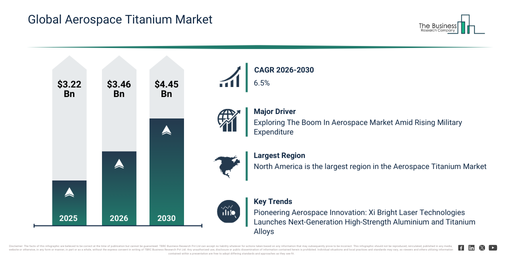
The aerospace titanium market size has experienced significant expansion in recent years. This market is projected to grow from $3.22 billion in 2025 to $3.46 billion in 2026, at a compound annual growth rate (CAGR) of 7.5%. The expansion witnessed historically can be attributed to the increasing utilization of titanium alloys in commercial aircraft airframes and engines, a rise in military aircraft and missile production demanding high-strength materials, growing demand for corrosion-resistant metals in aerospace applications, the broadening scope of spacecraft and satellite manufacturing, and improvements in titanium processing techniques enhancing material availability.
The aerospace titanium market is projected for substantial expansion, reaching $4.45 billion by 2030, exhibiting a compound annual growth rate (CAGR) of 6.5%. This anticipated growth is driven by several factors, including the increased manufacturing of advanced aircraft incorporating more titanium, greater utilization of titanium in engine components operating at high temperatures, and the expansion of space exploration and commercial launch initiatives that elevate titanium demand. Additionally, the creation of lightweight alloy compositions aimed at boosting fuel efficiency and the broadening application of titanium in sophisticated defense systems demanding superior durability contribute to this trend. Key trends anticipated during this period involve a heightened demand for high-performance titanium alloys in forthcoming aircraft models, an increasing emphasis on lightweight materials to enhance fuel efficiency, and the expanded application of additive manufacturing techniques for aerospace titanium parts. Further trends include wider integration of titanium in advanced engine components and the emergence of specialized alloy development tailored for aerospace applications in extreme temperature conditions.
Download A Free Sample Report For Comprehensive Market Insights:
Aerospace Titanium Market Development Factors: Which Trends Are Supporting Demand?
The projected rise in military expenditure is set to accelerate the expansion of the aerospace titanium market in the foreseeable future. Military spending refers to financial resources allocated by a government to equip its military with weapons, various equipment, and soldiers. Aerospace titanium is employed in aircraft, armor plating, naval ships, spacecraft, and missiles, owing to its superior tensile strength-to-density ratio, commendable corrosion resistance, and capacity to endure relatively high temperatures without creep. For instance, in April 2024, as reported by the Stockholm International Peace Research Institute (SIPRI), a Swedish-based non-governmental organization, global military spending in 2023 hit $2.443 trillion, indicating a 6.8% increase in real terms compared to 2022. Therefore, the escalation in military spending is propelling the growth of the aerospace titanium market.
Aerospace Titanium Market Segment Landscape: Which Areas Lead Market Development?
The aerospace titanium market covered in this report is segmented –
1) By Type: TC4, TC6, TC16, Ti555, Other Types
2) By Alloy Type: Alpha, Alpha+Beta, Beta
3) By Aircraft Type: Commercial Aircraft, Regional Aircraft, General Aviation, Helicopter, Military Aircraft
4) By Application: Structural Airframes, Engines, Other Applications
Subsegments:
1) By C4 (Titanium Alloy Grade 5): Alpha-Beta Alloy, Used In Critical Structural Applications
2) By TC6 (Titanium Alloy Grade 6): High Strength And Corrosion Resistance, Suitable For High-Temperature Applications
3) By TC16 (Titanium Alloy Grade 16): Alpha-Beta Alloy, Enhanced Weldability And Fatigue Resistance
4) By Ti555 (Titanium Alloy Grade 555): High Strength And Low Density, Used In Aerospace Components And Structures
5) By Other Types: Beta Titanium Alloys, Commercially Pure Titanium (CPT), Specialty Titanium Alloys
Aerospace Titanium Market Transformation Trends: Which Innovations Are Driving Change?
Leading companies within the aerospace titanium market are concentrating on developing innovative products like high-strength aluminum and titanium alloys, aiming to boost performance, decrease weight, and enhance fuel efficiency in aircraft. These high-strength aluminum and titanium alloys are sophisticated materials engineered to provide superior strength-to-weight ratios, rendering them highly suitable for aerospace applications. Such alloys deliver improved durability, increased corrosion resistance, and the capability to withstand extreme conditions. For instance, in July 2024, Xi, Bright Laser Technologies Co., Ltd., a manufacturing company based in China, unveiled two advanced materials: BLT-AlAM500, a high-strength aluminum alloy, and BLT-Ti65, a high-temperature titanium alloy. These were launched to enhance performance in various demanding applications, particularly within the aerospace sector. BLT-AlAM500 is a high-strength aluminum alloy designed for additive manufacturing, offering tensile strengths of 530–550 MPa and excellent fracture toughness, making it ideal for aerospace and automotive uses. Its optimized production process can reduce manufacturing costs by up to 50%, thereby enabling the creation of lightweight, complex components. Meanwhile, BLT-Ti65, a high-temperature titanium alloy, reliably maintains its strength and stability at temperatures up to 650 °C, positioning it as an excellent material for both aerospace and chemical industries.
Aerospace Titanium Market Competitive Landscape And Leading Companies
Major companies operating in the aerospace titanium market are Aperam Ltd., GE Aviation, Precision Castparts Corporation, Allegheny Technologies Incorporated, GKN Aerospace Services Limited, Carpenter Technology Corporation, VSMPO-AVISMA Corporation, Montana Aerospace AG, Baoji Titanium Industry Co. Ltd., Kobelco Group Ltd., Ducommun Incorporated, Kaman Corporation, Toho Titanium Co., Haynes International Ltd., Bralco Metals Inc., Metalex Co. Ltd., EDAC Technology Corp., Plymouth Tube Company, Acnis International, Gould Alloys Limited, Supra Alloys Inc., Weldaloy Specialty Forgings Company, Norsk Titanium US Inc., Titanium Metals Corporation, RMI Titanium Company Inc., Admat Inc.
Access The Complete Aerospace Titanium Market Report:
Aerospace Titanium Market Leading Geography: Which Region Generates The Most Revenue?
North America was the largest region in the aerospace titanium market in 2025. The regions covered in the aerospace titanium market report are Asia-Pacific, South East Asia, Western Europe, Eastern Europe, North America, South America, Middle East, Africa.
Access a Customized Aerospace Titanium Market Report for Deeper Competitive Insights
https://www.thebusinessresearchcompany.com/customise?id=8005&type=smp
Get in touch with us:
The Business Research Company: https://www.thebusinessresearchcompany.com/
Americas: +1 310-496-7795
Asia: +44 7882 955267 & +91 8897263534
Europe: +44 7882 955267
Email us at: marketing@tbrc.info
Follow us on:
LinkedIn: https://in.linkedin.com/company/the-business-research-company
YouTube: https://www.youtube.com/channel/UC24_fI0rV8cR5DxlCpgmyFQ
Global Market Model: https://www.thebusinessresearchcompany.com/global-market-model

Wasay has over a decade of experience in market research, data modelling, and analytics, with prior experience at GlobalData and Decision Tree Consulting Services. At The Business Research Company , he leads research operations across syndicated studies, customized consulting engagements, and the Global Market Model platform. His professional experience includes supporting organizations such as Boston Consulting Group, KPMG, and Ernst & Young. Wasay holds a degree in Electronics and Communications Engineering, postgraduate management qualifications from International Management Institute Belgium and Indian School of Business and Entrepreneurship, and completed the Integrated Program in Business Analytics from Indian Institute of Management Indore.