Enhanced with market attractiveness analysis, total addressable market evaluation, company benchmarking matrices, interactive Excel dashboards, expanded supply chain intelligence, emerging startup coverage, and detailed product insights, The Business Research Company’s 2026 market reports deliver more actionable and strategically valuable research.
Aerostructures Market Growth Potential: How Will Market Size Change Through 2030?
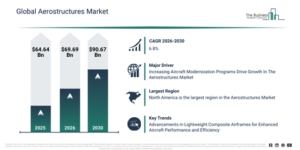
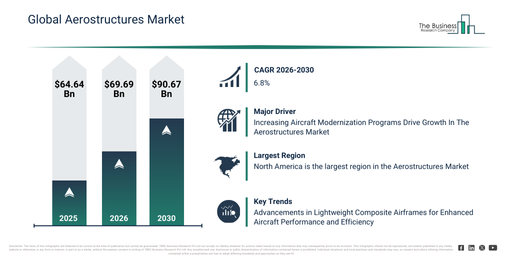
The aerostructures market has experienced significant growth in recent years. It is projected to expand from $64.64 billion in 2025 to $69.69 billion in 2026, at a compound annual growth rate (CAGR) of 7.8%. The historical growth in this sector can be attributed to a rise in commercial and military aircraft production, which boosted demand for primary airframe structures. Other contributing factors include the increasing use of lightweight aluminum and titanium alloys to improve aircraft performance, the expansion of outsourced aerostructure manufacturing by major aerospace OEMs, the development of high-strength steel components to enhance structural durability, and the growing integration of advanced aerostructure designs to support improved aerodynamics.
The aerostructures market is projected for substantial expansion in the coming years, with its size expected to reach $90.67 billion by 2030, growing at a compound annual growth rate (CAGR) of 6.8%. This anticipated growth can be attributed to an expected surge in next-generation aircraft platforms requiring more complex aerostructure assemblies, the increasing integration of hybrid material aerostructures combining metals and composites, rising investments in automated manufacturing technologies for airframe production, the ongoing global fleet renewal driving demand for new fuselage and wing structures, and a heightened emphasis on fuel-efficient aircraft boosting the need for lightweight aerostructure solutions. Major trends during this forecast period include the expanding adoption of advanced aerostructure materials such as titanium and high-strength alloys, a growing demand for modular airframe designs to support faster assembly cycles, the increasing application of composite aerostructures for weight reduction and enhanced fuel efficiency, continued development of next-generation wing and fuselage architectures, and advancements in precision forming, machining, and automated fabrication techniques.
Download A Free Sample Report For Comprehensive Market Insights:
Aerostructures Market Growth Momentum: Which Factors Are Influencing Demand?
The aerostructures market is anticipated to be propelled by the growing number of aircraft modernization initiatives. Aircraft modernization involves improving an aircraft’s components, systems, and technology to boost its performance, safety, efficiency, and overall capabilities. Aerostructures play a crucial role in these modernization programs, helping to achieve objectives such as extending an aircraft’s lifespan, enhancing its performance, or making it more eco-friendly. As an illustration, in June 2024, The U.S. Department of Defense, a US-based federal executive department, unveiled a substantial modernization plan for tactical aircraft located in Japan, committing over $10 billion. This effort seeks to strengthen the U.S.-Japan alliance and reinforce regional deterrence amidst escalating tensions in the Indo-Pacific region. As part of this, the Air Force plans to substitute 48 F-15C/D fighter jets with 36 F-15EX jets. Consequently, the expansion of aircraft modernization programs is a key driver for the aerostructures market.
Aerostructures Market Segmentation And Category Breakdown
The aerostructures market covered in this report is segmented –
1) By Component: Fuselage, Empennage, Flight Control Surfaces, Wings, Nose, Nacelle and Pylon, Doors and Skid
2) By Material: Composites, Alloys and Super Alloys, Metals
3) By Platform: Fixed Wing, Rotary Wing, Unmanned Aerial Vehicles (UAVs), Advanced Air Mobility
4) By End Use: OEM, Aftermarket
Subsegments:
1) By Fuselage: Forward Fuselage, Mid Fuselage, Aft Fuselage
2) By Empennage: Horizontal Stabilizer, Vertical Stabilizer, Rudder and Elevator Assemblies
3) By Flight Control Surfaces: Ailerons, Flaps, Slats, Spoilers
4) By Wings: Wing Structure, Wing Tips, Wing Box
5) By Nose: Nose Cone, Cockpit Canopy, Radar Dome
6) By Nacelle and Pylon: Engine Nacelle, Pylon Assembly
7) By Doors and Skid: Passenger Doors, Cargo Doors, Emergency Exits, Landing Gear Skids
Aerostructures Market Trends Reshaping Industry Growth
Leading companies within the aerostructures market are concentrating on developing innovative products, such as advanced composite airframes, with the goal of improving aircraft performance, decreasing weight, and boosting fuel efficiency. These advanced composite airframes are aircraft structures constructed from lightweight, high-strength materials like carbon fiber-reinforced polymers, which collectively reduce overall mass, enhance fuel economy, increase payload capacity, and improve resistance to corrosion. As an illustration, in August 2025, Vertical Aerospace Ltd., a UK-based aerospace and technology company, formed a partnership with Aciturri Aerostructures S.A., a Spain-based aerostructures manufacturing company. This collaboration is dedicated to supplying and producing the complete airframe for its VX4 eVTOL aircraft, encompassing the wings, fuselage, and empennage. The joint venture centers on integrating lightweight composite materials and advanced structural design to elevate performance, lessen weight, and enable efficient, scalable production. The VX4 airframe has been engineered specifically for electric flight, stressing its structural durability, aerodynamic efficiency, and smooth integration with electric propulsion systems. This design approach serves to minimize emissions and noise, concurrently accelerating assembly time and reducing operational costs when contrasted with traditional aircraft frameworks.
Aerostructures Market Leading Companies Driving Competitive Growth
Major companies operating in the aerostructures market are Spirit AeroSystems, Saab AB, Triumph Group Inc., Leonardo SpA, Elbit Systems Ltd., Airbus S.A.S., The Boeing Company, Lockheed Martin Corporation, Northrop Grumman Corporation, BAE Systems plc, Raytheon Technologies Corporation, Safran S.A., Bombardier Inc., Embraer S.A., General Dynamics Corporation, Kawasaki Heavy Industries Ltd., Mitsubishi Heavy Industries Ltd., GKN Aerospace Ltd., FACC AG, RUAG Group, Collins Aerospace Ltd., Dassault Aviation S.A., Meggitt PLC, Premium AEROTEC GmbH, Belge de Constructions Aéronautiques SA, Aero Vodochody AEROSPACE a.s., Singapore Technologies Engineering Ltd., Aviation Industry Corporation of China.
Access The Complete Aerostructures Market Report:
Aerostructures Market Global Footprint: Which Region Holds Market Leadership?
North America was the largest region in the aerostructures market in 2025, and it is also expected to be the fastest-growing region in the aerostructures market share during the forecast period. The regions covered in the aerostructures market report are Asia-Pacific, South East Asia, Western Europe, Eastern Europe, North America, South America, Middle East, Africa.
Access a Customized Aerostructures Market Report for Deeper Competitive Insights
https://www.thebusinessresearchcompany.com/customise?id=7110&type=smp
Get in touch with us:
The Business Research Company: https://www.thebusinessresearchcompany.com/
Americas: +1 310-496-7795
Asia: +44 7882 955267 & +91 8897263534
Europe: +44 7882 955267
Email us at: marketing@tbrc.info
Follow us on:
LinkedIn: https://in.linkedin.com/company/the-business-research-company
YouTube: https://www.youtube.com/channel/UC24_fI0rV8cR5DxlCpgmyFQ
Global Market Model: https://www.thebusinessresearchcompany.com/global-market-model

Wasay has over a decade of experience in market research, data modelling, and analytics, with prior experience at GlobalData and Decision Tree Consulting Services. At The Business Research Company , he leads research operations across syndicated studies, customized consulting engagements, and the Global Market Model platform. His professional experience includes supporting organizations such as Boston Consulting Group, KPMG, and Ernst & Young. Wasay holds a degree in Electronics and Communications Engineering, postgraduate management qualifications from International Management Institute Belgium and Indian School of Business and Entrepreneurship, and completed the Integrated Program in Business Analytics from Indian Institute of Management Indore.