
Enhanced with market attractiveness analysis, total addressable market evaluation, company benchmarking matrices, interactive Excel dashboards, expanded supply chain intelligence, emerging startup coverage, and detailed product insights, The Business Research Company’s 2026 market reports deliver more actionable and strategically valuable research.
Airborne Optronics Market Growth Potential: How Will Market Size Change Through 2030?
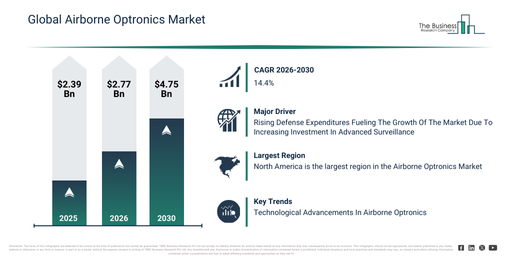
The airborne optronics market has experienced significant expansion in its size over recent years. It is projected to expand from $2.39 billion in 2025 to reach $2.77 billion by 2026, exhibiting a compound annual growth rate (CAGR) of 15.6%. Historically, this growth has been driven by several factors, including the growing deployment of airborne surveillance and targeting systems that necessitate advanced optronics, an escalating demand for laser warning and countermeasure systems designed to improve aircraft survivability, the expansion of intelligence and reconnaissance missions necessitating the integration of high-precision optical sensors, progress in laser range finding and sighting technologies that enhance mission accuracy, and the broader expansion of military modernization initiatives that integrate next-generation airborne optronics.
The airborne optronics market is anticipated to see significant expansion in the coming years, with its size projected to reach $4.75 billion by 2030, achieving a compound annual growth rate (CAGR) of 14.4%. This growth during the forecast period is primarily driven by an expected rise in demand for multi-sensor optronic suites crucial for integrated aerial mission support, the increasing implementation of AI-enabled image processing to enhance airborne identification capabilities, the growing deployment of unmanned aerial platforms equipped with advanced optronics, continuous advancements in lightweight and high-resolution optical systems that improve performance, and expanding investment in countermeasure technologies to address evolving airborne threats. Major trends expected in this period include the rising adoption of sophisticated surveillance and targeting payloads, an increasing shift toward multispectral and hyperspectral sensing systems, the growing integration of miniaturized optronics for lightweight aerial platforms, a rising demand for countermeasure and threat-detection technologies, and the expanding use of optronics for intelligence, reconnaissance, and specialized missions.
Download A Free Sample Report For Comprehensive Market Insights:
#Airborne Optronics Market Growth Drivers And Industry Catalysts
The airborne optronics market is expected to expand with the ongoing increase in defense expenditures. These expenditures signify the government or military budgets allocated for maintaining, upgrading, and expanding military capabilities, which include equipment, technology, and infrastructure. The rise in defense spending is driven by the growing demand for military modernization and advanced defense technologies. Such spending specifically supports airborne optronics by funding the development and deployment of sophisticated optical and sensor systems, leading to enhanced surveillance, targeting, and reconnaissance capabilities. For instance, in April 2025, the Stockholm International Peace Research Institute (SIPRI), an independent research organization based in Sweden, indicated that global military expenditures totaled $2.72 trillion in 2024, marking a 9.4 percent increase from 2023. Consequently, the growth of the airborne optronics market is being driven by these increasing defense expenditures.
Airborne Optronics Market Segment Analysis And Revenue Opportunities
The airborne optronics market covered in this report is segmented –
1) By Aircraft Type: Fixed Wing, Rotary Wing, Urban Air Mobility, Unmanned Aerial Vehicles
2) By Technology: Multispectral, Hyperspectral
3) By System: Reconnaissance System, Targeting System, Search and Track System, Surveillance System, Warning and Detection System, Countermeasure System, Navigation and Guidance System, Special Mission System
4) By Application: Commercial, Military, Space
5) By End User: Original Equipment Manufacturer (OEM), Aftermarket
Subsegments:
1) By Fixed Wing: Military Fixed Wing Aircraft, Commercial Fixed Wing Aircraft, Regional and Business Jets
2) By Rotary Wing: Military Helicopters, Civilian Helicopters, Unmanned Rotary Wing Systems
3) By Urban Air Mobility: Electric Vertical Takeoff and Landing (eVTOL) Aircraft, Air Taxis and Drones for Urban Transport
4) By Unmanned Aerial Vehicles (UAVs): Tactical UAVs, Strategic UAVs, Micro and Mini UAVs, Commercial Drones
5) By Other Types: Hybrid Aircraft, Aerostats and Balloons
#Airborne Optronics Market Trends Influencing Long-Term Demand
Leading companies within the airborne optronics market are concentrating on developing innovative solutions, such as advanced airborne imaging gimbals, to bolster real-time surveillance and intelligence-gathering capabilities. These advanced gimbals function as stabilized sensor platforms, capturing high-resolution images and videos from aircraft or drones, which in turn enhances surveillance, target tracking, and situational awareness across diverse operational scenarios. An example of this innovation occurred in September 2024, when HENSOLDT AG, a Germany-based defense technology firm, unveiled the ARGOS-15, an advanced airborne imaging system. The ARGOS-15 features a 15-inch modular gimbal designed for medium-to-high altitude missions, provides four-axis stabilization for sub-5 µrad image clarity, incorporates AI-driven object classification and tracking, and utilizes a common aperture architecture to optimize multispectral sensor performance. Unlike conventional airborne sensors, which often depend on single-spectrum imaging or limited stabilization, the ARGOS-15 integrates thermal, daylight, and short-wave infrared (SWIR) sensors, enabling precise target identification in challenging environments, including low-light or adverse weather conditions. Its applications span military, paramilitary, law enforcement, and search-and-rescue operations, delivering high-definition imagery while minimizing in-flight calibration needs and improving operational efficiency. Additionally, the system supports real-time data transmission to ground stations, facilitating faster decision-making and enhanced situational awareness.
Airborne Optronics Market Major Participants And Competitive Dynamics
Major companies operating in the airborne optronics market are Leonardo S.p.A, Thales Group, Teledyne Technologies Incorporated, Safran S.A, Elbit Systems Ltd., Lockheed Martin Corporation, Stark Aerospace Inc., L3Harris Technologies Inc., Hensoldt AG, Collins Aerospace, Israel Aerospace Industries, Rafael Advanced Defense Systems Ltd., Kappa Optronics GmbH, Bae Systems plc, Resonon Inc., Excelitas Technologies Corporation, Osi Optoelectronics Inc., Leidos Holdings Inc., Aselsan A.S, Intevac Inc., Ximea GmbH, Headwall Photonics Inc., Cubert GmbH., Maxar Technologies Inc., Northrop Grumman Corporation, RTX Corporation, General Dynamics Corporation, Honeywell Aerospace, Pratt & Whitney, Rolls-Royce Holdings plc, General Electric Aviation, Spirit AeroSystems Inc., GKN Aerospace Services Limited, Triumph Group Inc.
Access The Complete Airborne Optronics Market Report:
Airborne Optronics Market Largest Region By Revenue And Market Share
North America was the largest region in the airborne optronics market in 2025. North America is expected to be the fastest growing region in the forecast period. The regions covered in the airborne optronics market report are Asia-Pacific, South East Asia, Western Europe, Eastern Europe, North America, South America, Middle East, Africa.
Access a Customized Airborne Optronics Market Report for Deeper Competitive Insights
https://www.thebusinessresearchcompany.com/customise?id=6780&type=smp
Get in touch with us:
The Business Research Company: https://www.thebusinessresearchcompany.com/
Americas: +1 310-496-7795
Asia: +44 7882 955267 & +91 8897263534
Europe: +44 7882 955267
Email us at: marketing@tbrc.info
Follow us on:
LinkedIn: https://in.linkedin.com/company/the-business-research-company
YouTube: https://www.youtube.com/channel/UC24_fI0rV8cR5DxlCpgmyFQ
Global Market Model: https://www.thebusinessresearchcompany.com/global-market-model

Wasay has over a decade of experience in market research, data modelling, and analytics, with prior experience at GlobalData and Decision Tree Consulting Services. At The Business Research Company , he leads research operations across syndicated studies, customized consulting engagements, and the Global Market Model platform. His professional experience includes supporting organizations such as Boston Consulting Group, KPMG, and Ernst & Young. Wasay holds a degree in Electronics and Communications Engineering, postgraduate management qualifications from International Management Institute Belgium and Indian School of Business and Entrepreneurship, and completed the Integrated Program in Business Analytics from Indian Institute of Management Indore.
