
The Business Research Company’s 2026 market reports are designed to deliver research that is more actionable and strategically valuable. Key offerings include market attractiveness scoring, total addressable market sizing, company benchmarking matrices, interactive Excel dashboards, deeper supply chain intelligence, emerging startup tracking, and granular product-level insights.
Aircraft Electric Motor Market Size Insights: Annual Growth Rate, Revenue Outlook And Forecast Drivers
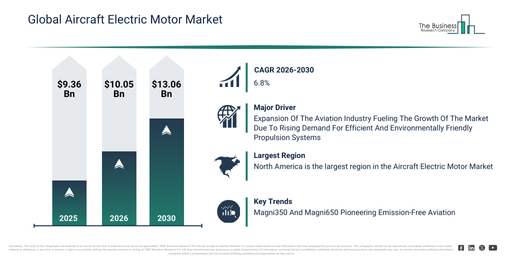
The aircraft electric motor market has experienced significant growth in recent years. It is anticipated to expand from $9.36 billion in 2025 to $10.05 billion in 2026, achieving a compound annual growth rate (CAGR) of 7.3%. This historical growth can be attributed to several factors, including the early adoption of electric propulsion concepts in light aircraft and unmanned platforms, increasing research investment in lithium-polymer battery technologies supporting electric motor development, rising demand for high-efficiency magnetic flux and coil assemblies to improve motor performance, the advancement of cobalt steel alloy stators enabling higher power density in aircraft motors, and the growing use of lightweight materials such as carbon fiber plates to reduce overall propulsion system weight.
The aircraft electric motor market is poised for significant expansion in the coming years, with its size expected to reach $13.06 billion by 2030, exhibiting a compound annual growth rate (CAGR) of 6.8%. This growth during the forecast period is primarily driven by the anticipated increase in hybrid-electric and fully electric aircraft programs, which in turn fuels the demand for advanced motors. Additional contributing factors include the rising imperative for high-efficiency electric propulsion to satisfy aviation emission reduction targets, continuous improvements in battery energy density that enhance the integration of electric motors into larger aircraft, the expanded development of high-reliability ball bearings and electromagnetic components suitable for aviation, and increasing investments from aerospace OEMs in scalable electric propulsion architectures for future aircraft platforms. Furthermore, major trends foreseen in this period encompass the escalating adoption of high-power-density permanent magnet motors for propulsion, a greater focus on thermal management and highly efficient cooling systems, the increasing incorporation of modular, distributed motor architectures for eVTOL and AAM, a wider use of lightweight composite and additive-manufactured motor housings, and the advancement of integrated motor-inverter units, often referred to as electromechanical power modules.
Request A Free Excerpt Of The Aircraft Electric Motor Global Market Report 2026:
What Will Drive Aircraft Electric Motor Market Growth Through 2030?
The aviation industry’s projected growth is anticipated to significantly advance the aircraft electric motor market moving forward. This industry refers to the sector encompassing all activities related to the design, development, production, operation, and upkeep of aircraft, as well as the management of air transport services for passengers, cargo, and mail. The aviation industry is expanding due to increasing global demand for air travel and cargo transport, which in turn necessitates the enlargement of airline fleets, routes, and airport infrastructure. Aircraft electric motors bolster the aviation industry’s expansion by enabling more efficient, lightweight, and environmentally friendly propulsion systems for both modern and next-generation aircraft. For example, in August 2025, data from the International Air Transport Association (IATA), a Canada-based trade association, showed that in 2024, the United States maintained its position as the largest aviation market globally, accommodating 876 million passengers. This was largely driven by robust domestic travel, indicating a year-on-year growth of 5.2%. Consequently, the expansion of the aviation industry is expected to stimulate demand in the aircraft electric motor market.
Aircraft Electric Motor Market Segment Analysis Covering All Major Categories
The aircraft electric motor market covered in this report is segmented –
1) By Type: AC Motor, DC Motor
2) By Aircraft Type: Fixed Wing, Rotary Wing, Unmanned Aerial Vehicles, Advanced Air Mobility
3) By Torque: Up to 1 Nm, 1-50 Nm, 50-200 Nm, Above 200 Nm
4) By Output Power: Up to 10 kW, 10-200 kW, Above 200 kW
5) By Application: Propulsion System, Flight Control System, Environmental Control System, Engine Control System, Avionics System, Door Actuation System, Landing and Braking System, Cabin Interior System, Other Applications
Subsegments:
1) By AC Motor: Synchronous AC Motors, Asynchronous AC Motors (Induction Motors), Permanent Magnet AC Motors, Brushless AC Motors
2) By DC Motor: Brushed DC Motors, Brushless DC Motors, Stepper Motors, Servo Motors
Major Trends Shaping The Future Of The Aircraft Electric Motor Market
Key players in the aircraft electric motors market are developing innovative offerings, such as advanced electric motors, to contribute to more sustainable aviation technologies. The HyperCore 900 kW Modular Motor exemplifies this as an advanced motor designed to operate at speeds up to 20,000 rpm, thereby serving a variety of aviation applications. As an illustration, in April 2024, Zeroavia, a US-based firm specializing in hydrogen-electric propulsion systems for aviation, announced the introduction of a 660 kW direct-drive motor and a 900 kW modular motor (HyperCore). These two motors include a 660 kW max-power direct-drive motor capable of speeds up to 2,200 rpm, and the HyperCore 900 kW modular motor, which can achieve speeds up to 20,000 rpm.
Aircraft Electric Motor Market Competitive Environment And Key Companies
Major companies operating in the aircraft electric motor market are Altra Industrial Motion Corporation, Moog Inc., Meggitt plc, Allied Motion Inc., Ametek Inc., Arc Systems Inc., Magneto Aero Dynamics, MagniX USA Inc., H3X Technologies Inc., Emrax d.o.o, Woodward Inc., Windings Inc., Xoar International LLC, Yasa Ltd., Rolls-Royce plc, Siemens AG, Honeywell International Inc., Parker Hannifin Corporation, Safran SA, General Electric Company, Nidec Corporation, ABB Ltd., Bühler Motor GmbH, CEF Industries LLC, Esterline Technologies Corporation, TQ Systems GmbH, Trust Automation Inc., Ultra Electronics Holdings plc, WEG S.A., Zunum Aero Inc., Maxon Motor AG, Nanotec Electronic GmbH & Co. KG, NovaTorque Inc., Pittman Motors, Portescap India Private Limited, Shinano Kenshi Co. Ltd., ThinGap Inc.
Access Expert Aircraft Electric Motor Market Analysis In The Full Report:
Which Regions Are Covered In The Aircraft Electric Motor Market Report?
North America was the largest region in the aircraft electric motor market in 2025. Asia-Pacific is expected to be the fastest-growing region in the forecast period. The regions covered in the aircraft electric motor market report are Asia-Pacific, South East Asia, Western Europe, Eastern Europe, North America, South America, Middle East, Africa.
Reach Out To Our Team:
The Business Research Company: https://www.thebusinessresearchcompany.com/
Americas: +1 310-496-7795
Asia: +44 7882 955267 & +91 8897263534
Europe: +44 7882 955267
Email us at: marketing@tbrc.info
Follow us on:
LinkedIn: https://in.linkedin.com/company/the-business-research-company
YouTube: https://www.youtube.com/channel/UC24_fI0rV8cR5DxlCpgmyFQ
Global Market Model: https://www.thebusinessresearchcompany.com/global-market-model

Wasay has over a decade of experience in market research, data modelling, and analytics, with prior experience at GlobalData and Decision Tree Consulting Services. At The Business Research Company , he leads research operations across syndicated studies, customized consulting engagements, and the Global Market Model platform. His professional experience includes supporting organizations such as Boston Consulting Group, KPMG, and Ernst & Young. Wasay holds a degree in Electronics and Communications Engineering, postgraduate management qualifications from International Management Institute Belgium and Indian School of Business and Entrepreneurship, and completed the Integrated Program in Business Analytics from Indian Institute of Management Indore.

