Delivering more actionable and strategically valuable research, The Business Research Company’s 2026 market reports feature market attractiveness analysis, total addressable market evaluation, company benchmarking matrices, interactive Excel dashboards, expanded supply chain intelligence, emerging startup coverage, and detailed product insights.
Aircraft Electrification Market Growth From $8.27 Billion In 2026 To $12.65 Billion By 2030 At A CAGR Of 11.18%
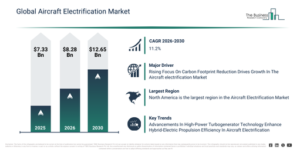
The aircraft electrification market has experienced rapid expansion in recent years. This market is projected to grow from $7.33 billion in 2025 to $8.28 billion in 2026, demonstrating a compound annual growth rate (CAGR) of 12.9%. Historically, this growth has been driven by increasing regulatory pressure to reduce aviation emissions, rising fuel costs stimulating interest in alternative propulsion systems, advancements in electric motor and power electronics technologies, greater research investments in hybrid-electric aircraft architectures, and the development of early partial turboelectric and hybrid prototypes.
The aircraft electrification market is poised for significant expansion in the next few years, with projections indicating a rise to $12.65 billion in 2030, demonstrating a compound annual growth rate (CAGR) of 11.2%. This expected increase can be attributed to several factors, including the increasing adoption of hybrid and fully electric propulsion concepts in commercial and regional aviation, advancements in high-energy-density batteries enabling broader electrification, airlines’ growing focus on reducing operating costs through electric systems, the expansion of government incentives supporting sustainable aviation technologies, and the integration of electric power for non-propulsive aircraft systems to enhance overall efficiency. Key developments anticipated during this period involve the rising implementation of hybrid-electric propulsion systems, the integration of advanced battery technologies in aircraft, the creation of lightweight electric motors for improved aircraft efficiency, the greater utilization of solar-assisted aircraft power systems, and a strategic emphasis on modular electric power systems for retrofitting existing fleets.
Download A Free Sample Report For Comprehensive Market Insights:
Aircraft Electrification Market Industry Drivers: What Is Driving Revenue Growth?
The increasing imperative to lessen the carbon footprint is a primary impetus for the aircraft electrification market. A carbon footprint denotes the cumulative quantity of greenhouse gases, primarily carbon dioxide, emitted by an entity or action, such as an individual’s activities or a product’s manufacturing and transportation, over a specified duration. Reducing carbon footprints can be achieved by modifying the execution of various activities. Aircraft electrification represents one such alteration that will contribute to a decrease in carbon emissions. Electric aircraft utilize electricity instead of traditional fuel, thereby lowering the discharge of harmful gases into the atmosphere and, in turn, shrinking the carbon footprint. As an illustration, in December 2023, data published by Earth System Science Data (ESSD) Copernicus, a Germany-based interdisciplinary journal, revealed that international aviation and shipping carbon emissions, which constitute 2.8% of global emissions, were forecast to increase by 11.9% in 2023, with aviation alone seeing a 28% rise from 2022, amounting to 1.2 Gt CO2. Thus, the escalating need to reduce the carbon footprint will energize the aircraft electrification market.
Aircraft Electrification Market Segmentation: How Is The Market Structured Across Key Categories?
The aircraft electrification market covered in this report is segmented –
1) By Component: Batteries, Fuel Cells, Solar Cells, Electric Actuators, Electric Pumps, Generators, Motor, Power Electronics, Distribution Devices
2) By Technology: Electric, Hybrid Electric, Fully Electric
3) By Platform: Fixed Wing, Rotary Wing, Unmanned Aerial Vehicles (UAVs), Advanced Air Mobility
Subsegments:
1) By Batteries: Lithium-Ion Batteries, Nickel-Cadmium Batteries, Solid-State Batteries
2) By Fuel Cells: Proton Exchange Membrane Fuel Cells (PEMFC), Solid Oxide Fuel Cells (SOFC)
3) By Solar Cells: Photovoltaic Solar Panels, Concentrated Solar Power Systems
4) By Electric Actuators: Linear Electric Actuators, Rotary Electric Actuators
5) By Electric Pumps: Hydraulic Electric Pumps, Fuel Electric Pumps
6) By Generators: Electric Generators, Auxiliary Power Units (APUs)
7) By Motor: Brushless DC Motors, Synchronous Motors
8) By Power Electronics: Inverters, Converters
9) By Distribution Devices: Circuit Breakers, Switches And Relays
#Aircraft Electrification Market Growth Trends: What Is Influencing The Future Outlook?
Leading firms within the aircraft electrification sector are concentrating on creating sophisticated technologies, specifically high-power turbogenerators, aimed at enhancing propulsion efficiency, decreasing fuel use, and facilitating the move towards environmentally friendly heavy-lift aircraft. These high-power turbogenerators are defined as integrated electrical power systems driven by turbines, providing energy to hybrid-electric propulsion designs. This capability allows for increased endurance, enhanced operational reliability, and a reduced environmental footprint when contrasted with traditional engines. An illustrative example occurred in April 2023 when Honeywell, an aerospace technology firm based in the US, engineered a 1-megawatt generator. This generator was chosen to energize FLYING WHALES’ LCA60T, a French-Canadian hybrid-electric rigid airship intended for transporting heavy loads. This generator will be incorporated into the airship’s hybrid propulsion setup, which merges electric and turbine power, fueled by both jet fuel and sustainable aviation fuel (SAF). Designed for high power density and efficiency, this innovation is anticipated to decrease its environmental impact and facilitate distinct hovering functions for cargo operations in isolated areas. The LCA60T is projected to commence flights in 2025, with an objective to manufacture 150 units over the subsequent ten years, thereby bolstering advancements in sustainable aviation within the cargo sector.
Aircraft Electrification Market Competitive Landscape: Who Are The Leading Companies?
Major companies operating in the aircraft electrification market are Safran S.A., Thales Group, Raytheon Technologies, General Electric Company, BAE Systems, Honeywell International Inc, Moog Inc, Textron Inc, Eaton, EaglePicher Technologies, Ge India, Nabtesco Corporation, The Boeing Company, Airbus Se, Catl, Byd Auto, Electroflight, Transair Flight Equipment, Custom Cells Itzehoe Gmbh, Saft Company, Wamtechnik Sp. Z O.O., Zenith Aircraft Company, Beta Technologies, Heart Aerospace, Universal Hydrogen, Wright Electric, Magnix, Ampaire, Bye Aerospace, Embraer S.A, Desaer, Collins Aerospace, Zeroavia, Agusta Westland
Access The Complete Aircraft Electrification Market Report:
Aircraft Electrification Market Global Footprint: Which Region Holds Market Leadership?
North America was the largest region in the aircraft electrification market in 2025. Asia-Pacific is expected to be the fastest-growing region in the forecast period. The regions covered in the aircraft electrification market report are Asia-Pacific, South East Asia, Western Europe, Eastern Europe, North America, South America, Middle East, Africa.
Access a Customized Aircraft Electrification Market Report for Deeper Competitive Insights
https://www.thebusinessresearchcompany.com/customise?id=25213&type=smp
Get in touch with us:
The Business Research Company: https://www.thebusinessresearchcompany.com/
Americas: +1 310-496-7795
Asia: +44 7882 955267 & +91 8897263534
Europe: +44 7882 955267
Email us at: marketing@tbrc.info
Follow us on:
LinkedIn: https://in.linkedin.com/company/the-business-research-company
YouTube: https://www.youtube.com/channel/UC24_fI0rV8cR5DxlCpgmyFQ
Global Market Model: https://www.thebusinessresearchcompany.com/global-market-model

Wasay has over a decade of experience in market research, data modelling, and analytics, with prior experience at GlobalData and Decision Tree Consulting Services. At The Business Research Company , he leads research operations across syndicated studies, customized consulting engagements, and the Global Market Model platform. His professional experience includes supporting organizations such as Boston Consulting Group, KPMG, and Ernst & Young. Wasay holds a degree in Electronics and Communications Engineering, postgraduate management qualifications from International Management Institute Belgium and Indian School of Business and Entrepreneurship, and completed the Integrated Program in Business Analytics from Indian Institute of Management Indore.