Market attractiveness scoring, total addressable market sizing, company benchmarking matrices, interactive Excel dashboards, deeper supply chain intelligence, emerging startup tracking, and granular product-level insights are among the key offerings featured in The Business Research Company’s 2026 market reports, designed to deliver more actionable and strategically valuable research.
What Is The Aircraft Insulation Market Size In 2026, And Where Is It Heading By 2030?
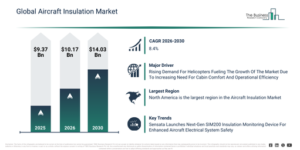
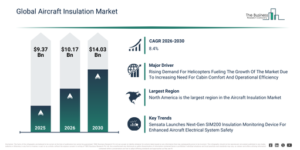
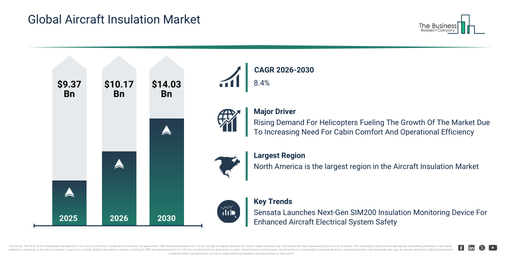
The aircraft insulation market has experienced substantial expansion in recent times. It is projected to expand from $9.37 billion in 2025 to $10.17 billion in 2026, demonstrating a compound annual growth rate (CAGR) of 8.4%. This historical growth is attributable to several factors, including the increasing application of thermal insulation for shielding passengers and crew from severe altitude temperatures, a heightened need for acoustic and anti-vibration insulation to enhance cabin comfort, a stronger regulatory emphasis on fire-resistant insulation materials for improved aircraft safety, the expansion of aircraft manufacturing leading to greater consumption of foam- and composite-based insulation, and the adoption of lightweight insulation options like cellulose and natural fibers to decrease aircraft weight.
The aircraft insulation market is projected to experience substantial expansion over the coming years, reaching $14.03 billion by 2030, demonstrating a compound annual growth rate (CAGR) of 8.4%. This growth during the forecast period is primarily attributed to the anticipated rise in next-generation aircraft requiring advanced multi-functional insulation solutions, an increasing adoption of eco-efficient and recyclable insulation materials in aviation, and a growing demand for high-performance ceramic and metal composite insulation for improved durability. Additionally, the expansion of global fleet modernization efforts is boosting replacement and retrofit insulation needs, alongside technological advancements that enable insulation materials with enhanced thermal, acoustic, and fire-resistant properties. Major trends anticipated in this period include the growing use of lightweight composite insulation, increasing adoption of multi-functional insulation materials, rising demand for advanced fire-resistant insulation solutions, expanding use of thermal-acoustic hybrid insulation, and the development of next-generation vibration-damping materials.
Request Your Free Aircraft Insulation Market Sample With Segment And Regional Data:
Aircraft Insulation Market Growth Drivers And Their Impact On Future Demand
The rising demand for helicopters is projected to drive the future expansion of the aircraft insulation market. A helicopter is defined as an aircraft equipped with rapidly spinning large blades on top, enabling it to hover and move vertically. The prevalence of helicopters is increasing due to a growing need for versatile aerial transportation and specialized services, prompting manufacturers and operators to expand their fleets for commercial, medical, and defense applications. Aircraft insulation enhances the demand for helicopters by improving cabin comfort, reducing noise, and increasing thermal efficiency, making these aircraft more reliable and appealing for commercial, medical, and defense operations. For instance, in January 2025, Airbus, a France-based aircraft manufacturer, announced that in 2024, Airbus Helicopters registered an order intake with unit growth approaching 10%, representing its second consecutive year of near-double-digit expansion. Thus, the escalating demand for helicopters is a primary catalyst for the growth of the aircraft insulation market.
What Categories Define The Aircraft Insulation Market?
The aircraft insulation market covered in this report is segmented –
1) By Type: Thermal Insulation, Acoustic And Vibration Insulation, Electric Insulation
2) By Platform: Fixed Wing, Rotary Wing, Unmanned Aerial Vehicles
3) By Material: Foamed Plastics, Fiberglass, Mineral Wool, Ceramic-Based Materials, Other Materials
4) By Application: Airframe, Propulsion System
Subsegments:
1) By Thermal Insulation: Reflective Thermal Insulation, Fiberglass Thermal Insulation, Foam Thermal Insulation, Aerogel Thermal Insulation
2) By Acoustic and Vibration Insulation: Soundproofing Materials, Acoustic Foam Panels, Vibration Damping Materials, Composite Acoustic Insulation
3) By Electric Insulation: Insulating Materials for Wiring, Electrical Insulation Coatings, Heat Shrink Tubing, Insulating Gaskets and Seals
What New Developments Are Emerging In The Aircraft Insulation Market?
Leading companies within the aircraft electrical systems market are prioritizing the utilization of innovative monitoring technologies, such as next-generation insulation monitoring devices, to boost safety, reliability, and operational efficiency in high-voltage systems. These next-generation insulation monitoring devices, which integrate advanced sensors and diagnostic algorithms, help identify insulation faults, avert electrical failures, and extend the longevity of high-voltage components, thereby guaranteeing safer and more efficient aircraft operations. For example, in March 2025, Sensata Technologies Holding plc, a US-based electronics and sensor company, introduced its next-gen SIM200 insulation monitoring device, crafted for sophisticated safety monitoring in high-voltage aircraft systems. Developed to satisfy the rising demand for dependable and intelligent electrical system management in modern aerospace applications, the device is designed to provide early fault detection and continuous monitoring while minimizing system downtime and maintenance costs. This technology leverages Sensata’s expertise in sensor development and high-precision electronics, delivering aircraft electrical systems that are safer, more reliable, and technologically advanced compared to conventional solutions.
Major Players Driving Competition In The Aircraft Insulation Market
Major companies operating in the aircraft insulation market are BASF SE, AVS Industries Limited Liability Company, Minnesota Mining and Manufacturing Company, Duracote Corporation, Boyd Corporation, DuPont de Nemours Inc., Rogers Corporation, Elmelin Ltd., Evonik Industries AG, Johns Manville, Hutchinson SA, Polymer Technologies Inc., Lamart Corporation, Safran S.A, Triumph Group Inc., Transdigm Group Inc., Zotefoams plc, Esterline Technologies Corporation, Zodiac Aerospace, Armacell International S.A., Unifrax I LLC, Cabot Corporation, Knauf Insulation, Owens Corning, Saint-Gobain S.A., Aeroflex Industries Limited, Autex Industries Ltd., Cellofoam North America Inc., Insul-Therm International Inc., Pacor Inc., Thermal Control Products
View The Comprehensive Aircraft Insulation Market Analysis:
Aircraft Insulation Market Regional Leaders: Insights From The 2026 Report
North America was the largest region in the aircraft insulation market in 2025. Asia-Pacific is expected to be the fastest-growing region in the forecast period. The regions covered in the aircraft insulation market report are Asia-Pacific, South East Asia, Western Europe, Eastern Europe, North America, South America, Middle East, Africa.
Reach Out To Our Team:
The Business Research Company: https://www.thebusinessresearchcompany.com/
Americas: +1 310-496-7795
Asia: +44 7882 955267 & +91 8897263534
Europe: +44 7882 955267
Email us at: marketing@tbrc.info
Follow us on:
LinkedIn: https://in.linkedin.com/company/the-business-research-company
YouTube: https://www.youtube.com/channel/UC24_fI0rV8cR5DxlCpgmyFQ
Global Market Model: https://www.thebusinessresearchcompany.com/global-market-model

Wasay has over a decade of experience in market research, data modelling, and analytics, with prior experience at GlobalData and Decision Tree Consulting Services. At The Business Research Company , he leads research operations across syndicated studies, customized consulting engagements, and the Global Market Model platform. His professional experience includes supporting organizations such as Boston Consulting Group, KPMG, and Ernst & Young. Wasay holds a degree in Electronics and Communications Engineering, postgraduate management qualifications from International Management Institute Belgium and Indian School of Business and Entrepreneurship, and completed the Integrated Program in Business Analytics from Indian Institute of Management Indore.