Featuring market attractiveness scoring, total addressable market sizing, company benchmarking matrices, interactive Excel dashboards, deeper supply chain intelligence, emerging startup tracking, and granular product-level insights, The Business Research Company’s 2026 market reports are built to deliver research that is both more actionable and more strategically valuable.
Anti-Submarine Warfare Systems Market Revenue Growth On Track For A 5.4% CAGR Through 2030
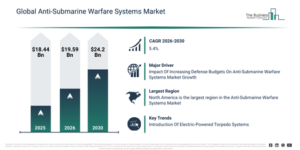
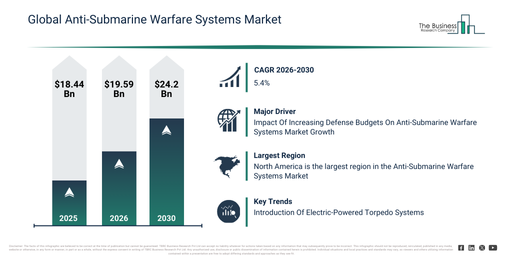
The anti-submarine warfare systems market has shown significant expansion in recent years. It is anticipated to increase from $18.44 billion in 2025 to $19.59 billion in 2026, demonstrating a compound annual growth rate (CAGR) of 6.3%. This historical growth can be linked to several factors, including the surge in naval modernization programs driving the procurement of fixed-wing aircraft and air-dropped ASW weapons. Additionally, heightened geopolitical tensions have boosted the demand for submarine detection and tracking capabilities. Advancements in underwater acoustics have improved the performance of sonobuoys and training targets, while the expansion of manufacturer-provided warranty-period maintenance and operational support services has also played a role. Furthermore, the historical increase in maritime patrol aircraft fleets has supported a broader deployment of ASW systems.
The anti-submarine warfare systems market is anticipated to experience robust expansion in the coming years. This market is projected to reach $24.2 billion by 2030, exhibiting a compound annual growth rate (CAGR) of 5.4%. Factors contributing to this growth during the forecast period include the increasing incorporation of multi-sensor detection technologies into next-generation ASW platforms, the heightened acquisition of sophisticated sonobuoys designed to combat stealthier and more effective submarines, the escalating need for long-range maritime patrol aircraft to broaden ASW coverage, a surge in investment towards unmanned systems for anti-submarine surveillance and engagement, and an anticipated rise in integrated lifecycle service solutions, such as system enhancements, data analysis, and predictive maintenance for ASW infrastructure. Key trends anticipated over this period encompass the greater deployment of long-range air-dropped ASW weaponry, a heightened requirement for advanced sonobuoys for broad submarine detection, improvements to maritime patrol aircraft through enhanced ASW mission suites, a growing uptake of training targets for naval ASW drills, and broader multi-platform ASW integration spanning ships, aircraft, and submarines.
Get A Free Sample Report With In-Depth Market Insights:
Anti-Submarine Warfare Systems Market Growth Catalysts And Demand Drivers
Future expansion of the anti-submarine warfare (ASW) systems market is anticipated to be driven by increasing defense budgets. Defense spending, or a defense budget, signifies the financial allocation by a nation to establish, sustain, and outfit its military forces. Enhanced defense expenditures facilitate the progress of ASW systems, offering essential capital for research, development, acquisition, and active implementation of technologies designed to combat submarine dangers and secure naval dominance. For example, data from February 2025, provided by the International Institute for Strategic Studies (IISS), a UK-headquartered global research organization, indicated that worldwide defense expenditure reached an unprecedented peak of $2.46 trillion in 2024, representing a 7.4% rise from the $2.24 trillion allocated in 2023. Consequently, the expansion of the anti-submarine warfare (ASW) systems market is being propelled by growing defense budgets.
Anti-Submarine Warfare Systems Market Segment Trends And Revenue Contributors
The anti-submarine warfare systems market covered in this report is segmented –
1) By Systems: Sensors, Electronic Support Measures, Armament
2) By Platform: Submarines, Surface Ships, Helicopters, Maritime Patrol Aircraft, Unmanned Systems
3) By End User: Naval Forces, Aerospace And Defense Contractors
Subsegments:
1) By Sensors: Sonar Sensors, Magnetic Sensors, Acoustic Sensors
2) By Electronic Support Measures: Radar Systems, Communication Interception Systems
3) By Armament: Torpedoes, Depth Charges, Anti-Submarine Missiles
Anti-Submarine Warfare Systems Market Trends Shaping Long-Term Demand
Leading companies within the anti-submarine warfare system market are innovating advanced technologies, such as anti-submarine torpedoes, to address evolving submarine threats and bolster maritime security. An anti-submarine torpedo is specifically engineered to neutralize or damage submarines. For instance, BAE Systems, a UK-based provider of defense, aerospace, and information security solutions, collaborated with Malloy Aeronautics, a UK-based producer of military drone systems, to introduce an inert Sting Ray training variant anti-submarine torpedo in September 2023. This anti-submarine torpedo features distinctive attributes, including electric vertical take-off and landing capabilities. It can carry payloads up to 200kg, achieve speeds of 140 km/h, and cover distances of 80km, depending on the payload. Furthermore, it is designed for convenient transport through easy disassembly, with dimensions comparable to a small car.
Anti-Submarine Warfare Systems Market Competitive Landscape: Which Companies Lead The Industry?
Major companies operating in the anti-submarine warfare systems market are Raytheon Technologies Corporation (RTX), Lockheed Martin Corporation, General Dynamics Corporation, Northrop Grumman Corporation, Mitsubishi Heavy Industries Ltd., BAE Systems PLC, L3Harris Technologies Inc., Thales Group, Leonardo S.p.A., Huntington Ingalls Industries Inc., IHI Corporation, Singapore Technologies Engineering Ltd, Rheinmetall Air Defence AG, Fincantieri S.p.A., Elbit Systems Ltd., Israel Aerospace Industries (IAI), Saab AB, Naval Group, Damen Schelde Naval Shipbuilding, Kawasaki Heavy Industries Ltd., Aselsan A.S., Japan Marine United Corporation, Mazagon Dock Shipbuilders Limited, Navantia S.A., Garden Reach Shipbuilders & Engineers Ltd., DSIT Solutions Ltd., Kongsberg Defence & Aerospace (Kongsberg Gruppen ASA)
View The Full Anti-Submarine Warfare Systems Market Report:
Anti-Submarine Warfare Systems Market Regional Split: Which Areas Are Fueling Growth?
North America was the largest region in the anti-submarine warfare system market in 2025. The regions covered in the anti-submarine warfare systems market report are Asia-Pacific, South East Asia, Western Europe, Eastern Europe, North America, South America, Middle East, Africa.
Reach Out To Our Team:
The Business Research Company: https://www.thebusinessresearchcompany.com/
Americas: +1 310-496-7795
Asia: +44 7882 955267 & +91 8897263534
Europe: +44 7882 955267
Email us at: marketing@tbrc.info
Follow us on:
LinkedIn: https://in.linkedin.com/company/the-business-research-company
YouTube: https://www.youtube.com/channel/UC24_fI0rV8cR5DxlCpgmyFQ
Global Market Model: https://www.thebusinessresearchcompany.com/global-market-model

Wasay has over a decade of experience in market research, data modelling, and analytics, with prior experience at GlobalData and Decision Tree Consulting Services. At The Business Research Company , he leads research operations across syndicated studies, customized consulting engagements, and the Global Market Model platform. His professional experience includes supporting organizations such as Boston Consulting Group, KPMG, and Ernst & Young. Wasay holds a degree in Electronics and Communications Engineering, postgraduate management qualifications from International Management Institute Belgium and Indian School of Business and Entrepreneurship, and completed the Integrated Program in Business Analytics from Indian Institute of Management Indore.