Featuring market attractiveness scoring, total addressable market sizing, company benchmarking matrices, interactive Excel dashboards, deeper supply chain intelligence, emerging startup tracking, and granular product-level insights, The Business Research Company’s 2026 market reports are built to deliver research that is both more actionable and more strategically valuable.
Armor Materials Market Forecast: What Value Will The Market Reach By 2030?
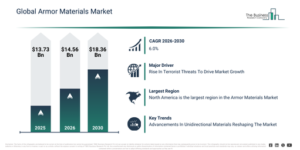
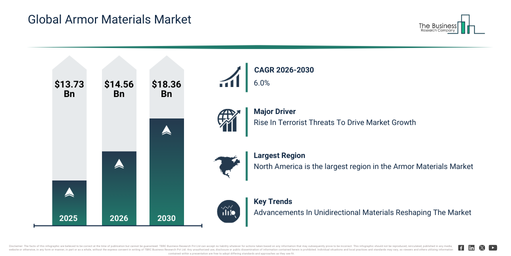
The armor materials market size has demonstrated significant growth in recent years. It is projected to expand from $13.73 billion in 2025 to $14.56 billion in 2026, achieving a compound annual growth rate (CAGR) of 6.0%. This growth observed in the past can be ascribed to the increasing integration of ceramics and kevlar for enhanced ballistic protection, the initial deployment of steel armor materials in military and law enforcement sectors, the escalating demand for lightweight polyethylene-based armor solutions, the progress in developing advanced composite armor to boost durability and impact resistance, and the expansion of defense and security operations, which in turn amplified the requirement for protective body armor.
The armor materials market is projected to experience substantial expansion in the coming years. Its valuation is anticipated to reach $18.36 billion by 2030, exhibiting a compound annual growth rate (CAGR) of 6.0%. This expansion during the forecast period is driven by several factors: a surging demand for innovative lightweight armor materials offering improved multi-hit capability; the increased incorporation of nanomaterials to boost strength-to-weight performance; heightened investment in sophisticated personal protection systems for military and law enforcement applications; an increase in vehicle and aircraft armor modernization initiatives necessitating high-performance materials; and technological progress leading to modular, flexible, and more durable armor designs. Key developments expected during this period involve the growing acceptance of lightweight, high-strength armor materials; a greater reliance on advanced ceramics for superior ballistic resistance; the creation of multi-layered hybrid composites for enhanced protection; breakthroughs in flexible and ergonomic body armor concepts; and an escalating need for fibers resistant to high temperatures and impacts.
Get A Free Sample Report With In-Depth Market Insights:
Armor Materials Market Growth Factors: What’s Supporting Expansion?
The escalating terrorist threat is anticipated to drive the expansion of the armor material market in the foreseeable future. A terrorist threat describes an act of violence that endangers others while exhibiting clear indifference to the harm it inflicts. Strong armor materials are utilized to protect individuals from projectiles such as knives, shell fragments, and bullets during terrorist incidents or other critical situations. Consequently, the rising terrorist threat will heighten the demand for the armor material market. For instance, in August 2024, a report published by the Australian Strategic Policy Institute (ASPI), an Australia-based non-profit organization, indicated that Australia’s terrorism threat level was elevated to ‘probable,’ signifying that the risk of a terrorist attack occurring within the next year exceeds 50%. Therefore, the increasing terrorist threat is a key factor propelling the growth of the armor material market.
Armor Materials Market Segment Outlook: Which Categories Are Growing Fastest?
The armor materials market covered in this report is segmented –
1) By Material Type: Metals And Alloys, Composites, Para-Aramid Fiber, UHMWPE (Ultra-High-Molecular-Weight Polyethylene), Fiberglass, Other Materials
2) By Product Type: Vest, Helmets, Other Products
3) By Protection: Level II, Level IIA, Level III, Level IIIA, Level IV
4) By Application: Vehicle Armor, Aerospace Armor, Body Armor, Civil Armor, Marine Armor
5) By End-User: Defense, Law Enforcement And Security Personnel, Civilians
Subsegments:
1) By Metals And Alloys: Steel Alloys, Aluminum Alloys, Titanium Alloys
2) By Composites: Ceramic Composites, Carbon Fiber Composites, Hybrid Composites
3) By Para-Aramid Fiber: Kevlar, Twaron, Other Para-Aramid Variants
4) By UHMWPE: Sheet UHMWPE, Fiber UHMWPE, UHMWPE Composites
5) By Fiberglass: E-Glass Fiberglass, S-Glass Fiberglass, Specialty Fiberglass Reinforcements
6) By Other Materials: Polycarbonate, Rubberized Materials, Organic Fiber Materials
Armor Materials Market Industry Trends: What’s Reshaping Demand?
Major companies operating in the armor materials market are developing new unidirectional materials to gain a competitive edge. Unidirectional material denotes a type of substance, frequently fiber-composed, where the reinforcement is primarily oriented in a single direction. In these materials, fibers are aligned parallel to one another, imparting strength and stiffness along a specific axis. For instance, in October 2023, Dyneema, owned by Avient Corporation, a US-based polymer materials company, unveiled the SB301, its third-generation UD material, with a focus on sustainability for ballistic vests. Featuring a 0–90 construction in unidirectional fabrics, this bio-based material achieves a 90% reduction in carbon footprint and offers a 15%-20% performance improvement or a 20% reduction in weight. The progression in fiber technology contributes to increased ballistic stopping power, addressing the vital need for effective protection in various operational scenarios. Dyneema SB301 complies with the Berry Amendment, fulfilling the standards mandated for law enforcement vests in the US market.
Armor Materials Market Leading Companies And Competitive Benchmarking
Major companies operating in the armor materials market are DuPont de Nemours Inc., Honeywell International Inc., 3M Company, Saab AB, Compagnie de Saint-Gobain S.A., Teijin Aramid B.V., Koninklijke Ten Cate BV., CeramTec GmbH, CoorsTek Inc., Morgan Advanced Materials plc, The Safariland Group LLC, PPG Industries Inc., NP Aerospace Ltd., Ballistic Body Armour Ltd., Pacific Safety Products Inc., ATI CeramTec GmbH, Ceradyne Inc., Allegheny Technologies Incorporated, AGY Holding Corp., White Horse Research and Development Inc., Megiddo Global LLC, Hard Shell U.S., ArmorCo Advanced Armoring Products Inc., Tata Steel Ltd., Armorup LP, Tex Tech Industries Inc., SAE Manufacturing Specialties Corp., SafeGuard Armor Ltd., Schunk Carbon Technology LLC, Aloca Inc.
View The Full Armor Materials Market Report:
Armor Materials Market Regional Analysis: Which Geography Leads On Revenue?
North America was the largest region in the armor materials market in 2025.North America is expected to be the fastest-growing region in the global armor materials market report during the forecast period. The regions covered in the armor materials market report are Asia-Pacific, South East Asia, Western Europe, Eastern Europe, North America, South America, Middle East, Africa.
Reach Out To Our Team:
The Business Research Company: https://www.thebusinessresearchcompany.com/
Americas: +1 310-496-7795
Asia: +44 7882 955267 & +91 8897263534
Europe: +44 7882 955267
Email us at: marketing@tbrc.info
Follow us on:
LinkedIn: https://in.linkedin.com/company/the-business-research-company
YouTube: https://www.youtube.com/channel/UC24_fI0rV8cR5DxlCpgmyFQ
Global Market Model: https://www.thebusinessresearchcompany.com/global-market-model

Wasay has over a decade of experience in market research, data modelling, and analytics, with prior experience at GlobalData and Decision Tree Consulting Services. At The Business Research Company , he leads research operations across syndicated studies, customized consulting engagements, and the Global Market Model platform. His professional experience includes supporting organizations such as Boston Consulting Group, KPMG, and Ernst & Young. Wasay holds a degree in Electronics and Communications Engineering, postgraduate management qualifications from International Management Institute Belgium and Indian School of Business and Entrepreneurship, and completed the Integrated Program in Business Analytics from Indian Institute of Management Indore.