Market attractiveness scoring, total addressable market sizing, company benchmarking matrices, interactive Excel dashboards, deeper supply chain intelligence, emerging startup tracking, and granular product-level insights are among the key offerings featured in The Business Research Company’s 2026 market reports, designed to deliver more actionable and strategically valuable research.
Artificial Gravity Systems Market Size Estimate For 2026 And Revenue Forecast Through 2030
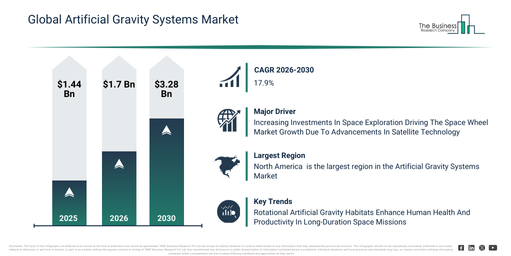
The artificial gravity systems market has shown rapid expansion in recent years. It is anticipated to grow from $1.44 billion in 2025 to $1.7 billion in 2026, driven by a compound annual growth rate (CAGR) of 18.1%. This historical growth can be attributed to a rising interest in long-duration space missions, advancements in centrifugal and rotational habitat technologies, increased investment in astronaut health and safety solutions, early adoption by space agencies for microgravity research, and collaborations between aerospace manufacturers and research institutions.
The artificial gravity systems market is poised for significant expansion in the coming years, with its size projected to reach $3.28 billion by 2030, exhibiting a compound annual growth rate (CAGR) of 17.9%. This anticipated growth is driven by several factors, including the development of compact and modular artificial gravity systems for spacecraft, their integration with life-support and exercise modules, increasing demand from commercial space tourism and private space missions, a stronger emphasis on human physiology optimization for deep-space travel, and the expansion of engineering and design services to support long-duration missions. Furthermore, key trends expected in this forecast period involve the expansion of modular rotating habitat architectures, advancements in compact centrifugal exercise systems, the integration of multi-force hybrid gravity simulation modules, a heightened demand for human physiology simulation for long-duration missions, and the creation of lightweight, radiation-shielded, gravity-enabled cabins.
Free Artificial Gravity Systems Market Report Sample Available For Download:
Why Is Demand In The Artificial Gravity Systems Market Expected To Keep Rising?
Growing financial commitments to space exploration are anticipated to boost the artificial gravity systems market in the future. Space exploration involves the scientific and technological study of outer space, utilizing crewed and uncrewed spacecraft for the discovery, examination, and comprehension of cosmic entities and events beyond Earth’s atmosphere. An increase in space exploration funding is motivated by national security concerns, as nations aim to fortify their space-based defense mechanisms, safeguard vital satellites, and preserve strategic supremacy against competitors. Enhanced investment in space exploration expedites the research, development, and implementation of artificial gravity systems, furnishing the essential financial support and technological progress needed to develop effective solutions for extended human spaceflights. As an illustration, in June 2024, data from New Zealand’s Ministry of Foreign Affairs and Trade indicated that the UK pledged to allocate roughly USD 12.5 billion (£10 billion) to space initiatives across a decade starting in 2023, with approximately USD 3.75 billion (£3 billion) specifically allocated during the 2023 spending review. Consequently, the expanding investments in space exploration are fueling the expansion of the artificial gravity systems market.
How Is The Artificial Gravity Systems Market Divided Across Segments And Subsegments?
The artificial gravity systems market covered in this report is segmented –
1) By Component: Rotating Habitats, Tether Systems, Control Systems, Power Systems
2) By Technology: Centrifugal Force, Linear Acceleration, Electromagnetic Force
3) By Application: Space Stations, Spacecraft, Space Tourism, Military And Defense
4) By End-User: Government, Commercial, Research Institution
Subsegments:
1) By Rotating Habitats: Ring-Shaped Structures, Cylindrical Modules, Toroidal Stations, Spherical Modules
2) By Tether Systems: Momentum Exchange Tethers, Hybrid Tether Systems
3) By Control Systems: Automated Navigation Systems, Attitude Control Systems, Stabilization Mechanisms, Artificial Gravity Adjustment Systems
4) By Power Systems: Solar Power Systems, Nuclear Power Systems, Fuel Cell Systems, Hybrid Power Systems
Artificial Gravity Systems Market Trends Reshaping Customer Demand And Business Strategies
Leading firms within the artificial gravity systems market are creating sophisticated rotational artificial-gravity habitats, intended for extended human space missions, commercial low-Earth orbit (LEO) platforms, and private astronaut activities. These structures produce centrifugal force through the rotation of either a portion or their entire design, thereby mimicking gravity. This simulation aims to mitigate muscle and bone deterioration common in conventional zero-gravity settings, consequently enhancing the health, comfort, and productivity of the crew. An example of this is Vast Space, a US-based space infrastructure company, which revealed its Haven-1 private space station in October 2025. Its launch is planned for no earlier than May 2026, utilizing a Falcon 9 rocket. The station, engineered with a sophisticated propulsion and rotational subsystem for artificial gravity experiments, provides a habitable volume of approximately 45 m³. It can accommodate up to four crew members and includes docking capabilities, life-support systems, a spacious domed window for Earth viewing, and adaptable modular lab space for research conducted in orbit.
Artificial Gravity Systems Market Major Players: Companies At The Forefront Of The Industry
Major companies operating in the artificial gravity systems market are Airbus SE, Lockheed Martin Corporation, Northrop Grumman Corporation, Thales S.A., L3Harris Technologies Inc., Leidos Holdings Inc., Blue Origin L.P., Sierra Space Corporation, Axiom Space Inc., The Charles Stark Draper Laboratory Inc., Maxar Technologies Inc., Gateway Spaceport LLC, gravityLab Inc., Joules Space Technology LLC, Orbital Assembly Corporation, Conglomera Astrogravitics Inc., Exodus Star Inc., DigitalBlast Inc., Vast Space LLC, GravityLab
Read More About The Artificial Gravity Systems Market In The Full Report:
Artificial Gravity Systems Market Regional Share Analysis For 2025
North America was the largest region in the artificial gravity systems market in 2025. Asia-Pacific is expected to be the fastest-growing region in the forecast period. The regions covered in the artificial gravity systems market report are Asia-Pacific, South East Asia, Western Europe, Eastern Europe, North America, South America, Middle East, Africa.
Reach Out To Our Team:
The Business Research Company: https://www.thebusinessresearchcompany.com/
Americas: +1 310-496-7795
Asia: +44 7882 955267 & +91 8897263534
Europe: +44 7882 955267
Email us at: marketing@tbrc.info
Follow us on:
LinkedIn: https://in.linkedin.com/company/the-business-research-company
YouTube: https://www.youtube.com/channel/UC24_fI0rV8cR5DxlCpgmyFQ
Global Market Model: https://www.thebusinessresearchcompany.com/global-market-model

Wasay has over a decade of experience in market research, data modelling, and analytics, with prior experience at GlobalData and Decision Tree Consulting Services. At The Business Research Company , he leads research operations across syndicated studies, customized consulting engagements, and the Global Market Model platform. His professional experience includes supporting organizations such as Boston Consulting Group, KPMG, and Ernst & Young. Wasay holds a degree in Electronics and Communications Engineering, postgraduate management qualifications from International Management Institute Belgium and Indian School of Business and Entrepreneurship, and completed the Integrated Program in Business Analytics from Indian Institute of Management Indore.