
Through market attractiveness analysis, total addressable market evaluation, company benchmarking matrices, interactive Excel dashboards, expanded supply chain intelligence, emerging startup coverage, and detailed product insights, The Business Research Company’s 2026 market reports provide more actionable and strategically valuable research.
Artificial Intelligence (AI) Swarm Control Station Market Expansion From $2.5 Billion In 2026 To $5.98 Billion In 2030
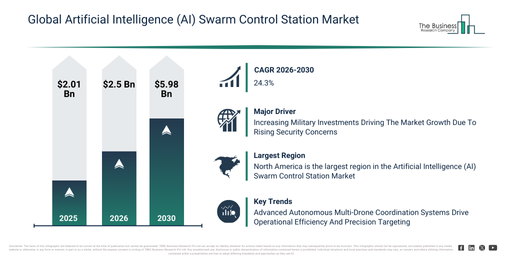
The market size for artificial intelligence (AI) swarm control stations has expanded significantly in recent years. It is projected to increase from $2.01 billion in 2025 to $2.5 billion in 2026, achieving a compound annual growth rate (CAGR) of 24.6%. Historically, this expansion has been driven by the adoption of AI in autonomous fleet management, improvements in swarm optimization algorithms, the creation of real-time monitoring interfaces, higher defense research and development spending, and an increasing reliance on simulation-based mission planning.
The artificial intelligence (AI) swarm control station market is poised for significant expansion over the next few years. It is projected to climb to $5.98 billion by 2030, progressing at a compound annual growth rate (CAGR) of 24.3%. This anticipated growth is driven by the integration of next-generation AI predictive analytics, the development of cloud-based swarm orchestration, enhanced interoperability with diverse autonomous platforms, sophisticated security and threat detection algorithms, and its increasing commercialization for industrial and logistics applications. Key trends expected during this forecast period include optimizing swarm coordination, continuous real-time performance monitoring, advancements in autonomous fleet management, simulation-driven mission planning, and robust cybersecurity measures for autonomous systems.
Download A Free Sample Report For Comprehensive Market Insights:
#Artificial Intelligence (AI) Swarm Control Station Market Growth Factors: Which Forces Are Supporting Market Expansion?
Future expansion of the artificial intelligence (AI) swarm control station market is anticipated, driven by a surge in military investments. These investments encompass governmental spending allocated for defense capabilities, cutting-edge technologies, and essential military infrastructure, aimed at bolstering national security and operational efficacy. The uptick in military spending stems from growing global security threats and geopolitical instability, prompting countries to upgrade their defense systems with advanced technological solutions. This increase in defense expenditure expedites the uptake of AI swarm control station systems, as military forces seek sophisticated autonomous platforms to concurrently manage numerous unmanned vehicles, drones, and robotic systems, thereby improving battlefield effectiveness and achieving strategic dominance. A notable example comes from the Stockholm International Peace Research Institute (SIPRI), a Sweden-based research institute, which reported in April 2023 that global defense spending in 2022 climbed by 3.7% in real terms, reaching an unparalleled $2,240 billion. The United States, China, and Russia alone constituted 56% of this worldwide military expenditure. Consequently, the expansion of the artificial intelligence (AI) swarm control station market is propelled by increasing military investments.
Artificial Intelligence (AI) Swarm Control Station Market Segment Breakdown: Which Categories Generate The Most Revenue?
The artificial intelligence (AI) swarm control station market covered in this report is segmented –
1) By Component: Hardware, Software, Services
2) By Deployment Mode: On-Premises, Cloud
3) By Platform: Aerial, Ground, Marine, Hybrid
4) By Application: Defense And Security, Industrial Automation, Agriculture, Transportation And Logistics, Environmental Monitoring, Other Applications
5) By End-User: Military, Commercial, Research And Development, Other End-Users
Subsegments:
1) By Hardware: Processors, Sensors, Communication Modules, Storage Devices, Power Supply Units
2) By Software: Swarm Management Software, Navigation Software, Simulation Software, Analytics Software, Security Software
3) By Services: System Integration, Consulting Services, Maintenance And Support, Training Services, Cloud Hosting Services
Artificial Intelligence (AI) Swarm Control Station Market Trends Reshaping Industry Growth
Leading companies in the artificial intelligence (AI) swarm control station market are dedicated to developing innovative solutions like autonomous multi-drone coordination systems to boost mission efficiency, improve targeting precision, and expand operational scalability. These autonomous multi-drone coordination systems are AI-powered platforms that enable numerous drones to work together without direct human intervention, thereby enhancing efficiency, accuracy, and safety in operations such as surveillance, target tracking, or delivery. For example, in August 2025, Nearthlab Inc., an aerospace company based in South Korea, unveiled XAiDEN, an AI-enabled autonomous swarm attack UAV system. XAiDEN is engineered for executing coordinated multi-drone operations in defense missions, including reconnaissance, automated target tracking, and precision strikes. The system allows a single operator to manage multiple squadrons simultaneously, with drones retaining the capability to complete missions independently even amidst communication or navigation disruptions. This significantly improves operational efficiency, increases mission success rates, and provides greater cost-effectiveness, marking a substantial progression in autonomous multi-drone coordination technology.
Artificial Intelligence (AI) Swarm Control Station Market Key Players And Strategic Industry Positioning
Major companies operating in the artificial intelligence (AI) swarm control station market are Raytheon Technologies Corporation, Northrop Grumman Corporation, Thales Group, L3Harris Technologies Inc., Leonardo S.P.A, Elbit Systems Ltd, ARES Autonomy, GreyOrange Inc., Quantum Systems GmbH, Fortem Technologies Inc., Shield AI, Auterion, Aquiline Drones, Israel Aerospace Industries Ltd., Raphe mPhibr Pvt. Ltd., Zhuhai Ziyan Technology Co. Ltd., Falco Robotics Private Limited., Nearthlab Inc., Sky-Drones Technologies Ltd., Swarmer
Access The Complete Artificial Intelligence (AI) Swarm Control Station Market Report:
Artificial Intelligence (AI) Swarm Control Station Market Regional Outlook: Where Are The Largest Opportunities Located?
North America was the largest region in the artificial intelligence (AI) swarm control station market in 2025. Asia-Pacific is expected to be the fastest-growing region in the forecast period. The regions covered in the artificial intelligence (AI) swarm control station market report are Asia-Pacific, South East Asia, Western Europe, Eastern Europe, North America, South America, Middle East, Africa.
Access a Customized Artificial Intelligence (AI) Swarm Control Station Market Report for Deeper Competitive Insights
https://www.thebusinessresearchcompany.com/customise?id=28500&type=smp
Get in touch with us:
The Business Research Company: https://www.thebusinessresearchcompany.com/
Americas: +1 310-496-7795
Asia: +44 7882 955267 & +91 8897263534
Europe: +44 7882 955267
Email us at: marketing@tbrc.info
Follow us on:
LinkedIn: https://in.linkedin.com/company/the-business-research-company
YouTube: https://www.youtube.com/channel/UC24_fI0rV8cR5DxlCpgmyFQ
Global Market Model: https://www.thebusinessresearchcompany.com/global-market-model

Wasay has over a decade of experience in market research, data modelling, and analytics, with prior experience at GlobalData and Decision Tree Consulting Services. At The Business Research Company , he leads research operations across syndicated studies, customized consulting engagements, and the Global Market Model platform. His professional experience includes supporting organizations such as Boston Consulting Group, KPMG, and Ernst & Young. Wasay holds a degree in Electronics and Communications Engineering, postgraduate management qualifications from International Management Institute Belgium and Indian School of Business and Entrepreneurship, and completed the Integrated Program in Business Analytics from Indian Institute of Management Indore.
