
Through market attractiveness analysis, total addressable market evaluation, company benchmarking matrices, interactive Excel dashboards, expanded supply chain intelligence, emerging startup coverage, and detailed product insights, The Business Research Company’s 2026 market reports provide more actionable and strategically valuable research.
Artificial Intelligence And Robotics In Aerospace and Defense Market Size Outlook: How Fast Will Revenue Grow Through 2030?
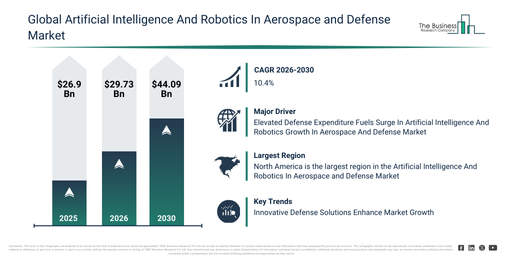
The artificial intelligence and robotics in aerospace and defense market has experienced substantial expansion recently. Projections indicate its expansion from $26.9 billion in 2025 to $29.73 billion in 2026, exhibiting a compound annual growth rate (CAGR) of 10.5%. Historically, this growth stemmed from factors such as the increasing deployment of autonomous drones and robotics in defense, the implementation of AI for threat detection and cybersecurity, heightened investment in defense R&D, the incorporation of advanced sensors into aerospace platforms, and the utilization of predictive analytics for maintenance and operational tasks.
The artificial intelligence and robotics in aerospace and defense market size is projected to experience substantial expansion over the coming years. This market is anticipated to reach a valuation of $44.09 billion by 2030, demonstrating a compound annual growth rate (CAGR) of 10.4%. This growth during the forecast period is primarily fueled by the implementation of AI-driven autonomous systems, the increasing use of robotics in defense operations, the integration of quantum computing for intelligence in defense, the adoption of AI in space exploration missions, and the broadening of AI-powered cybersecurity solutions. Key trends emerging in this period encompass the incorporation of AI-powered predictive maintenance into aerospace systems, the uptake of robotics for autonomous military activities, the rising application of AI-driven simulation and modeling for defense training, the increased deployment of sensor fusion technologies for surveillance in aerospace, and the expansion of AI-assisted decision support for planning space missions.
Download A Free Sample Report For Comprehensive Market Insights:
Artificial Intelligence And Robotics In Aerospace and Defense Market Expansion Drivers: What Is Shaping Future Growth?
The escalating defense expenditure is anticipated to fuel the expansion of artificial intelligence and robotics in the aerospace and defense market moving forward. Military expenditure, also known as defense spending, denotes the total financial resources a government allocates to its armed forces, defense-related activities, and national security initiatives. This spending is increasing due to heightened geopolitical tensions, compelling nations to fortify their military strength for national security and threat deterrence. Defense expenditure is utilized to advance artificial intelligence (AI) and robotics capabilities within the defense and aerospace sectors, enhancing military prowess, improving operational efficiency, and contributing to national security. For instance, in April 2024, a report published by the Stockholm International Peace Research Institute (SIPRI), a Sweden-based international research institute, indicated that global military spending reached $2.443 trillion in 2023, marking a 6.8% increase in real terms compared to 2022. Thus, the rising defense expenditure is propelling the growth of artificial intelligence and robotics in the aerospace and defense market.
Artificial Intelligence And Robotics In Aerospace and Defense Market Segment Landscape: Which Areas Lead Market Development?
The artificial intelligence and robotics in aerospace and defense market covered in this report is segmented –
1) By Type: Hardware, Software, Services
2) By Technology: Machine Learning, Natural Language Processing, Context-Aware Computing, Computer Vision, Intelligent Virtual Agent (IVA) Or Virtual Agents, Other Technologies
3) By Application: Military, Commercial Aviation, Space
Subsegments:
1) By Hardware: Robotics Systems, Sensors And Actuators, Embedded Systems
2) By Software: AI Algorithms For Flight Operations, Simulation And Modeling Software, Autonomous Navigation Software
3) By Services: Consulting And Integration Services, Maintenance And Support Services, Training And Simulation Services
Artificial Intelligence And Robotics In Aerospace and Defense Market Growth Trends Influencing Competitive Dynamics
Leading companies engaged in artificial intelligence and robotics within the aerospace and defense markets are concentrating on developing advanced defense solutions, such as AI-powered robots, to boost operational efficiency, refine decision-making, and reinforce security capabilities. These AI-powered robots are autonomous machines, embedded with artificial intelligence, capable of executing intricate tasks, making independent decisions, and adjusting to dynamic surroundings without human intervention. As an illustration, in July 2024, Zen Technologies, an India-based producer of defense training and counter-drone systems, introduced Prahasta, an AI-driven quadruped robot specifically designed for real-time 3D mapping. Prahasta functions as an automated robot, utilizing LiDAR (light detection and ranging) and reinforcement learning to produce real-time 3D terrain maps, which facilitates sophisticated mission planning, navigation, and threat evaluation. Concurrently, the Hawkeye anti-drone system camera, the Barbarik-URCWS remote-controlled weapon station, and the Sthir Stab 640 – a durable, stabilized sight chiefly for armored vehicles, infantry combat vehicles (ICVs), and boats – were also unveiled.
Artificial Intelligence And Robotics In Aerospace and Defense Market Industry Leaders And Market Competition
Major companies operating in the artificial intelligence and robotics in aerospace and defense market are Microsoft Corporation, Raytheon Technologies Corporation, Boeing Company, Lockheed Martin Corporation, Intel Corporation, Airbus SE, IBM Corporation, ThyssenKrupp, General Dynamics Corporation, Northrop Grumman Corporation, Honeywell International Inc., Nvidia Corporation, BAE Systems, Thales Group, Rolls-Royce, Leidos, Elbit Systems, Israel Aerospace Industries, T-Systems International GmbH, Safran, Indra Sistemas SA, QinetiQ, SITA, Spark Cognition, GE Aviation, Iris Automation Inc.
Access The Complete Artificial Intelligence And Robotics In Aerospace and Defense Market Report:
Artificial Intelligence And Robotics In Aerospace and Defense Market Global Footprint: Which Region Holds Market Leadership?
North America was the largest region in the artificial intelligence and robotics in aerospace and defense market in 2025. Asia-Pacific is expected to be the fastest-growing region in the forecast period. The regions covered in the artificial intelligence and robotics in aerospace and defense market report are Asia-Pacific, South East Asia, Western Europe, Eastern Europe, North America, South America, Middle East, Africa.
Access a Customized Artificial Intelligence And Robotics In Aerospace and Defense Market Report for Deeper Competitive Insights
https://www.thebusinessresearchcompany.com/customise?id=13582&type=smp
Get in touch with us:
The Business Research Company: https://www.thebusinessresearchcompany.com/
Americas: +1 310-496-7795
Asia: +44 7882 955267 & +91 8897263534
Europe: +44 7882 955267
Email us at: marketing@tbrc.info
Follow us on:
LinkedIn: https://in.linkedin.com/company/the-business-research-company
YouTube: https://www.youtube.com/channel/UC24_fI0rV8cR5DxlCpgmyFQ
Global Market Model: https://www.thebusinessresearchcompany.com/global-market-model

Wasay has over a decade of experience in market research, data modelling, and analytics, with prior experience at GlobalData and Decision Tree Consulting Services. At The Business Research Company , he leads research operations across syndicated studies, customized consulting engagements, and the Global Market Model platform. His professional experience includes supporting organizations such as Boston Consulting Group, KPMG, and Ernst & Young. Wasay holds a degree in Electronics and Communications Engineering, postgraduate management qualifications from International Management Institute Belgium and Indian School of Business and Entrepreneurship, and completed the Integrated Program in Business Analytics from Indian Institute of Management Indore.
