
The Business Research Company’s 2026 market reports combine market attractiveness scoring, total addressable market sizing, company benchmarking matrices, interactive Excel dashboards, deeper supply chain intelligence, emerging startup tracking, and granular product-level insights to deliver research that is more actionable and strategically valuable.
Autonomous Drone Swarm Security Market Value Projected To Grow At A 24.8% Compound Annual Growth Rate Through 2030
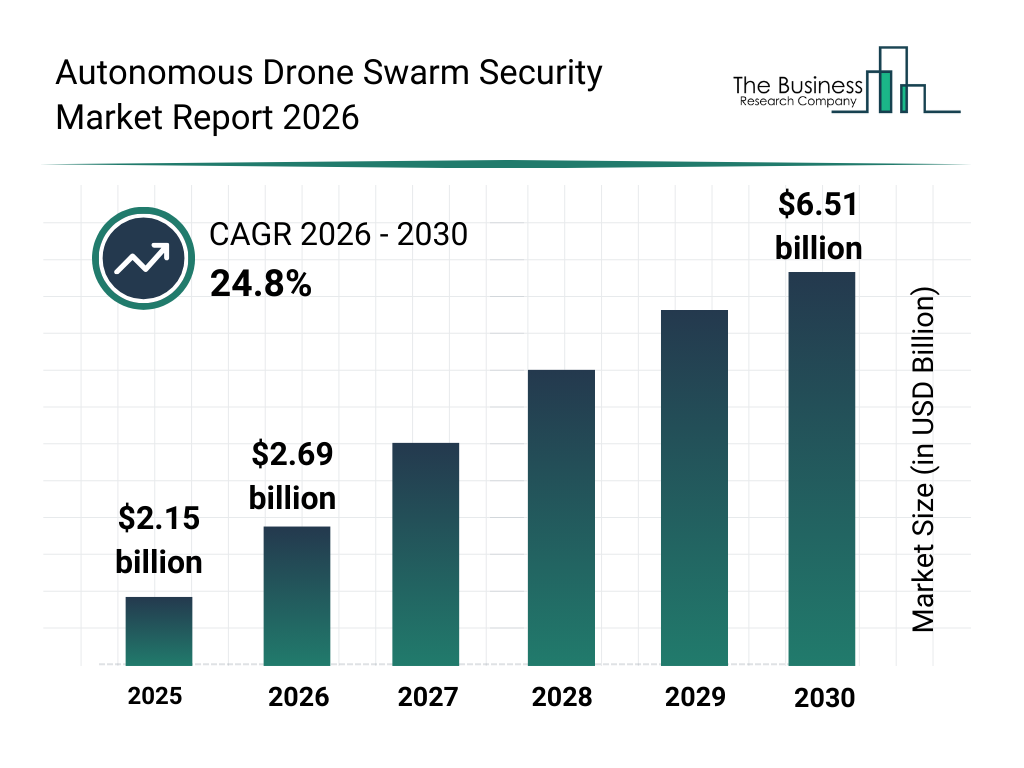
The autonomous drone swarm security market has seen considerable expansion in recent years. Its size is expected to reach $2.69 billion in 2026, up from $2.15 billion in 2025, at a compound annual growth rate (CAGR) of 25.0%. The past growth of this market can be linked to factors such as the increasing use of drone swarms for defense security, improvements in coordinated flight algorithms, the development of AI-powered threat detection, a greater demand for rapid response aerial surveillance, and advancements in drone-to-drone communication modules.
The autonomous drone swarm security market is anticipated to experience substantial growth in the near future. Its valuation is set to reach $6.51 billion in 2030, exhibiting a compound annual growth rate (CAGR) of 24.8%. This projected expansion is driven by factors such as the integration with autonomous threat neutralization systems, its increasing application in critical infrastructure security, the advancement of hybrid air-ground swarm operations, the utilization of advanced AI learning for dynamic threat response, and the implementation of cybersecurity measures for swarm networks. Key trends expected during this period encompass the broader implementation of multi-drone cooperative threat engagement models, continuous improvements in autonomous swarm navigation and collision avoidance technologies, a surge in the deployment of distributed sensor fusion across drone swarms, the proliferation of rapid response swarm systems for emergency scenarios, and an increasing embrace of modular swarm control units to enable scalable security operations.
Evaluate The Autonomous Drone Swarm Security Market Report Before You Buy With A Free Sample:
Autonomous Drone Swarm Security Market Growth Driver Analysis For The 2026–2030 Forecast Period
The increasing occurrence of security breaches and asymmetric threats is projected to drive the expansion of the autonomous drone swarm security market in the future. These breaches and threats involve illicit efforts to penetrate, monitor, obstruct, or harm vital assets through non-traditional, economical, and difficult-to-track approaches, including the use of unauthorized drones. This increase stems from the growing availability and reduced cost of drone technology, enabling malicious parties to deploy drones for various illicit purposes like surveillance, smuggling, or offensive actions with limited investment. Autonomous drone swarm security actively counters these security challenges by offering synchronized, real-time surveillance over expansive or intricate terrains, facilitating swift detection and reaction to incursions that traditional security setups might struggle to monitor adequately. As an illustration, Dedrone Holdings Inc., a US-based firm focused on counter-unmanned aerial system (C-UAS) technology, reported in September 2024 that drone-related flight violations in the United States surpassed 900,000 in 2024. This follows 1,067,112 violations recorded in 2023, highlighting a continuous rise in drone security events since 2022. Consequently, the escalating occurrences of security breaches and asymmetric threats are fueling the expansion of the autonomous drone swarm security market.
Autonomous Drone Swarm Security Market Segmentation Breakdown: Primary And Secondary Categories
The autonomous drone swarm security market covered in this report is segmented –
1) By Component: Hardware, Software, Services
2) By Deployment Mode: On-Premises, Cloud
3) By Application: Critical Infrastructure Protection, Border Security, Surveillance And Reconnaissance, Disaster Management, Other Applications
4) By End-User: Defense And Military, Homeland Security, Commercial, Industrial, Other End-Users
Subsegments:
1) By Hardware: Drones Or Unmanned Aerial Vehicles, Communication Modules, Sensors And Cameras, Navigation Or Global Positioning System Systems, Control Units
2) By Software: Swarm Management Software, Artificial Intelligence And Machine Learning Algorithms, Threat Detection And Analytics Software, Mission Planning Software, Simulation And Training Software
3) By Services: Installation And Integration Services, Maintenance And Support Services, Training And Consultation Services, Security Monitoring Services, Data Analysis And Reporting Services
Autonomous Drone Swarm Security Market Industry Trends: New Developments From Leading Companies
Companies operating within the autonomous drone swarm security market are prioritizing the creation of advanced solutions, such as autonomous defense systems, to enhance aerospace security and intelligent threat responses. Autonomous defense systems are defined as sophisticated defense technologies that integrate artificial intelligence, robotics, and automated decision-making processes to detect, track, and neutralize potential threats across multiple domains without needing constant human intervention. For example, in August 2025, Brightcom Group, an India-based digital technology company, introduced Brightcom Defence. This dedicated division was established to develop advanced aerospace intelligence and autonomous defense solutions. Brightcom Defence is engineered to address emerging issues in aerial security and modern warfare by focusing on AI-powered UAV flight systems, high-fidelity mission simulation engines, aerial-platform cybersecurity, real-time threat detection, and coordinated drone swarm operations. These capabilities provide enhanced resilience, precision, and automation, positioning Brightcom Defence as a strategic initiative to strengthen autonomous defense systems and support evolving security needs.
Who Are The Top Competitors In The Autonomous Drone Swarm Security Market?
Major companies operating in the autonomous drone swarm security market are Raytheon Technologies, Lockheed Martin, Northrop Grumman, Honeywell Aerospace, BAE Systems, L3Harris Technologies, Leonardo S.p.A., Elbit Systems, Israel Aerospace Industries (IAI), Kalashnikov Group, Anduril Industries Inc., Thales Group, Shield AI, XTEND Robotics, Airobotics, Fortem Technologies, Elsight Limited, Icarus Swarms, Sunflower Labs Inc., Sky-Drones Technologies Ltd.
Access The Autonomous Drone Swarm Security Market Report For Complete Segment-Level Analysis:
Which Region Leads The Autonomous Drone Swarm Security Market, And Which Regions Are Covered?
North America was the largest region in the autonomous drone swarm security market in 2025. Asia-Pacific is expected to be the fastest-growing region in the forecast period. The regions covered in the autonomous drone swarm security market report are Asia-Pacific, South East Asia, Western Europe, Eastern Europe, North America, South America, Middle East, Africa.
Reach Out To Our Team:
The Business Research Company: https://www.thebusinessresearchcompany.com/
Americas: +1 310-496-7795
Asia: +44 7882 955267 & +91 8897263534
Europe: +44 7882 955267
Email us at: marketing@tbrc.info
Follow us on:
LinkedIn: https://in.linkedin.com/company/the-business-research-company
YouTube: https://www.youtube.com/channel/UC24_fI0rV8cR5DxlCpgmyFQ
Global Market Model: https://www.thebusinessresearchcompany.com/global-market-model

Wasay has over a decade of experience in market research, data modelling, and analytics, with prior experience at GlobalData and Decision Tree Consulting Services. At The Business Research Company , he leads research operations across syndicated studies, customized consulting engagements, and the Global Market Model platform. His professional experience includes supporting organizations such as Boston Consulting Group, KPMG, and Ernst & Young. Wasay holds a degree in Electronics and Communications Engineering, postgraduate management qualifications from International Management Institute Belgium and Indian School of Business and Entrepreneurship, and completed the Integrated Program in Business Analytics from Indian Institute of Management Indore.

