
Designed to make market research more actionable and strategically valuable, The Business Research Company’s 2026 market reports feature market attractiveness scoring, total addressable market sizing, company benchmarking matrices, interactive Excel dashboards, deeper supply chain intelligence, emerging startup tracking, and granular product-level insights.
Autonomous Military Aircraft Market Revenue Expansion Outlook For The 2026–2030 Forecast Period
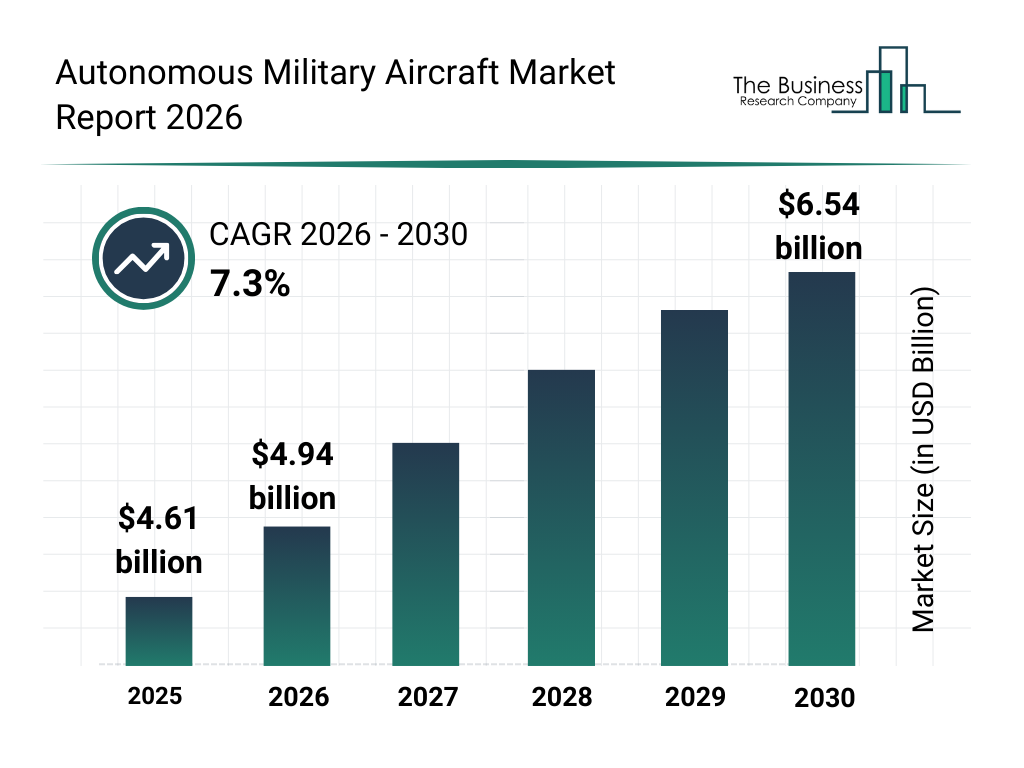
The autonomous military aircraft market has experienced robust growth in recent years. This market is projected to expand from $4.61 billion in 2025 to $4.94 billion in 2026, reflecting a compound annual growth rate (CAGR) of 7.1%. Historically, this expansion can be attributed to the development of early unmanned combat aerial vehicle (ucav) technologies, the adoption of autonomous aircraft for surveillance and strike missions, advancements in targeting and sensor systems, government investment in defense R&D programs, and the integration of electronic warfare and communication systems in autonomous military aircraft.
The autonomous military aircraft market is projected to experience substantial expansion over the coming years. This market is set to reach $6.54 billion by 2030, exhibiting a compound annual growth rate (CAGR) of 7.3%. This anticipated growth stems from several factors, including the expanded deployment of autonomous combat aircraft in contemporary warfare, ongoing progress in AI-powered target identification and mission strategizing, the proliferation of long-range and stealth autonomous military aircraft, increased defense spending on advanced autonomous weapon systems, and the incorporation of swarming and synchronized autonomous attack capabilities. Key developments expected during this period involve sophisticated targeting systems, the integration of precision-guided weapons, enhanced electronic warfare capabilities, autonomous missions with extended endurance, and adaptable flight control and navigation systems.
Download A Free Sample For In-Depth Autonomous Military Aircraft Market Intelligence:
Autonomous Military Aircraft Market Demand Driver: How It Is Shaping Industry Growth
The increasing global requirement for unmanned aerial vehicles (UAVs) is set to stimulate the expansion of the autonomous military aircraft market moving forward. UAVs are aircraft that operate without an onboard human pilot, capable of remote control or autonomous flight through integrated systems. Their rising adoption is attributed to their effectiveness in carrying out surveillance, reconnaissance, and combat missions without endangering human lives, thereby offering substantial benefits in contemporary warfare. This heightened demand for UAVs actively supports the growth of autonomous military aircraft by accelerating the development and deployment of advanced, pilotless platforms designed for efficient surveillance, reconnaissance, and combat operations, all while minimizing risks to human personnel. For example, in June 2025, the Ministry of Defence, a UK-based government body, declared that the UK plans to invest an unprecedented £350 million (approximately $473 million USD) in 2025 to bolster Ukraine’s drone supply, with an objective to increase the number of drones provided from 10,000 in 2024 to 100,000 in 2025. Consequently, the surging demand for unmanned aerial vehicles (UAVs) is a significant driver for the autonomous military aircraft market’s growth.
Autonomous Military Aircraft Market Segmentation Overview: Detailed Category Analysis
The autonomous military aircraft market covered in this report is segmented –
1) By Type: Fighter Aircrafts, Bombers, Reconnaissance And Surveillance Aircrafts, Airborne Early Warning Aircrafts, Others
2) By Component: Flight Management Computers, Air Data Inertial Reference Units, Sensors, Actuation Systems, Software, Intelligent Servos, Cameras, Radars And Transponders, Propulsion Systems
3) By Technology: Remotely Operated, Semi-Autonomous, Autonomous
Subsegments:
1) By Fighter Aircrafts: Autonomous Combat Aircraft, Unmanned Combat Aerial Vehicles (UCAVs)
2) By Bombers: Autonomous Strategic Bombers, Autonomous Tactical Bombers
3) By Reconnaissance And Surveillance Aircrafts: Autonomous Reconnaissance Drones, Surveillance UAVs (Unmanned Aerial Vehicles)
4) By Airborne Early Warning Aircrafts: Autonomous AWACS (Airborne Warning and Control System), Autonomous AEWAndC (Airborne Early Warning And Control) Aircraft
5) By Others: Autonomous Tankers, Autonomous Transport Aircraft, Autonomous Electronic Warfare Aircraft
Top Autonomous Military Aircraft Market Trends And Recent Industry Developments
Leading companies operating in the autonomous military aircraft market are concentrating on developing advanced solutions, such as drone swarming technology, to bolster conventional deterrence in modern warfare. This technology refers to the utilization of multiple autonomous or semi-autonomous drones that coordinate their operations to achieve a shared objective or mission. For instance, in October 2023, Shield AI, a US-based aerospace and defense company, launched V-BAT Teams, a new product designed to enable multiple V-BAT unmanned aircraft systems (UAS) to operate autonomously in electronically contested environments. It offers unique features including autonomous mission execution, real-time adaptation to adversaries, and cost-effective scalability for enhanced operational effectiveness in contested environments.
Autonomous Military Aircraft Market Company Landscape: Key Players To Watch
Major companies operating in the autonomous military aircraft market are The Boeing Company, Lockheed Martin Corporation, GE Aviation, Northrop Grumman Corporation, BAE Systems plc, Israel Aerospace Industries Ltd. (IAI), Elbit Systems Ltd., Dassault Aviation S.A., Denel Dynamics (Pty) Ltd, Airbus SE, United Technologies Corporation, General Dynamics Corporation, Raytheon Technologies Corporation, Safran S.A., Rolls-Royce Holdings plc, China Aerospace Science and Technology Corporation, Kratos Defense & Security Solutions Inc., Textron Inc., Anduril Industries, Shield AI Inc., Thales Group, Cobham Limited, QinetiQ Group plc, Endeavor Robotics (formerly known as iRobot Defense and Security), AeroVironment Inc., General Atomics Aeronautical Systems Inc., Aurora Flight Sciences a Boeing Company
Explore The Autonomous Military Aircraft Global Market Report For Full Insights:
Autonomous Military Aircraft Market Region-Wise Analysis: Largest Regional Market Identified
Asia-Pacific was the largest region in autonomous military aircraft market in 2025. Western Europe is expected to be the fastest-growing region in the autonomous military aircraft market during the forecast period. The regions covered in the autonomous military aircraft market report are Asia-Pacific, South East Asia, Western Europe, Eastern Europe, North America, South America, Middle East, Africa.
Reach Out To Our Team:
The Business Research Company: https://www.thebusinessresearchcompany.com/
Americas: +1 310-496-7795
Asia: +44 7882 955267 & +91 8897263534
Europe: +44 7882 955267
Email us at: marketing@tbrc.info
Follow us on:
LinkedIn: https://in.linkedin.com/company/the-business-research-company
YouTube: https://www.youtube.com/channel/UC24_fI0rV8cR5DxlCpgmyFQ
Global Market Model: https://www.thebusinessresearchcompany.com/global-market-model

Wasay has over a decade of experience in market research, data modelling, and analytics, with prior experience at GlobalData and Decision Tree Consulting Services. At The Business Research Company , he leads research operations across syndicated studies, customized consulting engagements, and the Global Market Model platform. His professional experience includes supporting organizations such as Boston Consulting Group, KPMG, and Ernst & Young. Wasay holds a degree in Electronics and Communications Engineering, postgraduate management qualifications from International Management Institute Belgium and Indian School of Business and Entrepreneurship, and completed the Integrated Program in Business Analytics from Indian Institute of Management Indore.

