Through market attractiveness analysis, total addressable market evaluation, company benchmarking matrices, interactive Excel dashboards, expanded supply chain intelligence, emerging startup coverage, and detailed product insights, The Business Research Company’s 2026 market reports provide more actionable and strategically valuable research.
Autonomous Rocket Flight Market Expected To Reach $15.17 Billion By 2030 At 10.43% CAGR
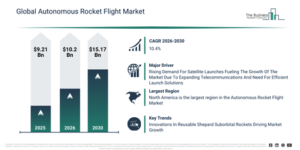
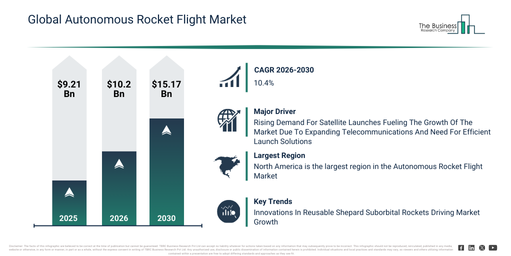
The autonomous rocket flight market size has witnessed significant expansion in recent years. It is projected to grow from $9.21 billion in 2025 to $10.2 billion in 2026, achieving a compound annual growth rate (CAGR) of 10.7%. Historically, this growth can be ascribed to several developments, such as the introduction of early autonomous navigation and guidance systems for rockets, the adoption of onboard control units vital for flight stability, the implementation of automated launch operations designed to lessen human intervention, the integration of propulsion modules equipped with autonomous control capabilities, and the increasing reliance on AI-powered flight software for precise trajectory adjustments and mission execution.
The market for autonomous rocket flight is anticipated to experience significant expansion over the coming years. This sector is projected to reach a valuation of $15.17 billion by 2030, demonstrating a compound annual growth rate (CAGR) of 10.4%. Factors contributing to this growth during the forecast period include an increasing need for completely autonomous rockets equipped with sophisticated in-flight decision-making capabilities, the proliferation of autonomous landing and recovery solutions, the growing integration of AI for payload deployment and mission optimization, an emphasis on developing modular and scalable autonomous rocket frameworks, and heightened acquisition for both commercial space ventures and defense purposes. Key trends anticipated during the forecast encompass the spread of reusable autonomous launch vehicles, the development of automated trajectory correction systems, a greater embrace of precision autonomous landing technologies, ongoing improvements in autonomous in-flight decision-making, and an escalating demand for autonomous payload deployment mechanisms.
Download A Free Sample Report For Comprehensive Market Insights:
#Autonomous Rocket Flight Market Growth Drivers And Industry Catalysts
The increasing need for satellite deployment is anticipated to fuel the expansion of the autonomous rocket flight market in the future. Satellite launches involve the act of deploying artificial satellites into space via rockets, positioning them in specific orbits for functions like communication, navigation, or scientific exploration. This rising demand for satellite launches stems from broader applications in telecommunications, as satellites facilitate extensive and worldwide communication capabilities, particularly in isolated or poorly served areas lacking sufficient ground-based infrastructure. Autonomous rocket flight assists satellite launches by ensuring accurate, efficient, and economical placement of satellites into orbit, achieved through live trajectory modifications and less human involvement. For example, data from July 2024, as per the Foreign Policy Research Institute, a US-based non-profit think tank, indicates Russia’s goal to enlarge its satellite network from approximately 160 satellites in 2023 to 1,000 satellites by 2030. Consequently, the heightened demand for satellite deployments is a significant impetus behind the expansion of the autonomous rocket flight market.
Autonomous Rocket Flight Market Segment Outlook: Which Categories Are Expanding The Fastest?
The autonomous rocket flight market covered in this report is segmented –
1) By Component: Hardware, Software, Services
2) By Application: Commercial, Military, Research And Development, Space Exploration, Other Applications
3) By End-User: Aerospace, Defense, Space Agencies, Other Users
Subsegments:
1) By Hardware: Navigation And Guidance Systems, Propulsion Systems, Sensors And Cameras, Communication Modules, Onboard Computers And Processors, Actuators And Control Systems
2) By Software: Flight Control Software, Autonomous Navigation Algorithms, Mission Planning Software, Data Processing And Analytics Software, Simulation And Testing Software
3) By Services: Launch And Flight Support Services, Maintenance And Repair Services, Software Update And Integration Services, Consulting And System Integration Services, Training And Technical Support Services
Autonomous Rocket Flight Market Trends: What Is Shaping Future Industry Growth?
Leading companies in the autonomous rocket flight market are concentrating on developing technologically advanced solutions, such as reusable Shepard suborbital rockets, to decrease launch expenses and boost flight frequency for commercial space operations. A reusable Shepard suborbital rocket is defined as a fully autonomous vehicle, designed for vertical launch and landing, and engineered to perform multiple suborbital missions with the same hardware, enhancing cost-efficiency and sustainability in spaceflight. For example, in May 2025, Blue Origin Enterprises L.P., a US-based space technology company, successfully launched six people on its New Shepard suborbital rocket for the NS-32 mission. The rocket system, which runs on a BE-3PM engine using liquid hydrogen and oxygen, is constructed to have minimal environmental impact, expelling only water vapor. This entirely autonomous, single-stage reusable rocket carried six civilian passengers in the RSS First Step crew capsule, reaching an altitude just beyond the Kármán Line (100 km), thereby officially entering space. The booster executed a precise vertical landing, while the capsule returned safely using parachutes and retro-thrust cushioning.
Autonomous Rocket Flight Market Key Companies And Competitive Benchmarking
Major companies operating in the autonomous rocket flight market are Space Exploration Technologies Corp., Blue Origin Enterprises L.P., Rocket Lab USA Inc., Relativity Space Inc., Firefly Aerospace Inc., Aevum Inc., Stoke Space Technologies Inc., Deep Blue Aerospace Co. Ltd., Virgin Orbit Inc., The Exploration Company GmbH, Isar Aerospace Technologies GmbH, Stratolaunch LLC, ABL Space Systems Inc., Astrobotic Technology Inc., Elecnor Deimos S.L.U., LandSpace Technology Corporation, iRocket Space Systems Inc., Exos Aerospace Systems & Technologies Inc., SpaceWalker Inc., Payload Aerospace S.L.
Access The Complete Autonomous Rocket Flight Market Report:
Autonomous Rocket Flight Market Regional Analysis: Which Region Leads By Revenue?
North America was the largest region in the autonomous rocket flight market in 2025. The regions covered in the autonomous rocket flight market report are Asia-Pacific, South East Asia, Western Europe, Eastern Europe, North America, South America, Middle East, Africa.
Access a Customized Autonomous Rocket Flight Market Report for Deeper Competitive Insights
https://www.thebusinessresearchcompany.com/customise?id=25235&type=smp
Get in touch with us:
The Business Research Company: https://www.thebusinessresearchcompany.com/
Americas: +1 310-496-7795
Asia: +44 7882 955267 & +91 8897263534
Europe: +44 7882 955267
Email us at: marketing@tbrc.info
Follow us on:
LinkedIn: https://in.linkedin.com/company/the-business-research-company
YouTube: https://www.youtube.com/channel/UC24_fI0rV8cR5DxlCpgmyFQ
Global Market Model: https://www.thebusinessresearchcompany.com/global-market-model

Wasay has over a decade of experience in market research, data modelling, and analytics, with prior experience at GlobalData and Decision Tree Consulting Services. At The Business Research Company , he leads research operations across syndicated studies, customized consulting engagements, and the Global Market Model platform. His professional experience includes supporting organizations such as Boston Consulting Group, KPMG, and Ernst & Young. Wasay holds a degree in Electronics and Communications Engineering, postgraduate management qualifications from International Management Institute Belgium and Indian School of Business and Entrepreneurship, and completed the Integrated Program in Business Analytics from Indian Institute of Management Indore.