
Through market attractiveness analysis, total addressable market evaluation, company benchmarking matrices, interactive Excel dashboards, expanded supply chain intelligence, emerging startup coverage, and detailed product insights, The Business Research Company’s 2026 market reports provide more actionable and strategically valuable research.
Ballistic Protection Market Growth Analysis: How Will Revenue Expand During The Forecast Period?
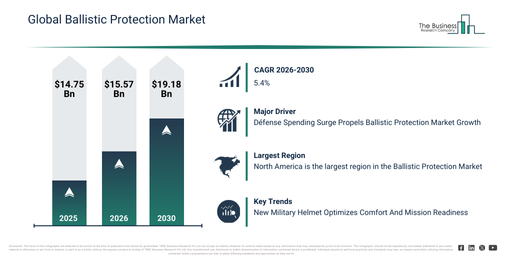
The ballistic protection market has seen substantial growth in recent years. It is anticipated to expand from $14.75 billion in 2025 to $15.57 billion in 2026, registering a compound annual growth rate (CAGR) of 5.5%. This historical rise can be attributed to increased worldwide military and law enforcement activities, which fuel demand for body armor; a rise in insurgency and terrorism incidents, boosting the adoption of ballistic vests and shields; developments in lightweight composite materials, enhancing the efficacy of protective gear; the expansion of domestic armor production facilities across emerging economies; and more rigorous safety standards for protective equipment, leading to higher procurement volumes.
The ballistic protection market size is projected to experience substantial expansion over the upcoming years. This market is anticipated to reach $19.18 billion by 2030, exhibiting a compound annual growth rate (CAGR) of 5.4%. This expansion during the forecast period is fueled by several factors, including the increasing creation of next-generation soft and hard armor that incorporates advanced materials, a heightened need for adaptive and user-friendly protective gear suited for diverse operational requirements, a sharper emphasis on safeguarding against high-speed and multiple-threat projectiles, the growth of civilian security and private defense industries that necessitate ballistic protection items, and ongoing advancements in nanotechnology and fiber engineering that enhance ballistic resistance. Key trends anticipated during this period involve an increasing appetite for lightweight and adaptable armor, a greater emphasis on comprehensive multi-threat defense, the integration of sophisticated composite materials, an expanded application of vehicle armor for urban safety, and the emergence of quick-prototyping and personalized armor options.
Download A Free Sample Report For Comprehensive Market Insights:
Ballistic Protection Market Development Factors: Which Trends Are Supporting Demand?
Increasing government spending on defense is anticipated to drive the expansion of the ballistic protection market in the future. This expenditure involves funds governments dedicate to military objectives, including the upkeep and modernization of armed forces, the creation of new weaponry and technologies, and covering operational expenses. Such funding enables the advancement of lightweight, comfortable, and robust materials, which are crucial for manufacturing effective ballistic protection gear. For example, data from the UK Parliament’s House of Commons Library, a UK government body, indicates that defense spending detailed in the 2025 Spending Review is projected to reach USD 83.3 billion (£62.2 billion) in 2025/26, subsequently rising to USD 98.2 billion (£73.5 billion) by 2028/29. This represents an average annual real-terms growth rate of 3.8% throughout this timeframe. Consequently, the increase in defense expenditure is a key factor boosting the expansion of the ballistic protection market.
Ballistic Protection Market Segments: Where Are The Largest Growth Opportunities?
The ballistic protection market covered in this report is segmented –
1) By Product Type: Personal Protection Equipment, Vehicle Protection Equipment
2) By Material: Aramid, Carbon Fiber Composites, Glass Fiber And Thermoplastic, Ceramic, Other Materials
3) By Platform: Land, Airborne, Marine
4) By Application: Defense, Homeland Security, Commercial, Other Applications
Subsegments:
1) By Personal Protection Equipment: Body Armor, Helmets, Shields, Protective Clothing
2) By Vehicle Protection Equipment: Armored Vehicles, Ballistic Glass, Blast-Resistant Materials, Armor Kits
#Ballistic Protection Market Trends Influencing Long-Term Demand
Major enterprises within the ballistic protection sector are prioritizing the creation of advanced products, such as next-generation combat helmets, to enhance soldier agility and safety in contemporary warfare scenarios. These next-generation combat helmets are characterized by their light weight and modular design, offering superior protection, comfort, and flexibility through the integration of accessory mounts, sophisticated liners, and adjustable sizing, which enables soldiers to move with greater ease, carry specialized equipment, and sustain high levels of protection without succumbing to fatigue. For instance, in October 2025, Galvion Inc., a U.S.-based defense technology firm, introduced the Batlskin Caiman UL, an exceptionally light next-generation combat helmet engineered to deliver optimal ballistic protection while significantly reducing mass and bulk. This helmet integrates Galvion’s sophisticated APEX liner system, an updated harness, and a modular 3-hole shroud, all meticulously designed to enhance fit, stability, and compatibility with night vision and other vital mission equipment. Developed over seven years with input from special operations teams, the Caiman UL addresses practical issues such as extended wear, demanding maneuvers, and the integration of head-mounted devices, ensuring a stable and comfortable fit even in extreme environments. Its streamlined shroud features rubber bumpers to prevent noise, multiple integrated anchor points for secure bungee storage and paracord routing, and an interchangeable metal shroud plate to support various night vision goggles and future attachments.
#Ballistic Protection Market Industry Leaders: Which Organizations Are Driving Competition?
Major companies operating in the ballistic protection market are Avon Protection plc ., BAE Systems plc, DuPont de Nemours Inc., Honeywell International Inc., Point Blank Enterprises Inc., Rheinmetall AG, Saab AB, Koninklijke Ten Cate BV, Teijin Limited, Survitec Group Limited, ArmorWorks Enterprises LLC, Revision Military Inc., ArmorSource LLC, MKU Limited, GENTEX Corporation, Tencate Advanced Armor, Ceradyne Inc., Craig International Ballistics Pty Ltd, EnGarde Body Armor, Safariland LLC, Blackhawk Industries Inc., Armor Express, Ballistic Body Armor Pty Ltd, C.P.E. Production Oy, CQC Limited, DMS Group, Eagle Industries SAS, Hellweg International, HighCom Security Inc., International Armored Group
Access The Complete Ballistic Protection Market Report:
Ballistic Protection Market Regional Distribution: Which Areas Drive Market Expansion?
North America was the largest region in the ballistic protection market in 2025.Asia-Pacific is expected to be the fastest-growing region in the global ballistic protection market report during the forecast period. The regions covered in the ballistic protection market report are Asia-Pacific, South East Asia, Western Europe, Eastern Europe, North America, South America, Middle East, Africa.
Access a Customized Ballistic Protection Market Report for Deeper Competitive Insights
https://www.thebusinessresearchcompany.com/customise?id=10109&type=smp
Get in touch with us:
The Business Research Company: https://www.thebusinessresearchcompany.com/
Americas: +1 310-496-7795
Asia: +44 7882 955267 & +91 8897263534
Europe: +44 7882 955267
Email us at: marketing@tbrc.info
Follow us on:
LinkedIn: https://in.linkedin.com/company/the-business-research-company
YouTube: https://www.youtube.com/channel/UC24_fI0rV8cR5DxlCpgmyFQ
Global Market Model: https://www.thebusinessresearchcompany.com/global-market-model

Wasay has over a decade of experience in market research, data modelling, and analytics, with prior experience at GlobalData and Decision Tree Consulting Services. At The Business Research Company , he leads research operations across syndicated studies, customized consulting engagements, and the Global Market Model platform. His professional experience includes supporting organizations such as Boston Consulting Group, KPMG, and Ernst & Young. Wasay holds a degree in Electronics and Communications Engineering, postgraduate management qualifications from International Management Institute Belgium and Indian School of Business and Entrepreneurship, and completed the Integrated Program in Business Analytics from Indian Institute of Management Indore.
