The Business Research Company’s 2026 market reports are designed to deliver research that is more actionable and strategically valuable. Key offerings include market attractiveness scoring, total addressable market sizing, company benchmarking matrices, interactive Excel dashboards, deeper supply chain intelligence, emerging startup tracking, and granular product-level insights.
Ballistic Protective Gear Market Historical Growth Vs. Forecast Growth: How Do The Numbers Compare?
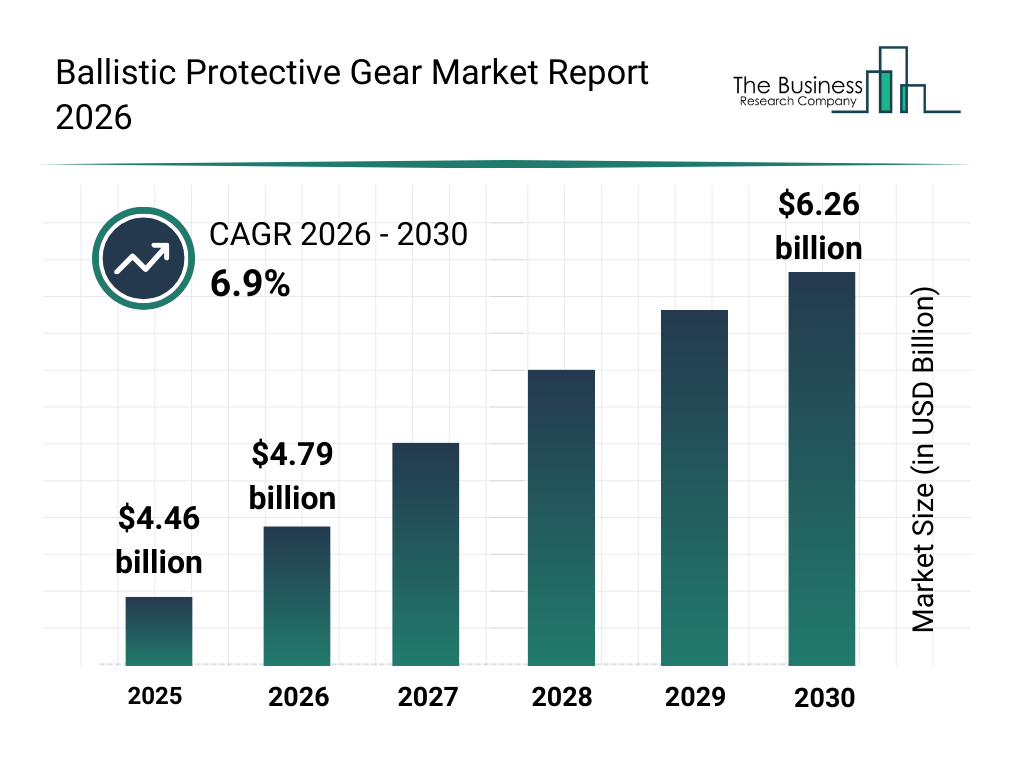
In recent years, the ballistic protective gear market size has experienced strong growth. It is projected to expand from $4.46 billion in 2025 to $4.79 billion in 2026, at a compound annual growth rate (CAGR) of 7.4%. This past growth is attributable to various factors, such as the adoption of bullet-resistant vests and plate carriers within military and law enforcement sectors, the advancement of ballistic helmets for head protection, an increase in the use of face shields to protect against fragments and shrapnel, the deployment of tactical gloves for hand protection during operations, and the implementation of specialized tactical boots for improved mobility and safety.
The ballistic protective gear market is projected to experience significant expansion in the coming years. It is anticipated to reach $6.26 billion in 2030, demonstrating a compound annual growth rate (CAGR) of 6.9%. This growth during the forecast period is attributable to an increasing need for lightweight and high-performance ballistic materials, the expansion of modular and multi-threat protective equipment, the rising integration of smart sensors and wearable technology into ballistic gear, a focus on ergonomic and mission-specific protective designs, and heightened procurement for defense, law enforcement, and high-risk security applications. Key trends expected in this period include a growing demand for lightweight and high-strength ballistic materials, an increasing adoption of modular and customizable protective gear, wider use of multi-threat protective solutions, the incorporation of communication and situational-awareness features into equipment, and an expanding civilian and private security market for personal protection.
Start With A Free Sample Of The Ballistic Protective Gear Market Research Report:
The Leading Growth Driver In The Ballistic Protective Gear Market Explained
The increasing occurrence of terrorism is anticipated to stimulate the expansion of the ballistic protective gear market in the future. Terrorism is defined as the unlawful application of violence or threats, particularly targeting civilians, to achieve political, religious, or ideological aims. The growing incidence of terrorism largely stems from a combination of political instability, as factors like weak governance, power vacuums, and civil unrest create environments where extremist groups can flourish and attract supporters. Ballistic protective gear improves the effectiveness of counter-terrorism operations by shielding security personnel from gunfire, explosions, and other ballistic threats during high-risk missions, thereby boosting their survivability, maintaining operational readiness, and enabling them to respond more confidently and efficiently in hostile environments. For instance, in February 2024, a report published by the Institute for Economics and Peace, an Australia-based think tank, revealed that in 2023, global deaths from terrorism increased to 8,352, representing a 22 % rise compared with the preceding year. Consequently, the rising prevalence of terrorism fuels the growth of the ballistic protective gear market.
Key Segments Shaping The Ballistic Protective Gear Market Landscape
The ballistic protective gear market covered in this report is segmented –
1) By Type: Body Armor, Head Protection, Shields
2) By Material Type: Kevlar, Ultra High Molecular Weight Polyethylene (UHMWPE), Ceramics, Steel, Composite Materials
3) By Distribution Channel: Online Retailing, Direct Sales, Third-Party Distributors, Specialty Stores, Government Procurement
4) By Application Area: Combat Operations, Crowd Control, Surveillance and Protection, Transportation Security, Sports and Recreation
5) By End User: Military, Law Enforcement, Private Security, Civilians, Industrial Workers
Subsegments:
1) By Body Armor: Soft Body Armor, Hard Body Armor, Concealable Vests, Tactical Vests, Plate Carriers
2) By Head Protection: Ballistic Helmets, Visors And Face Shields, Communication-Integrated Helmets, Modular Helmet Systems
3) By Shields: Handheld Ballistic Shields, Wheeled Ballistic Shields, Transparent Ballistic Shields, Foldable Or Collapsible Shields
Ballistic Protective Gear Market Trend Spotlight: Key Shifts Shaping Future Demand
Major companies operating in the ballistic protective gear market are concentrating on developing innovative products, such as high-cut, lightweight ballistic helmets, aiming to enhance operational flexibility, user comfort, and safety. These specialized helmets feature elevated ear sections, constructed from light ballistic materials such as aramid fibers or polyethylene. Their purpose is to lessen head burden while offering ballistic defense and facilitating integration with communication and tactical gear, thereby boosting maneuverability and situational understanding during critical missions. As an example, in March 2024, US-based ballistic protection provider Premier Body Armor, LLC introduced the Fortis Ballistic Helmet, a high-cut Level IIIA helmet that weighs merely 2.8 lbs. This helmet incorporates a modular rail system, enabling effortless compatibility with night vision devices, communication headsets, and tactical accessories, thereby making it exceptionally versatile for various mission requirements. Its advanced moisture-wicking liner and adaptable suspension system guarantee optimal comfort and a stable fit even during extended wear. Engineered to surpass international protection standards, this helmet offers top-tier performance at an accessible price point, establishing a new standard for protective headgear.
Ballistic Protective Gear Market Competitive Analysis: Who Are The Main Competitors?
Major companies operating in the ballistic protective gear market are BAE Systems plc, Safariland LLC, Point Blank Enterprises Inc., Australian Defence Apparel Pty Ltd., MKU Limited, U.S. Armor Corporation, Mehler Vario System GmbH, VestGuard UK Limited, HardShell FZE, MARS Armor Ltd., Indian Armour Systems Pvt. Ltd., Armored Republic LLC, Ningbo Dacheng Machine Tool Manufacturing Co. Ltd., Ballistic Body Armour, Premier Body Armor LLC, Anorak Hellas Ltd., MC Armor, Sarkar Tactical India Private Limited, PGD Body Armor, SMPP Limited
Find The Complete Ballistic Protective Gear Market Outlook In The Full Report:
Mapping The Ballistic Protective Gear Market: Regional Leadership And Global Reach
North America was the largest region in the ballistic protective gear market in 2025. Asia-Pacific is expected to be the fastest-growing region in the forecast period. The regions covered in the ballistic protective gear market report are Asia-Pacific, South East Asia, Western Europe, Eastern Europe, North America, South America, Middle East, Africa.
Reach Out To Our Team:
The Business Research Company: https://www.thebusinessresearchcompany.com/
Americas: +1 310-496-7795
Asia: +44 7882 955267 & +91 8897263534
Europe: +44 7882 955267
Email us at: marketing@tbrc.info
Follow us on:
LinkedIn: https://in.linkedin.com/company/the-business-research-company
YouTube: https://www.youtube.com/channel/UC24_fI0rV8cR5DxlCpgmyFQ
Global Market Model: https://www.thebusinessresearchcompany.com/global-market-model

Wasay has over a decade of experience in market research, data modelling, and analytics, with prior experience at GlobalData and Decision Tree Consulting Services. At The Business Research Company , he leads research operations across syndicated studies, customized consulting engagements, and the Global Market Model platform. His professional experience includes supporting organizations such as Boston Consulting Group, KPMG, and Ernst & Young. Wasay holds a degree in Electronics and Communications Engineering, postgraduate management qualifications from International Management Institute Belgium and Indian School of Business and Entrepreneurship, and completed the Integrated Program in Business Analytics from Indian Institute of Management Indore.