
The Business Research Company’s 2026 market reports are designed to deliver research that is more actionable and strategically valuable. Key offerings include market attractiveness scoring, total addressable market sizing, company benchmarking matrices, interactive Excel dashboards, deeper supply chain intelligence, emerging startup tracking, and granular product-level insights.
Which Factors Will Shape The Big Data Analytics In Defense And Aerospace Market Size Through 2030?
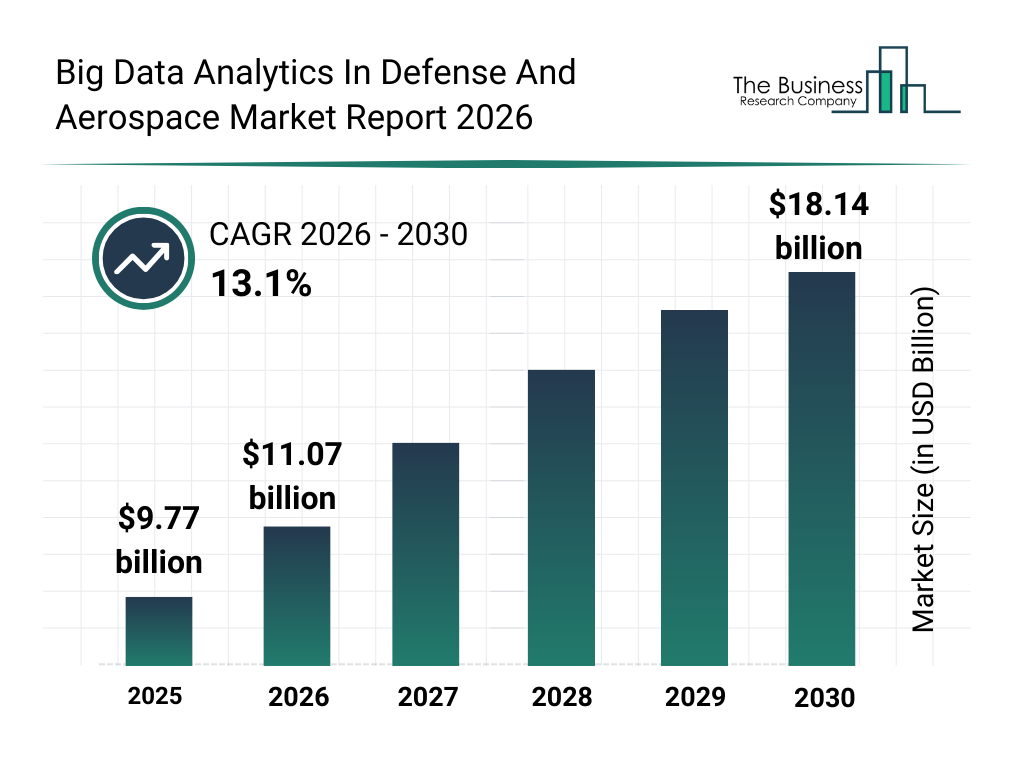
The big data analytics in defense and aerospace market has experienced substantial expansion in recent years. It is projected to grow from $9.77 billion in 2025 to $11.07 billion in 2026, demonstrating a compound annual growth rate (CAGR) of 13.3%. The growth observed in prior periods can be attributed to the adoption of integrated data management platforms, an increase in predictive maintenance analytics, the use of threat and risk analysis systems, the deployment of real-time operational intelligence tools, and the implementation of multi-source data acquisition.
The big data analytics in defense and aerospace market is projected to experience substantial expansion over the coming years. This market is forecasted to reach $18.14 billion by 2030, exhibiting a compound annual growth rate (CAGR) of 13.1%. Factors contributing to this growth during the forecast period include the increasing adoption of AI-driven predictive threat analytics, the integration with autonomous defense systems, the rise of edge computing for quick battlefield insights, the wider use of cloud-based analytics platforms, and the development of intelligent mission planning solutions. Key trends anticipated in the same period involve a heightened demand for real-time battlefield analytics, an expansion of predictive maintenance specifically for aerospace platforms, the integration of multi-domain command and control systems, advancements in sensor fusion and sophisticated data acquisition, and an increasing embrace of secure defense data-sharing frameworks.
Request A Free Big Data Analytics In Defense And Aerospace Market Sample To Support Your Strategic Planning:
What Is Propelling The Big Data Analytics In Defense And Aerospace Market Toward $18.14 Billion By 2030?
Growing defense expenditures are anticipated to boost the expansion of big data analytics within the defense and aerospace market. These budgets represent the monetary resources governments allocate for military activities, staffing, purchasing equipment, research and development, and various national security initiatives. Their increase is primarily fueled by escalating geopolitical conflicts and the imperative to modernize military forces, with countries increasingly investing in cutting-edge technologies to address emerging security challenges and secure strategic dominance in disputed areas. Greater defense funding allows military organizations to acquire advanced data analytics systems, thereby improving operational intelligence, strengthening strategic decision-making, and streamlining mission planning by processing extensive security and surveillance data. For example, data from the Committee for a Responsible Federal Budget, a US-based nonpartisan organization, indicates a rapid rise in global defense spending, hitting an unprecedented $2,718 billion in 2024, reflecting a 9.4% real-term increase over 2023. Consequently, the expansion of defense budgets is a key factor propelling the development of big data analytics in the defense and aerospace market.
What Are The Key Segments And Subsegments In The Big Data Analytics In Defense And Aerospace Market?
The big data analytics in defense and aerospace market covered in this report is segmented –
1) By Component: Software, Hardware, Services
2) By Deployment Type: On-Premises, Cloud-Based
3) By Application: Military, Aerospace, Defense Intelligence, Cybersecurity, Weapon Systems
4) By End-User: Defense Contractors, Government Agencies, Aerospace Manufacturers, Research Institutions, Private Contractors
Subsegments:
1) By Software: Predictive Analytics Software, Artificial Intelligence (AI) Software, Machine Learning (ML) Software, Simulation And Modeling Software, Data Visualization Software, Command, Control, Communications, Computers, Intelligence, Surveillance, And Reconnaissance (C4ISR) Software
2) By Hardware: High-Performance Computing (HPC) Systems, Servers, Sensors, Drones Or Unmanned Aerial Vehicles (UAVs), Radar And Surveillance Systems, Networking Equipment
3) By Services: System Integration Services, Consulting And Advisory Services, Managed Services, Training And Support Services, Implementation And Deployment Services
Big Data Analytics In Defense And Aerospace Market Trends Behind The 13.1% CAGR Forecast
Leading firms within the big data analytics in the defense and aerospace market are prioritizing the creation of sophisticated solutions, including fifth-generation collaborative combat aircraft, to facilitate unified, data-centric operations across airborne, terrestrial, and maritime environments. Such an aircraft represents a highly advanced fighter jet, incorporating stealth capabilities, superior agility, and integrated sensor systems. It can share real-time data with other assets, enabling synchronized, network-centric operations for improved situational awareness and accuracy on the battlefield. For example, in September 2025, Lockheed Martin Skunk Works, an aerospace firm based in the US, introduced the Vectis drone. This drone is classified as a Group 5 collaborative combat aircraft, engineered for autonomous operation alongside fighter jets such as the F-35 and other next-generation aircraft. Its capabilities span precision strike missions, electronic warfare, intelligence, surveillance, and reconnaissance (ISR), as well as both offensive and defensive counter-air tasks. The Vectis drone prioritizes survivability, agility, and cost-effectiveness, with the goal of supporting multi-domain operations and offering extended reach for deployments in the Indo-Pacific, European, and Middle Eastern regions.
Major Companies Profiled In The Big Data Analytics In Defense And Aerospace Market Report
Major companies operating in the big data analytics in defense and aerospace market are Google LLC, Microsoft Corporation, Amazon Web Services Inc, The Boeing Company, Airbus SE, Lockheed Martin Corporation, RTX Corporation, Accenture plc, International Business Machines Corporation, Cisco Systems Inc, Oracle Corporation, General Dynamics Corporation, Northrop Grumman Corporation, BAE Systems plc, Hewlett Packard Enterprise Company, Thales Group, Saab AB, SAS Institute Inc, Palantir Technologies Inc, Teradata Corporation
Explore The Business Research Company’s Complete Big Data Analytics In Defense And Aerospace Market Report:
Where Does The Big Data Analytics In Defense And Aerospace Market Generate The Most Revenue?
North America was the largest region in the big data analytics in the defense and aerospace market in 2025. Asia-Pacific is expected to be the fastest-growing region in the forecast period. The regions covered in the big data analytics in defense and aerospace market report are Asia-Pacific, South East Asia, Western Europe, Eastern Europe, North America, South America, Middle East, Africa.
Reach Out To Our Team:
The Business Research Company: https://www.thebusinessresearchcompany.com/
Americas: +1 310-496-7795
Asia: +44 7882 955267 & +91 8897263534
Europe: +44 7882 955267
Email us at: marketing@tbrc.info
Follow us on:
LinkedIn: https://in.linkedin.com/company/the-business-research-company
YouTube: https://www.youtube.com/channel/UC24_fI0rV8cR5DxlCpgmyFQ
Global Market Model: https://www.thebusinessresearchcompany.com/global-market-model

Wasay has over a decade of experience in market research, data modelling, and analytics, with prior experience at GlobalData and Decision Tree Consulting Services. At The Business Research Company , he leads research operations across syndicated studies, customized consulting engagements, and the Global Market Model platform. His professional experience includes supporting organizations such as Boston Consulting Group, KPMG, and Ernst & Young. Wasay holds a degree in Electronics and Communications Engineering, postgraduate management qualifications from International Management Institute Belgium and Indian School of Business and Entrepreneurship, and completed the Integrated Program in Business Analytics from Indian Institute of Management Indore.

