Enhanced with market attractiveness analysis, total addressable market evaluation, company benchmarking matrices, interactive Excel dashboards, expanded supply chain intelligence, emerging startup coverage, and detailed product insights, The Business Research Company’s 2026 market reports deliver more actionable and strategically valuable research.
Carbon Fiber Composites In Aerospace Market Expected To Reach $4.37 Billion By 2030 At 8.44% CAGR
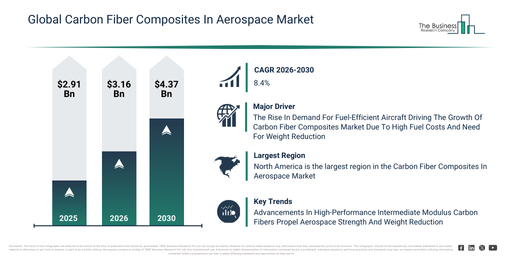
The carbon fiber composites in aerospace market has experienced significant growth in recent years. It is expected to increase from $2.91 billion in 2025 to $3.16 billion in 2026, achieving a compound annual growth rate (CAGR) of 8.6%. This historical expansion can be attributed to the widespread use of carbon fiber reinforced polymer panels for producing lightweight aircraft structures, the advancement of carbon fiber tow and prepregs for advanced manufacturing techniques, the growing application of composite structural components to enhance durability, the incorporation of carbon fiber composite engine parts for improved performance, and the implementation of interior aerospace components constructed from carbon fiber composites.
The carbon fiber composites in aerospace market is anticipated to experience substantial expansion over the coming years. This market is projected to reach $4.37 billion by 2030, exhibiting a compound annual growth rate (CAGR) of 8.4%. This anticipated growth stems from several factors, including the increasing need for robust, lightweight carbon fiber composites in new aircraft designs, the wider integration of these composites into engine and propulsion systems, the growing use of automated and additive manufacturing for composite components, an emphasis on aerospace parts that resist corrosion and fatigue, and increased purchasing for commercial, military, and space aerospace initiatives. Key developments during this period are expected to include a growing move towards lighter aircraft constructions, greater use of high-temperature composites in aerospace engines, an escalating requirement for corrosion-resistant materials in space applications, broadened deployment of composites in advanced UAV platforms, and stricter fatigue performance demands for cutting-edge aerospace designs.
Download A Free Sample Report For Comprehensive Market Insights:
Carbon Fiber Composites In Aerospace Market Expansion Drivers: What Is Shaping Future Growth?
The growing need for aircraft that conserve fuel is anticipated to boost the expansion of carbon fiber composites within the aerospace market. These aircraft are defined as planes engineered to consume less fuel per unit of distance or passenger, commonly achieved via sophisticated aerodynamics, light materials, and high-efficiency engines. This increased demand for fuel-efficient aircraft stems from escalating environmental concerns, pushing airlines to pursue reduced carbon emissions and adhere to more stringent international rules. Within aerospace, carbon fiber composites play a crucial role in boosting fuel efficiency by decreasing aircraft mass without compromising strength and durability, which in turn leads to less fuel usage and fewer emissions. For instance, in September 2025, the Bureau of Transportation Statistics, a US-based government agency, reported U.S. airlines’ July 2025 fuel cost and consumption figures. These indicated that U.S. scheduled service airlines consumed 1.760 billion gallons of fuel, which was 4.3% more fuel than in June 2025 (1.688 billion gallons) and 1.6% more fuel than July 2024 (1.734 billion gallons). Consequently, the increasing need for fuel-efficient aircraft is propelling the market for carbon fiber composites in the aerospace sector.
Carbon Fiber Composites In Aerospace Market Segment Analysis: What Are The Major Market Categories?
The carbon fiber composites in aerospace market covered in this report is segmented –
1) By Type Of Carbon Fiber Composite: Polymer Matrix Composites, Ceramic Matrix Composites, Metal Matrix Composites
2) By Manufacturing Process: Hand Lay-Up, Spray-Up, Resin Transfer Molding (RTM), Filament Winding
3) By Application: Aircraft Structures, Aerospace Components, Spacecraft
4) By End-User: Commercial Aviation, Military Aviation, Space Exploration, Unmanned Aerial Vehicles
Subsegments:
1) By Polymer Matrix Composites: Epoxy-Based Carbon Fiber Composites, Thermoplastic Carbon Fiber Composites, Phenolic-Based Carbon Fiber Composites, Polyester-Based Carbon Fiber Composites
2) By Ceramic Matrix Composites: Carbon Or Carbon Composites, Carbo Or Silicon Carbide Composites, Silicon Carbide Or Silicon Carbide Composites
3) By Metal Matrix Composites: Aluminum-Based Carbon Fiber Composites, Titanium-Based Carbon Fiber Composites, Magnesium-Based Carbon Fiber Composites
Carbon Fiber Composites In Aerospace Market Growth Trends Influencing Competitive Dynamics
Leading companies in the carbon fiber composites in the aerospace market are concentrating on creating innovative products, such as high-performance intermediate modulus (IM) carbon fibers, to boost strength and decrease weight. These high-performance intermediate modulus (IM) carbon fibers are lightweight, robust fibers that offer a balanced stiffness and tensile strength, optimized for aerospace applications where enhanced durability and mass reduction are crucial. For example, in March 2024, Hexcel Corporation, a US-based aerospace and defense company, launched the HexTow IM9 24K carbon fiber. This advanced composite material, incorporating 24,000 filaments, provides an average tensile strength exceeding 6,300 MPa, a modulus of 298 GPa, and a strain of 1.9%, markedly surpassing prior standards like IM7. Developed for high-rate manufacturing and challenging aerospace uses, the IM9 24K delivers a 12% improvement in tensile strength and increased productivity thanks to its larger tow size.
Carbon Fiber Composites In Aerospace Market Leading Companies: Who Holds Significant Market Presence?
Major companies operating in the carbon fiber composites in aerospace market are Mitsubishi Chemical Group, Toray Industries Inc., Solvay S.A., DuPont de Nemours Inc., Formosa Plastics Corporation, TEIJIN LIMITED, Hexcel Corporation, SGL Carbon, Zoltek Companies Inc., BGF Industries Inc, Bally Ribbon Mills, A&P Technology Inc., FDC Composites Inc., Hyosung Advanced Materials, Clearwater Composites LLC, Kineco Limited, DowAksa, Creedx Composites, Epsilon Composite, Jiangsu Hengshen Co. Ltd.
Access The Complete Carbon Fiber Composites In Aerospace Market Report:
Carbon Fiber Composites In Aerospace Market Regional Analysis And Leading Geography
North America was the largest region in the carbon fiber composites in aerospace market in 2025. Asia-Pacific is expected to be the fastest-growing region in the forecast period. The regions covered in the carbon fiber composites in aerospace market report are Asia-Pacific, South East Asia, Western Europe, Eastern Europe, North America, South America, Middle East, Africa.
Access a Customized Carbon Fiber Composites In Aerospace Market Report for Deeper Competitive Insights
https://www.thebusinessresearchcompany.com/customise?id=25254&type=smp
Get in touch with us:
The Business Research Company: https://www.thebusinessresearchcompany.com/
Americas: +1 310-496-7795
Asia: +44 7882 955267 & +91 8897263534
Europe: +44 7882 955267
Email us at: marketing@tbrc.info
Follow us on:
LinkedIn: https://in.linkedin.com/company/the-business-research-company
YouTube: https://www.youtube.com/channel/UC24_fI0rV8cR5DxlCpgmyFQ
Global Market Model: https://www.thebusinessresearchcompany.com/global-market-model

Wasay has over a decade of experience in market research, data modelling, and analytics, with prior experience at GlobalData and Decision Tree Consulting Services. At The Business Research Company , he leads research operations across syndicated studies, customized consulting engagements, and the Global Market Model platform. His professional experience includes supporting organizations such as Boston Consulting Group, KPMG, and Ernst & Young. Wasay holds a degree in Electronics and Communications Engineering, postgraduate management qualifications from International Management Institute Belgium and Indian School of Business and Entrepreneurship, and completed the Integrated Program in Business Analytics from Indian Institute of Management Indore.