
The Business Research Company’s 2026 market reports are designed to deliver research that is more actionable and strategically valuable. Key offerings include market attractiveness scoring, total addressable market sizing, company benchmarking matrices, interactive Excel dashboards, deeper supply chain intelligence, emerging startup tracking, and granular product-level insights.
Chem-Bio Protective Aircraft Filter Market Historical Growth Vs. Forecast Growth: How Do The Numbers Compare?
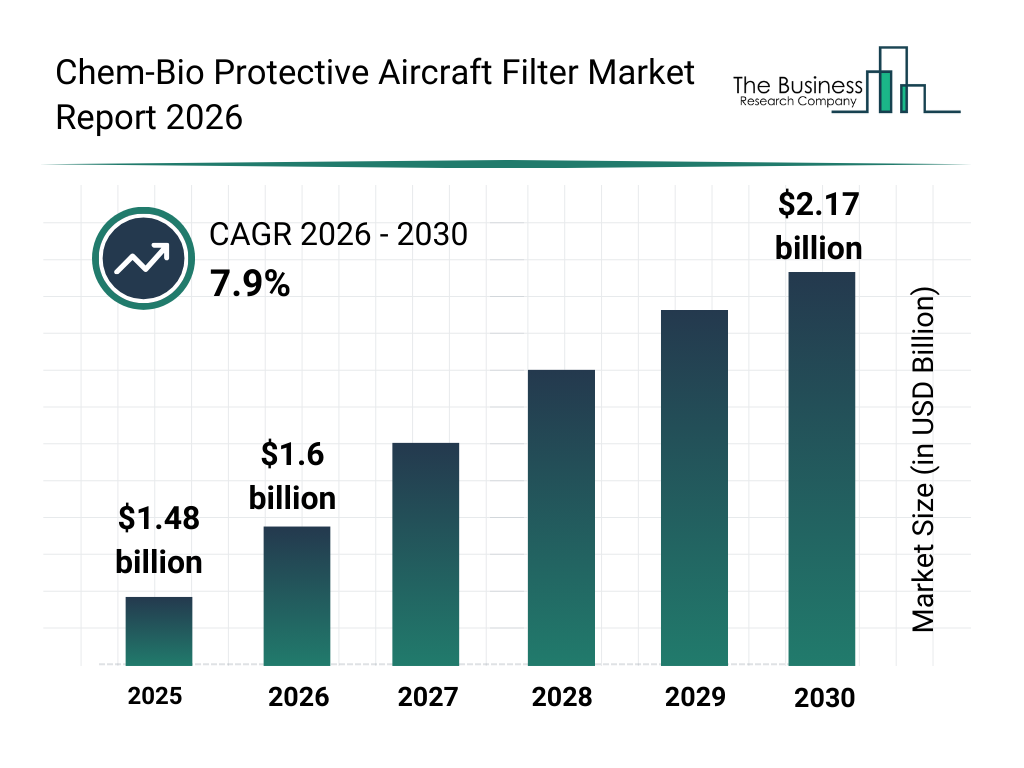
The chem-bio protective aircraft filter market has experienced robust expansion over recent years. Forecasts indicate that its valuation will rise from $1.48 billion in 2025 to $1.6 billion in 2026, demonstrating a compound annual growth rate (CAGR) of 8.1%. This historical increase can be ascribed to several factors, including an escalating emphasis on the safety of aircraft crew and passengers, the increasing integration of advanced air filtration technologies into both military and commercial aircraft, improvements in activated carbon and high-efficiency filter substances, mandates concerning in-flight air quality and protection, and partnerships forged between aircraft producers and filter technology suppliers.
The chem-bio protective aircraft filter market is anticipated to experience substantial expansion over the coming years. By 2030, its size is projected to reach $2.17 billion, achieving a compound annual growth rate (CAGR) of 7.9%. This projected growth is driven by several factors, including the creation of multi-threat chem-bio filters for advanced aircraft, the incorporation of these systems into cabin ventilation and air monitoring setups, increasing demand from defense and special mission aircraft, a focus on filters that are lightweight, compact, and energy-efficient, and the expansion of services for maintenance, replacement, and upgrades of aircraft filtration systems. Key trends anticipated during this period involve improvements in filtration media, the adoption of modular filter systems, broadening regulatory compliance and certification, a preference for lightweight and compact filters, and an emphasis on real-time air quality monitoring.
Start With A Free Sample Of The Chem-Bio Protective Aircraft Filter Market Research Report:
The Leading Growth Driver In The Chem-Bio Protective Aircraft Filter Market Explained
The projected rise in commercial aviation activities is anticipated to foster the expansion of the chem-bio protective aircraft filter market moving forward. Commercial aviation encompasses the operation of aircraft for both passenger and cargo transport across domestic and international routes. The surge in commercial aviation primarily stems from increasing disposable incomes and expanding middle-class populations, enabling more individuals to afford air travel for business and leisure. Commercial aviation enhances the utilization of chem-bio protective aircraft filters by integrating advanced filtration systems into aircraft cabins, ensuring passenger safety from chemical and biological threats. These systems improve in-flight air quality and mitigate hazards, thereby supporting operational reliability and compliance with safety regulations. For instance, in November 2024, Eurostat, a Luxembourg-based government agency, reported that the number of air passengers transported in the EU climbed to 973 million in 2023, showing a 19.3% increase compared to 2022. Thus, the escalating commercial aviation activities are propelling the growth of the chem-bio protective aircraft filter market.
Key Segments Shaping The Chem-Bio Protective Aircraft Filter Market Landscape
The chem-bio protective aircraft filter market covered in this report is segmented –
1) By Product Type: Particulate Filters, Gas Or Vapor Filters, Combination Filters, Other Product Types
2) By Material: Activated Carbon, High Efficiency Particulate Air (HEPA), Fiberglass, Other Materials
3) By Distribution Channel: Original Equipment Manufacturer (OEM), Aftermarket
4) By Application: Military Aircraft, Commercial Aircraft, Cargo Aircraft, Other Applications
5) By End-User: Defense, Commercial Aviation, Other End-Users
Subsegments:
1) By Particulate Filters: High Efficiency Particulate Air Filters, Ultra Low Penetration Air Filters, Standard Particulate Filters: Disposable Particulate Filters
2) By Gas Or Vapor Filters: Organic Vapor Filters, Acid Gas Filters, Ammonia And Methylamine Filters, Multi Gas Filters
3) By Combination Filters: Particulate And Organic Vapor Filters, Particulate And Acid Gas Filters, Multi Gas And Particulate Filters, Specialty Combination Filters
4) By Other Product Types: Biological Agent Filters, Radiological Filters, Custom Engineered Filters, Experimental Composite Filters
Chem-Bio Protective Aircraft Filter Market Trend Spotlight: Key Shifts Shaping Future Demand
Leading companies within the chem-bio protective aircraft filter market are concentrating on developing innovative solutions, such as nanofiber-enhanced multilayer cabin filtration systems, to improve protective efficiency, hazard mitigation, and operational compatibility. These nanofiber-enhanced multilayer cabin filtration systems are advanced filters featuring ultrafine fiber layers designed to efficiently capture submicron particles, volatile compounds, allergens, and microbial threats while maintaining optimal airflow, even under varying temperature and humidity conditions. For instance, in August 2024, MANN+HUMMEL, a Germany-based manufacturer of liquid and air filter systems, launched the MANN-FILTER FreciousPlus cabin air filter, which incorporates nanofiber technology. This filter employs ultrathin nanofibers, approximately 100 times thinner than traditional fibers, forming a spider-web-like structure to capture ultra-fine particles, including PM1 and particles smaller than 0.1 micrometers, with up to 90% efficiency. The extremely thin nanofiber ensures that the FP 38 004 is resistant to humidity and temperature fluctuations and provides consistently high filtration throughout its entire service interval. It filters pollutants from both outside and inside the vehicle, offering protection against allergens, bacteria, and mold.
Chem-Bio Protective Aircraft Filter Market Competitive Analysis: Who Are The Main Competitors?
Major companies operating in the chem-bio protective aircraft filter market are Safran S.A., Arconic Corporation, MANN+HUMMEL GmbH, Saab AB, Donaldson Company Inc., Drägerwerk AG & Co. KGaA, MSA Safety Incorporated, Filtration Group Corporation, Pall Corporation, Survitec Group Limited, Freudenberg Filtration Technologies SE & Co. KG, ILC Dover LP, Heinen & Hopman Engineering B.V., HDT Global Inc., Avon Protection Systems Inc., VACCO Industries Inc., EMCEL Filters Ltd., Temet Oy, APC Filtration Inc., AirBoss Defense Group Ltd., Porvair plc
Find The Complete Chem-Bio Protective Aircraft Filter Market Outlook In The Full Report:
Mapping The Chem-Bio Protective Aircraft Filter Market: Regional Leadership And Global Reach
North America was the largest region in the chem-bio protective aircraft filter market in 2025. Asia-Pacific is expected to be the fastest-growing region in the forecast period. The regions covered in the chem-bio protective aircraft filter market report are Asia-Pacific, South East Asia, Western Europe, Eastern Europe, North America, South America, Middle East, Africa.
Reach Out To Our Team:
The Business Research Company: https://www.thebusinessresearchcompany.com/
Americas: +1 310-496-7795
Asia: +44 7882 955267 & +91 8897263534
Europe: +44 7882 955267
Email us at: marketing@tbrc.info
Follow us on:
LinkedIn: https://in.linkedin.com/company/the-business-research-company
YouTube: https://www.youtube.com/channel/UC24_fI0rV8cR5DxlCpgmyFQ
Global Market Model: https://www.thebusinessresearchcompany.com/global-market-model

Wasay has over a decade of experience in market research, data modelling, and analytics, with prior experience at GlobalData and Decision Tree Consulting Services. At The Business Research Company , he leads research operations across syndicated studies, customized consulting engagements, and the Global Market Model platform. His professional experience includes supporting organizations such as Boston Consulting Group, KPMG, and Ernst & Young. Wasay holds a degree in Electronics and Communications Engineering, postgraduate management qualifications from International Management Institute Belgium and Indian School of Business and Entrepreneurship, and completed the Integrated Program in Business Analytics from Indian Institute of Management Indore.

