The Business Research Company’s 2026 market reports combine market attractiveness scoring, total addressable market sizing, company benchmarking matrices, interactive Excel dashboards, deeper supply chain intelligence, emerging startup tracking, and granular product-level insights to deliver research that is more actionable and strategically valuable.
What Is The Commercial Aircraft Airframe Materials Market Growth Rate? A 9.7% CAGR Outlook Through 2030
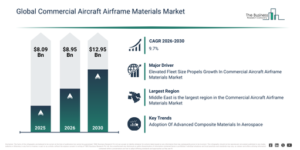
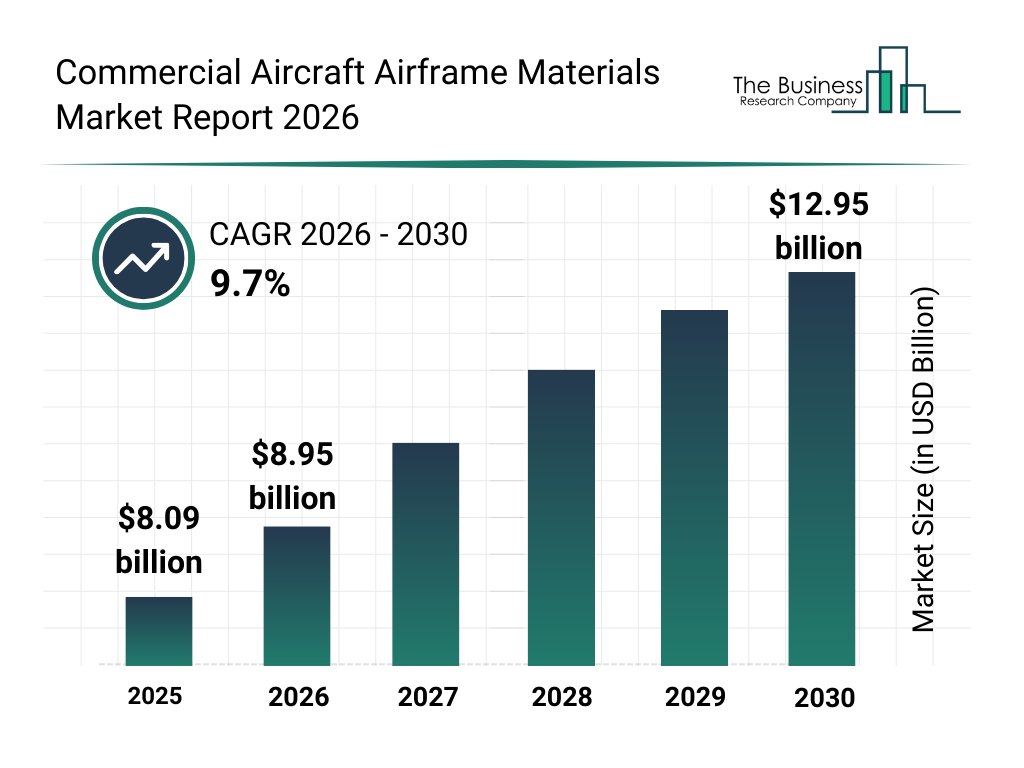
The commercial aircraft airframe materials market has seen substantial growth in recent years. Its value is expected to rise from $8.09 billion in 2025 to $8.95 billion in 2026, at a compound annual growth rate (CAGR) of 10.7%. In previous periods, this expansion was driven by the increasing deployment of surveillance and reconnaissance systems to support real-time battlefield intelligence, the greater adoption of adaptive sensors for improved situational awareness, the modernization of command and control platforms integrating advanced communications and computing, the expansion of satellite-based communication networks enhancing military operational capabilities, and the growing use of mission management and support equipment to coordinate complex defense operations.
The commercial aircraft airframe materials market is anticipated to show significant expansion in the coming years. It is projected to grow to $12.95 billion in 2030, demonstrating a compound annual growth rate (CAGR) of 9.7%. This growth during the forecast period is driven by factors such as the increasing integration of AI-driven ISR analytics for predictive intelligence and decision support, the expansion of secure next-generation communication networks across defense forces, a rising demand for interoperable C4ISR systems to facilitate joint and coalition operations, growing investment in advanced adaptive sensors with enhanced detection and range capabilities, and the ongoing modernization of military platforms requiring upgraded mission management and support systems. Major trends influencing this period include the increasing adoption of aluminum-lithium alloys for weight reduction, a higher demand for nickel and high-temperature alloys for engine and hot-section structural parts, the wider use of additive manufacturing (metal 3D printing) for complex structural components and forgings, a rising uptake of advanced surface treatments and corrosion-resistant coatings to extend airframe life, and regional supply-chain localization alongside strategic sourcing of critical alloy feedstocks.
Access A Free Sample Of The Latest Commercial Aircraft Airframe Materials Market Analysis:
Why Is The Commercial Aircraft Airframe Materials Market Growing? The Key Demand Driver Explained
The expanding fleet of commercial aircraft is anticipated to fuel the growth of the commercial aircraft airframe materials market. Commercial aircraft are defined as planes routinely employed for moving passengers and goods between designated airports. A larger fleet necessitates more aircraft airframe materials for structural fabrication, consequently boosting the commercial aircraft airframe materials sector. As an illustration, in January 2024, Airbus, a Netherland-based aircraft manufacturer, reported delivering 735 commercial aircraft in 2023, representing an 11% increase over 2022. Consequently, this expanded fleet size is propelling the advancement of the commercial aircraft airframe materials market.
What Are The Main Segments Of The Commercial Aircraft Airframe Materials Market?
The commercial aircraft airframe materials market covered in this report is segmented –
1) By Type: Aluminum Alloys, Titanium Alloys, Composites, Steel Alloys
2) By Application: Narrow-Body Aircraft, Wide-Body Aircraft, Regional Aircraft, Other Applications
Subsegments:
1) By Aluminum Alloys: 2000 Series Aluminum Alloys, 5000 Series Aluminum Alloys, 6000 Series Aluminum Alloys
2) By Titanium Alloys: Alpha Titanium Alloys, Beta Titanium Alloys, Alpha-Beta Titanium Alloys
3) By Composites: Carbon Fiber Reinforced Polymer (CFRP), Glass Fiber Reinforced Polymer (GFRP), Aramid Fiber Reinforced Polymer (AFRP)
4) By Steel Alloys: Stainless Steel Alloys, Carbon Steel Alloys, High-Strength Low-Alloy Steel (HSLA)
Commercial Aircraft Airframe Materials Market Trend Analysis: Where Leading Companies Are Focusing
Leading companies within the commercial aircraft airframe materials market are prioritizing research and development. Their objective is to boost material strength, minimize weight, and optimize fuel efficiency, all while ensuring sustainable and cost-effective aircraft production. Advancements through R&D in commercial aircraft airframe materials are crucial for progress in the aviation sector, particularly in improving fuel economy, lessening environmental footprints, and elevating total aircraft performance. As an example, during March 2023, the National Aeronautics and Space Administration (NASA), a U.S. independent agency overseeing civil space, aeronautics, and space research, provided $50 million in grants to 14 different organizations. These funds are for developing innovative manufacturing processes and advanced composite materials tailored for aircraft structures. Such environmentally friendly technologies possess the capacity to significantly decrease carbon emissions from aviation. The financial awards stem from NASA’s Hi-Rate Composite Aircraft Manufacturing (HiCAM) project, which endeavors to cut expenses and increase the domestic production of composite structures.
Which Companies Are Major Players In The Commercial Aircraft Airframe Materials Market?
Major companies operating in the commercial aircraft airframe materials market are Solvay S.A, Constellium SE, Arconic Corporation, Toray Industries Inc., Teijin Limited, Southwest Aluminium, Hexcel Corporation, VSMPO-AVISMA Corporation, HITCO Carbon Composites Inc, Kobe Steel Ltd., Alcoa Corporation, AMG Advanced Metallurgical Group NV, Dupopnt de Nemours Inc., The Boeing Company, Lockheed Martin Corporation, Commercial Aircraft Corporation of China (COMAC), Airbus SE, TATA Advanced Systems Ltd., Spirit AeroSystems Inc., Mitsubishi Chemical Corporation, Owens Corning, Koninklijke Ten Cate BV, Henkel AG & Co. KGaA, Huntsman Corporation, SGL Carbon SE, BASF SE, Evonik Industries AG, Norsk Titanium AS, Aleris Corporation, Kaiser Aluminum Corporation, Materion Corporation, Precision Castparts Corp., ThyssenKrupp Aerospace
Get The Complete Commercial Aircraft Airframe Materials Market Analysis Here:
Which Region Held The Largest Share Of The Commercial Aircraft Airframe Materials Market In 2025?
Middle East was the largest region in the commercial aircraft airframe materials market in 2025. Asia-Pacific is expected to be the fastest-growing region in the forecast period. The regions covered in the commercial aircraft airframe materials market report are Asia-Pacific, South East Asia, Western Europe, Eastern Europe, North America, South America, Middle East, Africa.
Reach Out To Our Team:
The Business Research Company: https://www.thebusinessresearchcompany.com/
Americas: +1 310-496-7795
Asia: +44 7882 955267 & +91 8897263534
Europe: +44 7882 955267
Email us at: marketing@tbrc.info
Follow us on:
LinkedIn: https://in.linkedin.com/company/the-business-research-company
YouTube: https://www.youtube.com/channel/UC24_fI0rV8cR5DxlCpgmyFQ
Global Market Model: https://www.thebusinessresearchcompany.com/global-market-model

Wasay has over a decade of experience in market research, data modelling, and analytics, with prior experience at GlobalData and Decision Tree Consulting Services. At The Business Research Company , he leads research operations across syndicated studies, customized consulting engagements, and the Global Market Model platform. His professional experience includes supporting organizations such as Boston Consulting Group, KPMG, and Ernst & Young. Wasay holds a degree in Electronics and Communications Engineering, postgraduate management qualifications from International Management Institute Belgium and Indian School of Business and Entrepreneurship, and completed the Integrated Program in Business Analytics from Indian Institute of Management Indore.