With a focus on actionable insights and strategic value, The Business Research Company’s 2026 market reports include market attractiveness scoring, total addressable market sizing, company benchmarking matrices, interactive Excel dashboards, deeper supply chain intelligence, emerging startup tracking, and granular product-level insights.
How Much Will The Commercial Airport Radar System Market Be Worth By 2030?
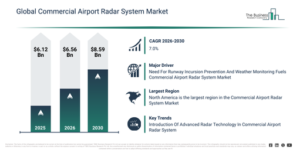
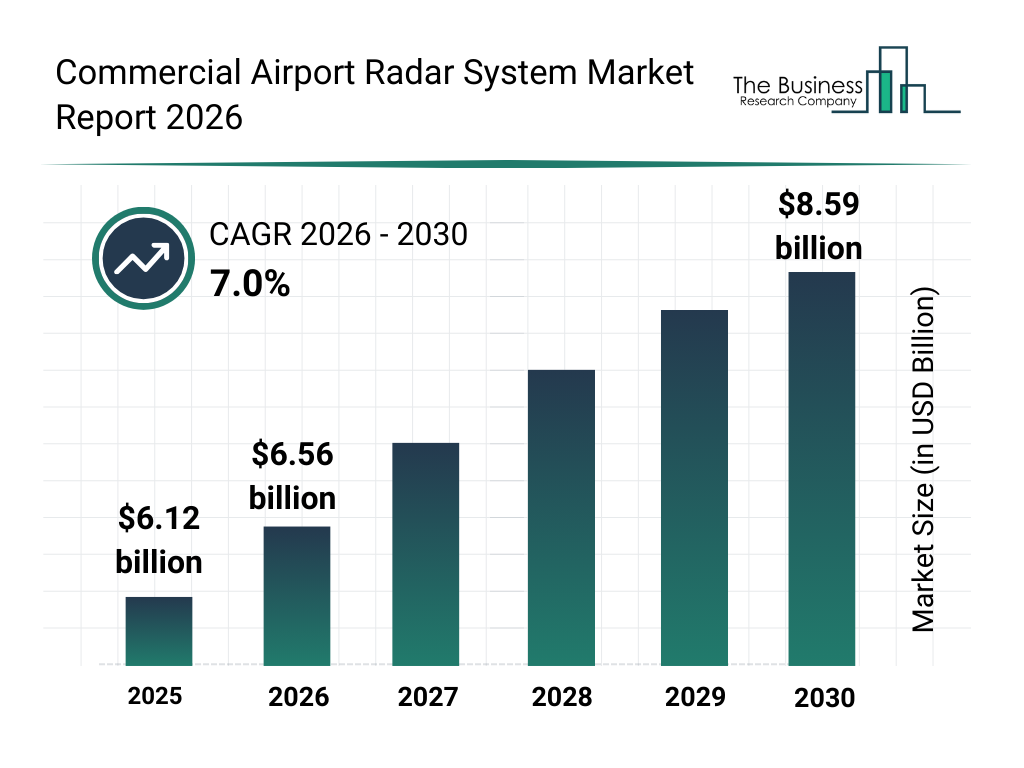
The commercial airport radar system market size has experienced significant expansion recently. This market is projected to expand from $6.12 billion in 2025 to $6.56 billion in 2026, demonstrating a compound annual growth rate (CAGR) of 7.1%. Historical growth in this sector can be ascribed to several factors, including the surge in commercial air traffic, which has elevated the need for terminal area radar coverage. Other contributing elements include the implementation of primary and secondary surveillance radar systems to enhance aircraft detection precision, the enlargement of airport infrastructure prompting the deployment of new radar systems, stringent regulatory mandates for improved safety promoting radar maintenance and calibration offerings, and advancements in radar transmitters and antennas facilitating system modernizations.
The commercial airport radar system market is projected to experience robust expansion over the coming years. This market is predicted to reach $8.59 billion by 2030, demonstrating a compound annual growth rate (CAGR) of 7.0%. Key factors contributing to this growth include the increasing number of airport modernization initiatives driving the need for sophisticated radar solutions, a greater implementation of weather and wind shear detection radar systems to boost operational safety, the integration of digital and automated radar technologies for more efficient air traffic management, the proliferation of surface movement radar systems due to congestion at major airports, and a rising demand for lifecycle support services covering training, upgrades, and sustained maintenance. Significant trends anticipated during this period involve a greater adoption of integrated primary and secondary radar systems within commercial airports, an escalating requirement for precision approach and improved landing systems, the wider installation of advanced weather and wind shear detection radar, expanding modernization and upgrade efforts for existing radar infrastructure, and a rise in the outsourcing of radar maintenance, calibration, and lifecycle support.
Get Access To A Free Commercial Airport Radar System Market Report Sample:
The Key Driver Behind The Commercial Airport Radar System Market’s 7% CAGR
The commercial airport radar system market is projected to see growth propelled by the necessity for runway incursion prevention and weather monitoring. Runway incursion prevention entails measures designed to stop incidents where an aircraft, vehicle, or person enters or strays from a designated runway area without permission or clearance. Weather monitoring, on the other hand, involves overseeing and predicting atmospheric conditions to ensure safe flight operations. The commercial airport radar system addresses the increasing need for both by offering advanced radar solutions that boost safety, enhance situational awareness, and improve operational efficiency in commercial airport settings. For instance, in December 2023, according to the U.S. Federal Aviation Administration (FAA), there were 1,756 runway incursions in 2023, which was 26 more than the previous year, marking a 1.5% year-over-year increase. Consequently, the rising demand for runway incursion prevention and weather monitoring is driving the expansion of the commercial airport radar system market.
Commercial Airport Radar System Market Classification: Main Segments And Detailed Subsegments
The commercial airport radar system market covered in this report is segmented –
1) By Type: Surveillance Radar, Surface Movement Radar, Precision Approach Radar, Weather Radar
2) By Range: Short-Range, Medium-Range, Long-Range
3) By Application: Air Traffic Control, Surface Movement Monitoring, Precision Approach And Landing, Weather Monitoring, Wind Shear Detection, Other Applications
Subsegments:
1) By Surveillance Radar: Primary Surveillance Radar (PSR), Secondary Surveillance Radar (SSR)
2) By Surface Movement Radar: Ground-Based Surface Movement Radar, Airport Surface Detection Equipment (ASDE)
3) By Precision Approach Radar: Monopulse Precision Approach Radar (MPAR), Long-Range Precision Approach Radar
4) By Weather Radar: Doppler Weather Radar, C-Band Weather Radar, X-Band Weather Radar
Commercial Airport Radar System Market Strategic Shifts: What Leading Players Are Prioritizing
Leading commercial airport radar system developers are creating new products featuring advanced solutions like dual-polarization technology, aiming to boost aviation safety and refine airport operations. This dual-polarization (dual-pol) technology functions by concurrently transmitting and receiving electromagnetic waves across two perpendicular polarizations, specifically right-handed circular polarization (RHCP) and left-handed circular polarization (LHCP). As an example, Kuching International Airport (KIA) in Malaysia implemented a new weather radar system utilizing dual-polarization (dual-pol) technology in November 2023. This system delivers diverse data services, encompassing weather data visualization through HD Radio Doppler Radar and SiriusXM, along with access to fuel price details and stock market updates. The integrated Doppler Radar significantly improves the airport’s operational capacity by providing precise weather conditions across its operational range. Its primary goals are to boost aviation safety and enhance the airport’s overall operational efficiency. This modernization of the radar system underscores the airport’s dedication to upgrading its facilities and guaranteeing secure and efficient air traffic management.
Commercial Airport Radar System Market Company Analysis: Major Industry Participants
Major companies operating in the commercial airport radar system market are Raytheon Technologies Corporation, Northrop Grumman Corporation, BAE Systems Plc, Thales Group, Leonardo S.p.A., Wipro Limited, Harris Corporation, Honeywell International Inc., Saab AB, lndra SistemasS.A., Hensoldt AG, NEC Corporation, JMA Solutions LLC, Frequentis AG, Terma A/S, Telephonics Corporation, Selex ES Inc., DeTect Inc., Intelcan Technosystems Inc., Micro Nav Limited, GEM elettronica S.r.l., ELDIS Pardubice s.r.o., Easat Radar Systems Ltd., Blighter Surveillance Systems Limited, Cambridge Pixel Ltd., ERA a.s., L3Harris Technologies Inc., M7 Aerospace LLC, Navtech Radar Ltd., Park Air Systems AS
Get Full Access To The Commercial Airport Radar System Market Report 2026:
Commercial Airport Radar System Market Global Regional Breakdown: Key Regions Analyzed
North America was the largest region in the commercial airport radar system market in 2025. Asia-Pacific is expected to be the fastest-growing region in the forecast period. The regions covered in the commercial airport radar system market report are Asia-Pacific, South East Asia, Western Europe, Eastern Europe, North America, South America, Middle East, Africa.
Reach Out To Our Team:
The Business Research Company: https://www.thebusinessresearchcompany.com/
Americas: +1 310-496-7795
Asia: +44 7882 955267 & +91 8897263534
Europe: +44 7882 955267
Email us at: marketing@tbrc.info
Follow us on:
LinkedIn: https://in.linkedin.com/company/the-business-research-company
YouTube: https://www.youtube.com/channel/UC24_fI0rV8cR5DxlCpgmyFQ
Global Market Model: https://www.thebusinessresearchcompany.com/global-market-model

Wasay has over a decade of experience in market research, data modelling, and analytics, with prior experience at GlobalData and Decision Tree Consulting Services. At The Business Research Company , he leads research operations across syndicated studies, customized consulting engagements, and the Global Market Model platform. His professional experience includes supporting organizations such as Boston Consulting Group, KPMG, and Ernst & Young. Wasay holds a degree in Electronics and Communications Engineering, postgraduate management qualifications from International Management Institute Belgium and Indian School of Business and Entrepreneurship, and completed the Integrated Program in Business Analytics from Indian Institute of Management Indore.