The Business Research Company’s 2026 market reports combine market attractiveness scoring, total addressable market sizing, company benchmarking matrices, interactive Excel dashboards, deeper supply chain intelligence, emerging startup tracking, and granular product-level insights to deliver research that is more actionable and strategically valuable.
Commercial Space Payload Market Value Projected To Grow At A 9% Compound Annual Growth Rate Through 2030
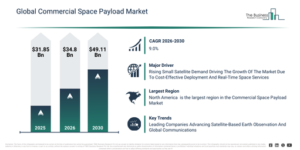
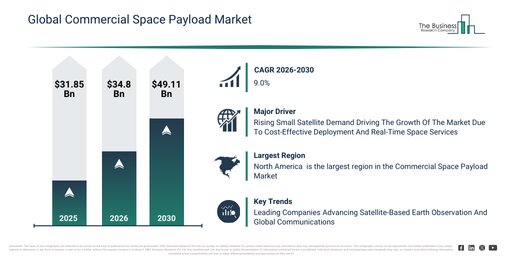
The commercial space payload market has shown robust expansion over recent years. This market is forecasted to increase from $31.85 billion in 2025 to $34.8 billion in 2026, exhibiting a compound annual growth rate (CAGR) of 9.3%. Historically, this upward trend can be ascribed to a surge in demand for commercial satellite launches, progress in payload miniaturization and modular design, elevated investment in earth observation and communication technologies, the initial deployment of commercial payloads for scientific research, and joint ventures between private aerospace companies and governmental space organizations.
The commercial space payload market size is forecast to experience strong expansion over the next few years, reaching $49.11 billion by 2030 at a compound annual growth rate (CAGR) of 9.0%. This anticipated growth is fueled by factors such as the development of multi-mission and reusable commercial payload platforms, the integration of artificial intelligence and autonomous operations for payload management, escalating demand from the telecommunications, earth observation, and space research sectors, the broadening of low-earth-orbit and geostationary payload deployments, and a strong focus on lifecycle support, in-orbit servicing, and efficient payload integration services. Significant trends expected during this forecast period include the miniaturization of satellite payload components, a rising demand for multi-mission payload architectures, increased investment in high-resolution earth observation instruments, the growth in commercial deep-space scientific payload deployments, and continuous advancements in thermal management solutions for space payloads.
Evaluate The Commercial Space Payload Market Report Before You Buy With A Free Sample:
Commercial Space Payload Market Growth Driver Analysis For The 2026–2030 Forecast Period
The rising need for small satellites is anticipated to fuel the expansion of the commercial space payload market in the future. These are defined as satellites possessing comparatively minimal mass and dimensions when contrasted with conventional satellites. Their appeal stems from their economic efficiency, involving considerably reduced production and deployment costs compared to traditional large satellites, thereby broadening access to space for various commercial, research, and communication uses. Commercial space payloads assist small satellites by offering launch facilities, deployment frameworks, and ongoing orbital assistance, ensuring economical, dependable, and prompt space access for assignments like communication, Earth observation, and technological evaluations. An example illustrating this trend is the report from NASA, a US-based government agency, in January 2025, stating that in 2023, 2,938 spacecraft were launched in total. Of these, 68% weighed under 600 kg and 27% were below 200 kg, which indicates a 17% increase from 2022, largely attributed to next-generation SmallSat constellations. Consequently, the escalating demand for small satellites is a key factor boosting the expansion of the commercial space payload market.
Commercial Space Payload Market Segmentation Breakdown: Primary And Secondary Categories
The commercial space payload market covered in this report is segmented –
1) By Type Of Payload: Satellite Payloads, Cargo Payloads, Human Spaceflight Payloads, Scientific Payloads, Technology Demonstration Payloads
2) By Launch Vehicle Type: Reusable Launch Vehicles, Expendable Launch Vehicles, Small Satellite Launch Vehicles, Heavy-Lift Launch Vehicles, Medium-Lift Launch Vehicles
3) By Orbit Type: Low Earth Orbit, Medium Earth Orbit, Geostationary Orbit, Beyond Geostationary Orbit
4) By Application: Communication, Earth Observation, Space Exploration, Surveillance And Reconnaissance
5) By End User: Commercial, Government, Defense
Subsegments:
1) By Satellite Payloads: Communication, Earth Observation, Navigation
2) By Cargo Payloads: Equipment, Fuel, Experiments
3) By Human Spaceflight Payloads: Life Support Systems, Crew Modules, Medical Equipment
4) By Scientific Payloads: Research Instruments, Telescopes, Particle Detectors
5) By Technology Demonstration Payloads: Propulsion Tests, New Materials, Robotics
Commercial Space Payload Market Industry Trends: New Developments From Leading Companies
Leading companies operating in the commercial space payload market are concentrating on developing innovative solutions, such as imaging satellites, to enhance Earth observation, improve global communications, and support data-driven applications across defense, agriculture, and environmental monitoring. Imaging satellites are defined as artificial satellites outfitted with sensors and cameras designed to capture high-resolution images and data of Earth’s surface for purposes including mapping, environmental monitoring, agriculture, urban planning, and defense applications. For instance, in August 2025, Space Exploration Technologies Corp., a US-based astronautics company, successfully launched a Falcon 9 rocket, deploying multiple satellites into orbit. This reusable two-stage rocket was engineered by SpaceX to reliably and cost-effectively transport payloads and people into Earth orbit and beyond. Its key benefits include the reusability of the first stage, which significantly lowers launch costs, and high reliability, demonstrated by a strong track record of successful flights. Falcon 9 accommodates a wide range of missions, from commercial satellite launches to cargo and crew deliveries to the International Space Station.
Who Are The Top Competitors In The Commercial Space Payload Market?
Major companies operating in the commercial space payload market are Lockheed Martin Corporation, The Boeing Company, BlackSky Technology Inc., Airbus SE, Northrop Grumman Corporation, Thales Group, L3Harris Technologies Inc., Space Exploration Technologies Corp. (SpaceX), Blue Origin LLC, General Atomics, Sierra Nevada Corporation, MDA Ltd., Planet Labs Public Benefit Corporation, OneWeb Ltd., GomSpace A/S, Surrey Satellite Technology Limited, Firefly Aerospace Inc., Capella Space Corp., Deep Blue Aerospace Co. Ltd., Antrix Corporation Limited.
Access The Commercial Space Payload Market Report For Complete Segment-Level Analysis:
Which Region Leads The Commercial Space Payload Market, And Which Regions Are Covered?
North America was the largest region in the commercial space payload market in 2025. Asia-Pacific is expected to be the fastest-growing region in the forecast period. The regions covered in the commercial space payload market report are Asia-Pacific, South East Asia, Western Europe, Eastern Europe, North America, South America, Middle East, Africa.
Reach Out To Our Team:
The Business Research Company: https://www.thebusinessresearchcompany.com/
Americas: +1 310-496-7795
Asia: +44 7882 955267 & +91 8897263534
Europe: +44 7882 955267
Email us at: marketing@tbrc.info
Follow us on:
LinkedIn: https://in.linkedin.com/company/the-business-research-company
YouTube: https://www.youtube.com/channel/UC24_fI0rV8cR5DxlCpgmyFQ
Global Market Model: https://www.thebusinessresearchcompany.com/global-market-model

Wasay has over a decade of experience in market research, data modelling, and analytics, with prior experience at GlobalData and Decision Tree Consulting Services. At The Business Research Company , he leads research operations across syndicated studies, customized consulting engagements, and the Global Market Model platform. His professional experience includes supporting organizations such as Boston Consulting Group, KPMG, and Ernst & Young. Wasay holds a degree in Electronics and Communications Engineering, postgraduate management qualifications from International Management Institute Belgium and Indian School of Business and Entrepreneurship, and completed the Integrated Program in Business Analytics from Indian Institute of Management Indore.