Delivering more actionable and strategically valuable research, The Business Research Company’s 2026 market reports feature market attractiveness analysis, total addressable market evaluation, company benchmarking matrices, interactive Excel dashboards, expanded supply chain intelligence, emerging startup coverage, and detailed product insights.
Commercial Space Station Market Value Analysis: What Growth Is Expected Over The Forecast Period?
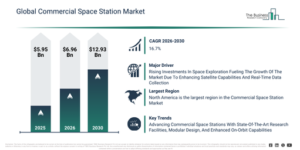
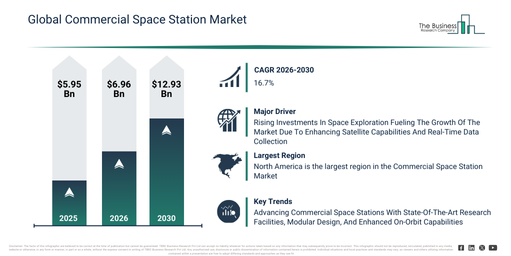
The commercial space station market size has seen swift expansion in recent years. It is projected to grow from $5.95 billion in 2025 to $6.96 billion in 2026, demonstrating a compound annual growth rate (CAGR) of 17.1%. The growth observed in the historic period stems from increasing government support for orbital infrastructure programs, a rising demand for microgravity research activities, growing private sector participation in space initiatives, the expansion of international collaborations for space exploration, and an increasing reliance on space-based logistics and payload hosting.
The commercial space station market is anticipated to experience substantial growth over the next few years. It is projected to expand to $12.93 billion by 2030, achieving a compound annual growth rate (CAGR) of 16.7%. This expansion during the forecast period can be attributed to the rising demand for space tourism experiences, increased investment in commercial low Earth orbit habitats, a growing need for in-space manufacturing capabilities, the broadening of public-private partnerships for orbital stations, and an increasing requirement for orbital servicing and refueling nodes. Noteworthy trends in the forecast period include technological advancements in modular orbital station design, innovations in autonomous and robotic maintenance systems, developments in in-space manufacturing processes, ongoing research and developments in advanced life support technologies, and improvements in commercial crew and cargo transport systems.
Download A Free Sample Report For Comprehensive Market Insights:
Commercial Space Station Market Demand Drivers: What Is Fueling Industry Growth?
The expansion of the commercial space station market is anticipated due to increasing investments in space exploration, which involves the study and discovery of outer space using both crewed and uncrewed spacecraft, satellites, and advanced technologies. A key factor behind the growing investment in space exploration is intensified geopolitical rivalry, as countries strive for strategic control and technological superiority in space. These investments boost commercial space stations by providing funds for sophisticated infrastructure, critical life-support systems, and sustainable operations. Furthermore, they enhance research capabilities and commercial prospects by facilitating extended missions, encouraging private sector involvement, and fostering the creation of new space-based services. For instance, data from Novaspace, a France-based space governance provider, indicates that government expenditures on space exploration reached $27 billion in 2024 and are forecasted to climb to almost $31 billion by 2034. Consequently, the increasing financial commitment to space exploration is a significant catalyst for the growth of the commercial space station market.
Commercial Space Station Market Categorization By Product Type And Application
The commercial space station market covered in this report is segmented –
1) By Component: Structure, Life Support Systems, Power Systems, Communication Systems, Propulsion Systems, Other Components
2) By Orbit: Low Earth Orbit, Medium Earth Orbit, Other Orbits
3) By Application: Research And Development, Space Tourism, Manufacturing, Earth Observation, Other Applications
4) By End-User: Government, Commercial, Defense, Other End-Users
Subsegments:
1) By Structure: Primary Load-Bearing Trusses, Pressurized Habitat Modules, Unpressurized Logistics Carriers, Docking Ports and Adapters, External Experiment Platforms, Robotic Arm Attachment Points, Meteoroid and Debris Shielding
2) By Life Support Systems: Atmospheric Control and Revitalization, Water Recovery and Management, Waste Management and Sanitation, Fire Detection and Suppression, Temperature and Humidity Control, Air Composition Monitoring
3) By Power Systems: Solar Photovoltaic Arrays, Battery Energy Storage, Power Management and Distribution Units, Electrical Conversion and Regulation, Thermal Power Rejection Systems
4) By Communication Systems: Space to Ground Communication Links, Inter-Satellite Communication Links, Internal Station Data Networks, Audio and Video Communication Systems, Navigation and Timing Systems
5) By Propulsion Systems: Attitude Control Thrusters, Orbital Reboost Thrusters, Reaction Control Systems, Propellant Storage and Transfer Systems
6) By Other Components: Thermal Control Systems, Robotic Manipulator Systems, Scientific Payload Racks, Internal Outfitting and Crew Systems, External Stowage Platforms
Commercial Space Station Market Innovation Trends: Which Developments Are Transforming The Industry?
Leading companies within the commercial space station market are concentrating on developing advanced habitation technologies, such as human-centric interior design and innovative life support systems, to improve the comfort, well-being, and scientific output of crews in microgravity. Human-centric design in this context signifies the deliberate organization of living and working areas to meet the distinct physical and psychological requirements of astronauts on prolonged missions. For example, in October 2024, Vast Space LLC, a US-based space habitation technology firm, unveiled its Final Haven-1 space station design, which incorporates cutting-edge facilities for scientific research. The station features a streamlined, single-module architecture engineered for a SpaceX Falcon 9 launch, offering a 1.1-meter domed window for Earth observation, communal zones for crew interaction, and integrated microgravity research amenities, thus setting a new benchmark for comfort and functionality in low Earth orbit habitation. It serves as a strong foundation for biotechnology, materials science, and other experimental fields, extending possibilities for on-orbit innovation and scientific breakthroughs.
Commercial Space Station Market Company Landscape And Strategic Competition
Major companies operating in the commercial space station market are The Boeing Company, Northrop Grumman Corporation, Blue Origin LLC, Thales Alenia Space, OHB System AG, Airbus SE, MDA Ltd., Sierra Space Corporation, Redwire Space Inc., Axiom Space Inc., Bigelow Aerospace LLC, Starlab Space LLC, Nanoracks LLC, Vast Space Inc., Genesis Engineering Solutions Inc., Gravitics Inc., ThinkOrbital Inc., Orbital Assembly Corporation
Access The Complete Commercial Space Station Market Report:
Commercial Space Station Market Geographic Analysis: Where Is Demand Growing The Fastest?
North America was the largest region in the commercial space station market in 2025. Asia-Pacific is expected to be the fastest-growing region in the forecast period. The regions covered in the commercial space station market report are Asia-Pacific, South East Asia, Western Europe, Eastern Europe, North America, South America, Middle East, Africa.
Get in touch with us:
The Business Research Company: https://www.thebusinessresearchcompany.com/
Americas: +1 310-496-7795
Asia: +44 7882 955267 & +91 8897263534
Europe: +44 7882 955267
Email us at: marketing@tbrc.info
Follow us on:
LinkedIn: https://in.linkedin.com/company/the-business-research-company
YouTube: https://www.youtube.com/channel/UC24_fI0rV8cR5DxlCpgmyFQ
Global Market Model: https://www.thebusinessresearchcompany.com/global-market-model

Wasay has over a decade of experience in market research, data modelling, and analytics, with prior experience at GlobalData and Decision Tree Consulting Services. At The Business Research Company , he leads research operations across syndicated studies, customized consulting engagements, and the Global Market Model platform. His professional experience includes supporting organizations such as Boston Consulting Group, KPMG, and Ernst & Young. Wasay holds a degree in Electronics and Communications Engineering, postgraduate management qualifications from International Management Institute Belgium and Indian School of Business and Entrepreneurship, and completed the Integrated Program in Business Analytics from Indian Institute of Management Indore.