
Through market attractiveness analysis, total addressable market evaluation, company benchmarking matrices, interactive Excel dashboards, expanded supply chain intelligence, emerging startup coverage, and detailed product insights, The Business Research Company’s 2026 market reports provide more actionable and strategically valuable research.
Cubesat Market CAGR Analysis And Future Market Development
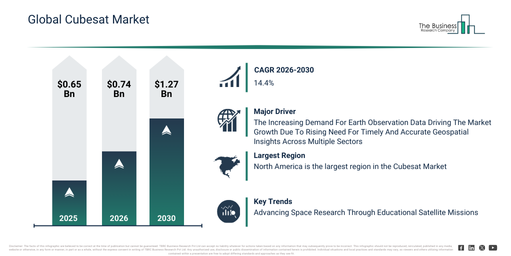
The cubesat market has seen significant expansion in recent years. Its valuation is anticipated to rise from $0.65 billion in 2025 to $0.74 billion by 2026, exhibiting a compound annual growth rate of 14.6%. The historical growth of this market can be attributed to several factors, including the increasing number of academic and commercial research missions that promote cost-effective cubesat deployments, the wider adoption of standardized propulsion and attitude control systems, initial investments in cubesat communication subsystems that enable deep-space exploration, the expansion of environmental testing infrastructure to support rapid satellite integration, and the growing utilization of cubesats for technology validation and sensor testing.
The cubesat market size is projected to experience rapid expansion in the coming years, reaching $1.27 billion by 2030, with a compound annual growth rate (CAGR) of 14.4%. This growth is primarily driven by the increasing deployment of cubesat constellations for earth observation and communication services, the adoption of advanced onboard data processing tools to facilitate real-time analytics, a rising demand for high-efficiency solar panels and next-generation batteries for extended missions, the expansion of cubesat launch opportunities through rideshare and dedicated small-launch vehicles, and the advancement of autonomous mission control software that enables minimal-human-intervention satellite operations. Significant trends during this period also encompass the growth in multi-payload cubesat configurations, an increasing demand for rapid-orbit deployment, the expansion of commercial earth-imaging constellations, progress in miniaturized propulsion technologies, and the growing adoption of cubesats for academic and research missions.
Download A Free Sample Report For Comprehensive Market Insights:
#Cubesat Market Growth Drivers And Industry Catalysts
The escalating demand for Earth observation data is anticipated to foster the expansion of the cubesat market moving forward. Earth observation data refers to information gathered from satellites, airborne sensors, and ground-based systems that track and quantify the Earth’s physical, chemical, and biological systems, including land, oceans, and atmosphere. The need for Earth observation data is increasing due to growing requirements for precise, real-time insights to address climate change, manage natural disasters, and plan for sustainable resources, as governments, research institutions, and private sectors progressively rely on satellite-based data to support informed decision-making and policy development. Cubesats facilitate Earth observation data by providing an economical, flexible, and rapidly deployable platform equipped with advanced miniaturized sensors, enabling frequent, high-resolution monitoring of the planet’s surface, atmosphere, and oceans, thereby enhancing environmental analysis, disaster management, and global sustainability efforts. For instance, in August 2023, Spire Global Inc., a US-based space-to-cloud data and analytics company, received a $6.5 million, 12-month contract renewal to continue its participation in NASA’s commercial smallsat data acquisition (CSDA) program. This renewal signifies a $500,000 increase over the previous $6 million contract awarded in June 2022. Thus, the escalating demand for Earth observation data is driving the growth of the cubesat market.
Cubesat Market Segmentation And Category Breakdown
The cubesat market covered in this report is segmented –
1) By Size: 1 U, 2 U, 3 U, 6 U, 12 U
2) By Subsystem: Payloads, Structures, Electrical Power Systems, Command And Data Handling, Propulsion Systems, Attitude Determination And Control System, Other Subsystems
3) By Application: Communication, Earth Observation, Traffic Monitoring, Meteorology, Science, Technology, and Education, Space Observation, Other Applications
4) By End-User: Academic, Commercial, Defense, Government, Non-profit Organizations, Other End-Users
Cubesat Market Growth Trends Influencing Competitive Dynamics
Major companies operating in the cubesat market are actively developing innovative solutions, such as miniaturized modular satellite systems, to enhance mission flexibility, reduce launch costs, and accelerate space-based data collection. Miniaturized modular satellite systems are compact, standardized satellite units that can be easily assembled and customized for specific missions, helping to decrease development time, lower launch costs, and increase adaptability in deploying space-based technologies. For instance, in March 2024, the National Aeronautics and Space Administration (NASA), a US-based space agency, launched four small satellites known as CubeSats to the International Space Station (ISS) through its Educational Launch of Nanosatellites (ELaNa 51) mission. These CubeSats, named Big Red Sat-1, BurstCube, SNoOPI, and HyTI, were developed by NASA centers and partner universities to advance scientific research and technology demonstrations in space. Each satellite carries unique instruments and objectives: Big Red Sat-1, built by a student team from Nebraska, is designed to test the performance of next-generation perovskite solar cells. BurstCube, developed by NASA’s Goddard Space Flight Center, aims to detect high-energy phenomena such as gamma-ray bursts and solar flares. SNoOPI focuses on measuring root-zone soil moisture and snowpack water content to support agricultural and environmental monitoring. HyTI, created by the University of Hawai?i at Manoa, employs a hyperspectral thermal imager to map water resources and study crop water use across the globe.
Cubesat Market Competitive Analysis Of Major Industry Participants
Major companies operating in the cubesat market are The Boeing Company, Airbus S.A.S., Lockheed Martin Corporation, OHB SE, Sierra Nevada Corporation, Planet Labs Inc., EnduroSat Ltd., GomSpace Group AB, NanoAvionika UAB, AAC Clyde Space AB, Astrocast SA, Satellogic S.A., Busek Co. Inc., Berlin Space Technologies GmbH, CU Aerospace L.L.C., Tyvak Nano-Satellite Systems Inc., Interorbital Systems Inc., SERENUM a.s., Exobotics Inc., Pumpkin Inc.
Access The Complete Cubesat Market Report:
Cubesat Market Geographic Distribution And Regional Opportunities
North America was the largest region in the cubesat market in 2025. The regions covered in the cubesat market report are Asia-Pacific, South East Asia, Western Europe, Eastern Europe, North America, South America, Middle East, Africa.
Access a Customized Cubesat Market Report for Deeper Competitive Insights
https://www.thebusinessresearchcompany.com/customise?id=27490&type=smp
The Business Research Company: https://www.thebusinessresearchcompany.com/
Americas: +1 310-496-7795
Asia: +44 7882 955267 & +91 8897263534
Europe: +44 7882 955267
Email us at: marketing@tbrc.info
Follow us on:
LinkedIn: https://in.linkedin.com/company/the-business-research-company
YouTube: https://www.youtube.com/channel/UC24_fI0rV8cR5DxlCpgmyFQ
Global Market Model: https://www.thebusinessresearchcompany.com/global-market-model

Wasay has over a decade of experience in market research, data modelling, and analytics, with prior experience at GlobalData and Decision Tree Consulting Services. At The Business Research Company , he leads research operations across syndicated studies, customized consulting engagements, and the Global Market Model platform. His professional experience includes supporting organizations such as Boston Consulting Group, KPMG, and Ernst & Young. Wasay holds a degree in Electronics and Communications Engineering, postgraduate management qualifications from International Management Institute Belgium and Indian School of Business and Entrepreneurship, and completed the Integrated Program in Business Analytics from Indian Institute of Management Indore.