The Business Research Company’s 2026 market reports combine market attractiveness scoring, total addressable market sizing, company benchmarking matrices, interactive Excel dashboards, deeper supply chain intelligence, emerging startup tracking, and granular product-level insights to deliver research that is more actionable and strategically valuable.
Defense Communication Intelligence Market Size Review: What Shaped Past Growth And What Will Drive Future Expansion?
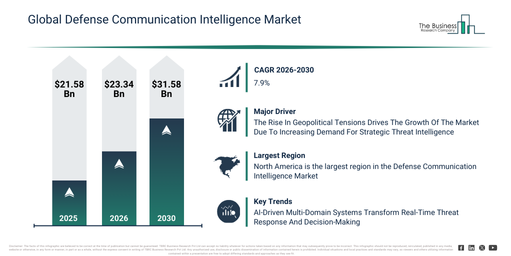
The defense communication intelligence market has experienced robust expansion in recent years. Its size is projected to grow from $21.58 billion in 2025 to $23.34 billion in 2026, achieving a compound annual growth rate (CAGR) of 8.2%. This historical growth can be attributed to several factors: an increasing reliance on signal intelligence systems for intercepting and analyzing adversary communications, the expansion of electronic warfare capabilities driving the adoption of advanced interception and jamming tools, the growing deployment of secure communication equipment to protect military data exchanges, the development of encryption devices to safeguard classified operational information, and the rising integration of satellite communication tools supporting global intelligence operations.
The defense communication intelligence market is projected to experience substantial expansion in the coming years. Its size is anticipated to reach $31.58 billion by 2030, exhibiting a compound annual growth rate (CAGR) of 7.9%. This growth is attributable to several factors, including the increasing integration of AI-driven analytics for improved real-time intelligence interpretation, a heightened need for advanced cyber intelligence solutions to combat complex digital threats, the broadening of network-centric warfare approaches necessitating interoperable and secure communication platforms, enhancements in electronic warfare systems for more accurate signal detection and disruption, and the creation of advanced software platforms facilitating automated communication intelligence processing. Key trends anticipated during this period encompass a greater dependency on real-time electronic warfare support systems, a surge in the application of sophisticated signal interception technologies, increased incorporation of satellite-based communication intelligence, a strong demand for encrypted tactical communication solutions, and the proliferation of modular and portable intelligence systems.
Access Free Sample Pages From The Defense Communication Intelligence Market Report 2026:
Understanding The Main Driver Of The Defense Communication Intelligence Market
The expansion of the defense communication intelligence market is anticipated to be spurred by increasing geopolitical tensions. These tensions describe strained political, economic, or military relations among nations or regions, often resulting in instability or conflict. A common cause of escalating geopolitical tensions involves territorial disputes, where competition over land or maritime boundaries generates strained diplomatic ties and potential conflict. Defense communication intelligence plays a crucial role by improving situational awareness and decision-making for nations, enabling them to foresee threats and respond strategically to lessen the impact of increasing geopolitical tensions. As an illustration, in January 2025, Euronews SA, a television network based in France, reported that global conflicts escalated in 2024, with political violence seeing a 25% increase compared to 2023, impacting one in eight individuals and causing approximately 223,000 deaths, along with a 37% rise in total fatalities. Consequently, the heightened geopolitical tensions are acting as a significant driver for the expansion of the defense communication intelligence market.
Defense Communication Intelligence Market Segment Mapping For 2026 And Beyond
The defense communication intelligence market covered in this report is segmented –
1) By Types: Satellite Communication Intelligence, Radar Intelligence, Signal Intelligence, Cyber Intelligence, Other Types
2) By Component: Hardware, Software, Services
3) By Installations: Handheld, Vehicle Mounted, Fixed, Other Installations
4) By Platform: Land, Airborne, Naval, Space-Based Platforms
5) By Applications: Military Commands, Surveillance And Reconnaissance, Situational Awareness, Electronic Warfare, Combat Operations
Subsegments:
1) By Satellite Communication Intelligence: Satellite Intercept Systems, Satellite Data Processing, Space-Based Surveillance, Ground Station Integration
2) By Radar Intelligence: Ground-Based Radar Intelligence, Airborne Radar Intelligence, Over-the-Horizon Radar Systems, Synthetic Aperture Radar (SAR) Analysis
3) By Signal Intelligence: Communication Intelligence (COMINT): Electronic Intelligence (ELINT), Foreign Instrumentation Signals Intelligence (FISINT), Direction Finding And Signal Interception
4) By Cyber Intelligence: Network Traffic Monitoring: Threat Intelligence Platforms, Malware Analysis And Reverse Engineering, Cyber Forensics And Intrusion Detection
5) By Other Types: Acoustic Intelligence (ACINT), Measurement and Signature Intelligence (MASINT), Open-Source Intelligence (OSINT), Electro-Optical / Infrared Intelligence (EO/IR), Geospatial Intelligence (GEOINT)
What Key Trend Is Expected To Shape The Defense Communication Intelligence Market Over The Forecast Period?
Major companies operating in the defense communication intelligence market are actively developing advanced AI-driven platforms, such as unified multi-domain command and control systems, to improve real-time threat detection and decision-making. Unified multi-domain command and control (MDC2) systems facilitate seamless coordination and strategic choices across land, air, sea, space, and cyber domains, thereby assisting defense communication intelligence by integrating real-time data for quicker, more informed responses to complex threats. For example, in March 2025, Ultra Electronics Advanced Tactical Systems, Inc., a US defense technology company, introduced a unified ADSI platform, signifying a major step forward in AI-enabled multi-domain command and control (C2). This platform delivers superior tactical data translation and integration from sources like Link-16 platforms, net-enabled weapons, and hypersonic systems. Equipped with an AI assistant, it ensures the delivery of actionable intelligence even in highly contested or disconnected environments. Its scalable architecture supports smooth functionality across both cloud-based and traditional networks, offering robust security and rapid adaptability for modern multi-domain operations.
Defense Communication Intelligence Market Major Players And Industry Competition Overview
Major companies operating in the defense communication intelligence market are Raytheon Technologies Corporation, The Boeing Company, Lockheed Martin Corporation, Airbus Defence and Space GmbH, General Dynamics Corporation, Northrop Grumman Corporation, BAE Systems Plc, Thales S.A, L3Harris Technologies Inc., Leonardo S.p.A., Elbit Systems Ltd., Israel Aerospace Industries, SAAB AB, Indra Sistemas S.A., Bharat Electronics Limited, HENSOLDT AG, Cubic Corporation, Ultra Electronics Holdings plc, Rohde And Schwarz GmbH And Co KG, Tata Advanced Systems Limited
Full Defense Communication Intelligence Market Report: Market Size, Trends, Segments And Key Players:
Defense Communication Intelligence Market Geographic Segmentation: Regions Covered In The Report
North America was the largest region in the defense communication intelligence market in 2025. Asia-Pacific is expected to be the fastest-growing region in the forecast period. The regions covered in the defense communication intelligence market report are Asia-Pacific, South East Asia, Western Europe, Eastern Europe, North America, South America, Middle East, Africa.
Reach Out To Our Team:
The Business Research Company: https://www.thebusinessresearchcompany.com/
Americas: +1 310-496-7795
Asia: +44 7882 955267 & +91 8897263534
Europe: +44 7882 955267
Email us at: marketing@tbrc.info
Follow us on:
LinkedIn: https://in.linkedin.com/company/the-business-research-company
YouTube: https://www.youtube.com/channel/UC24_fI0rV8cR5DxlCpgmyFQ
Global Market Model: https://www.thebusinessresearchcompany.com/global-market-model

Wasay has over a decade of experience in market research, data modelling, and analytics, with prior experience at GlobalData and Decision Tree Consulting Services. At The Business Research Company , he leads research operations across syndicated studies, customized consulting engagements, and the Global Market Model platform. His professional experience includes supporting organizations such as Boston Consulting Group, KPMG, and Ernst & Young. Wasay holds a degree in Electronics and Communications Engineering, postgraduate management qualifications from International Management Institute Belgium and Indian School of Business and Entrepreneurship, and completed the Integrated Program in Business Analytics from Indian Institute of Management Indore.