The Business Research Company’s 2026 market reports are designed to deliver research that is more actionable and strategically valuable. Key offerings include market attractiveness scoring, total addressable market sizing, company benchmarking matrices, interactive Excel dashboards, deeper supply chain intelligence, emerging startup tracking, and granular product-level insights.
Defense Logistics Market Size 2026: Valuation, Growth Rate And Forecast To 2030
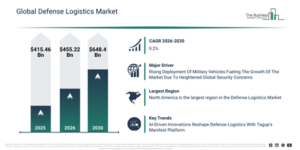
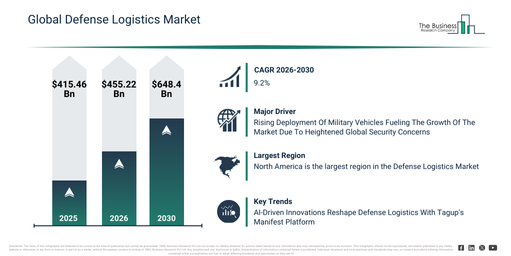
The defense logistics market has demonstrated substantial growth in recent years. It is projected to expand from $415.46 billion in 2025 to $455.22 billion in 2026, recording a compound annual growth rate (CAGR) of 9.6%. This historical expansion can be attributed to increasing military operations driving demand for comprehensive logistics planning and coordination, the expansion of warehousing and depot maintenance services to support large defense inventories, a rising use of armored transport vehicles and mobile storage units for secure field operations, the development of reverse logistics processes to manage equipment repair and return flows, and the adoption of tactical supply kits and fuel distribution systems to enhance mission readiness.
The defense logistics market is projected for significant expansion over the coming years, reaching $648.4 billion in 2030, exhibiting a compound annual growth rate (CAGR) of 9.2%. This anticipated growth is driven by factors such as the increasing incorporation of automation and AI-powered tools to streamline defense supply chain processes, a heightened need for real-time logistics monitoring and in-theater assistance, the proliferation of interoperable logistics platforms for joint and coalition operations, the greater adoption of advanced inventory tools and digital twins for proactive maintenance and resource planning, and the establishment of robust and adaptive logistics networks to mitigate evolving geopolitical and supply chain challenges. Key developments during this period will encompass a rising demand for in-theater supply chain automation, the development of armored transport and tactical mobility solutions, an increasing requirement for depot-level maintenance support, the broadening of reverse logistics activities, and greater expenditure on logistics training and simulation.
Get A Free Sample Of The Defense Logistics Market Report 2026:
What Is Driving The Growth Of The Defense Logistics Market?
The growth in the defense logistics market is projected to be driven by the increasing quantity of military vehicles in the future. These vehicles are land-based combat and transport platforms created and produced for defense purposes, including armored personnel carriers, infantry fighting vehicles, main battle tanks, tactical trucks, and reconnaissance vehicles. The rise in military vehicles is attributed to growing global security concerns, as nations prioritize defense readiness against emerging threats. Defense logistics is critical for ensuring the timely supply, maintenance, and operational readiness of military vehicles by coordinating the delivery of essential spare parts, fuel, and technical support. For instance, in September 2024, according to Veterans Affairs Canada, a Canada-based government department, the Canadian industry manufactured 1,700,000 small arms, 40,000 field, naval, and anti-aircraft guns, 50,000 tanks, and over 800,000 military transport vehicles. Furthermore, in November 2023, Defense Express, a Ukraine-based company specializing in the defense sector, reported that 210 new tanks were delivered to the Russian army in 2023, an increase from 30 in 2022. Therefore, the expanding number of military vehicles is a primary factor fueling the growth of the defense logistics market.
How Is The Defense Logistics Market Segmented?
The defense logistics market covered in this report is segmented –
1) By Logistics Type: Transportation And Storage, Inventory Management, Distribution, Sourcing, Procurement
2) By Technology Used: Automated Systems, Data Analytics, Cloud Computing, Blockchain Technology, Internet Of Things (IoT)
3) By Mode Of Transportation: Land Transportation, Air Transportation, Maritime Transportation, Intermodal Transportation
4) By Application: Military Operations, Training, Emergency Response
5) By End-User: Military, Government, Commercial
Subsegments:
1) By Transportation And Storage: Cold Chain Storage, Hazardous Materials Handling, High-Value Asset Transport, Secure Storage Facilities
2) By Inventory Management: Demand Forecasting, Spare Parts Management, Inventory Auditing, Stock Replenishment
3) By Distribution: Last-Mile Delivery, Regional Distribution Centers, Load Planning, Shipment Tracking
4) By Sourcing: Vendor Evaluation, Strategic Sourcing, Contract Management, Supplier Risk Assessment
5) By Procurement: Tactical Procurement, E-Procurement Platforms, Defense Acquisition Planning, Purchase Order Management
What Are The Latest Trends In The Defense Logistics Market?
Leading entities within the defense logistics market are prioritizing the creation of cutting-edge innovations, including AI-driven logistics platforms, aiming to boost the efficiency, flexibility, and robustness of defense logistics activities. Such a platform is a digital infrastructure that leverages artificial intelligence and machine learning algorithms to examine, predict, and streamline logistics processes, thereby elevating efficiency, agility, and the quality of decision-making throughout supply chains. As an example, in May 2024, Tagup Inc., a US-based software firm, introduced Manifest, positioning it as an advanced solution for future defense logistics needs. Its primary capabilities encompass real-time tracking of assets, AI-driven predictive maintenance, and automated systems for decision support, all designed to improve operational readiness and minimize periods of inactivity. Furthermore, the platform facilitates interoperability with existing defense systems, guaranteeing smooth integration and potential for expansion. Centered on cybersecurity and regulatory compliance, Manifest backs essential logistics functions across air, land, and sea sectors, empowering defense organizations to make quicker, informed choices in constantly changing operational settings.
Who Are The Key Players In The Defense Logistics Market?
Major companies operating in the defense logistics market are DHL Group, FedEx Corporation, A.P. Møller – Mærsk A/S, RTX Corporation, The Boeing Company, Lockheed Martin Corporation, Airbus SE, Kuehne + Nagel International AG, General Dynamics Corporation, Northrop Grumman Corporation, Honeywell International Inc., BAE Systems plc, Thales Group, CEVA Logistics AG, L3Harris Technologies Inc., Leonardo S.p.A., Fluor Corporation, Huntington Ingalls Industries Inc., KBR Inc., Elbit Systems Ltd.
Read The Complete Defense Logistics Market Report 2026:
Which Region Is The Largest In The Defense Logistics Market?
North America was the largest region in the defense logistics market in 2025. Asia-Pacific is expected to be the fastest-growing region in the forecast period. The regions covered in the defense logistics market report are Asia-Pacific, South East Asia, Western Europe, Eastern Europe, North America, South America, Middle East, Africa.
Reach Out To Our Team:
The Business Research Company: https://www.thebusinessresearchcompany.com/
Americas: +1 310-496-7795
Asia: +44 7882 955267 & +91 8897263534
Europe: +44 7882 955267
Email us at: marketing@tbrc.info
Follow us on:
LinkedIn: https://in.linkedin.com/company/the-business-research-company
YouTube: https://www.youtube.com/channel/UC24_fI0rV8cR5DxlCpgmyFQ
Global Market Model: https://www.thebusinessresearchcompany.com/global-market-model

Wasay has over a decade of experience in market research, data modelling, and analytics, with prior experience at GlobalData and Decision Tree Consulting Services. At The Business Research Company , he leads research operations across syndicated studies, customized consulting engagements, and the Global Market Model platform. His professional experience includes supporting organizations such as Boston Consulting Group, KPMG, and Ernst & Young. Wasay holds a degree in Electronics and Communications Engineering, postgraduate management qualifications from International Management Institute Belgium and Indian School of Business and Entrepreneurship, and completed the Integrated Program in Business Analytics from Indian Institute of Management Indore.