Enhanced with market attractiveness analysis, total addressable market evaluation, company benchmarking matrices, interactive Excel dashboards, expanded supply chain intelligence, emerging startup coverage, and detailed product insights, The Business Research Company’s 2026 market reports deliver more actionable and strategically valuable research.
Drone Communication Market Revenue Growth Supported By A CAGR Of $8.87 Through 2030
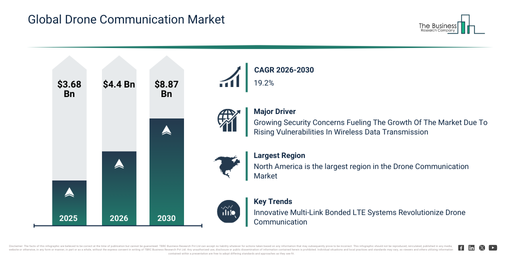
The drone communication market size has seen significant growth in recent years. It is anticipated to expand from $3.68 billion in 2025 to $4.4 billion in 2026, achieving a compound annual growth rate (CAGR) of 19.6%. The expansion observed historically can be attributed to the rising integration of drones in commercial, industrial, and defense operations that demand stable telemetry links, the progression of radio transceivers and modems facilitating more dependable command-and-control communication, the increased utilization of high-gain antennas and signal amplifiers to extend operational reach, the broader deployment of ground control stations to support multi-drone fleet management, and developments in software-defined radio platforms enhancing communication adaptability and bandwidth efficiency.
The drone communication market is anticipated to experience significant expansion in the coming years, with its size projected to reach $8.87 billion by 2030, demonstrating a compound annual growth rate (CAGR) of 19.2%. This growth over the forecast period is primarily driven by the increasing need for secure and encrypted communication systems to protect sensitive drone data flows, the expanding adoption of beyond-line-of-sight connectivity for long-range and autonomous drone missions, and the escalating demand for high-definition video and sensor-data streaming in inspection, surveillance, and logistics applications. Furthermore, the integration of 5G and satellite communication networks is enhancing long-distance and low-latency drone links, alongside the development of swarm communication architectures that enable coordinated multi-drone operations. Prominent trends for this period include an increasing regulatory emphasis on secure and resilient command-and-control (C2) links for unmanned aircraft, the expansion of beyond-visual-line-of-sight (BVLOS) drone operations, which is boosting demand for long-range data links, and a growing preference for modular and upgradeable drone communication payloads and ground stations. Also significant is the rising localization of drone communication hardware manufacturing aimed at reducing supply-chain and export-control risks, coupled with robust growth in vertically specialized communication solutions tailored for sectors such as agriculture, inspection, and oil & gas.
Download A Free Sample Report For Comprehensive Market Insights:
#Drone Communication Market Growth Factors: Which Forces Are Supporting Market Expansion?
The increasing security concerns and system vulnerabilities are anticipated to drive expansion in the drone communication market. These security issues and weaknesses denote potential flaws in systems that could be utilized by attackers to gain unauthorized entry, interrupt operations, or acquire confidential data. The proliferation of vulnerabilities stems from greater digital connectivity, which broadens the scope for potential threats as more systems become linked. Drone communication itself contributes to these vulnerabilities by transmitting sensitive information across wireless networks, making it susceptible to interception or disruption if security measures are inadequate. As an illustration, in November 2024, data from the Australian Cyber Security Centre (ACSC), an Australia-based government agency, revealed that during the 2023–24 financial year, the Australian Cyber Security Hotline managed by ASD handled over 36,700 calls, representing a 12% rise from the preceding year. Consequently, the escalating security concerns and vulnerabilities are propelling the growth of the drone communication market.
Drone Communication Market Segmentation: How Is The Market Structured Across Key Categories?
The drone communication market covered in this report is segmented –
1) By Component: Transmitter, Receiver, Antenna, Data Link
2) By Technology: Radio Frequency, Cellular, Satellite, Meshed Network
3) By Application: Agriculture, Construction And Mining, Inspection, Oil And Gas, Other Applications
4) By End Use: Government And Defense Organizations, Commercial Enterprises, Private Operators
Subsegments:
1) By Transmitter: RF Transmitters, Telemetry Transmitters, FPV (First-Person View) Video Transmitters, Digital Signal Transmitters, Satellite-Based Transmitters
2) By Receiver: RF Receivers, Telemetry Receivers, GPS Receivers, FPV Video Receivers, Command And Control (C2) Receivers
3) By Antenna: Omnidirectional Antennas, Directional Antennas, Patch Antennas, Helical Antennas, Phased Array Antennas
4) By Data Link: Line-Of-Sight (LOS) Data Links, Beyond Visual Line-Of-Sight (BVLOS) Data Links, Satellite Communication Links, Radio Frequency (RF) Links, Cellular (4G/5G) Data Links
Drone Communication Market Innovation Trends: Which Developments Are Transforming The Industry?
Leading companies in the drone communication market are concentrating on developing innovative solutions, such as multi-link bonded LTE communication systems, to improve data transmission reliability, boost bandwidth, and ensure uninterrupted connectivity even in challenging environments. Multi-link bonded LTE communication systems refer to sophisticated communication solutions that combine multiple LTE (4G) network connections from different carriers or frequency bands into a single, more reliable, and high-bandwidth data stream. For instance, in September 2024, Elsight Ltd., an Israel-based technology company, introduced a robust multi-link bonded LTE communication system as part of their DroneCommX aftermarket kit for DJI’s Matrice 30 and 350 drones. This system integrates four LTE modems into a single bonded link, delivering jam-resistant, secure communications utilizing advanced encryption protocols like M-TLS and AES-256. It supersedes DJI’s standard 2.4 GHz peer-to-peer (P2P) communication, enabling non-line-of-sight (NLOS) flight and facilitating continuous, high-bandwidth, encrypted data and video transmission to remote command centers.
Drone Communication Market Competitive Landscape: Who Are The Leading Companies?
Major companies operating in the drone communication market are General Dynamics Corporation, L3Harris Technologies Inc., Honeywell International Inc., BAE Systems plc, Thales S.A., Elbit Systems Ltd., Israel Aerospace Industries Ltd., Viasat Inc., Aselsan Elektronik Sanayi ve Ticaret A.S., Iridium Communications Inc., AeroVironment Inc., Gilat Satellite Networks Ltd., Skydio Inc., Microdrones GmbH, Paras Defence and Space Technologies Limited, BRINC Drones Inc., Delair SAS, AgEagle Aerial Systems Inc., DroneShield Ltd., Freefly Systems Inc., Teal Drones Inc., Draganfly Innovations Inc., ZALA Aero Group, Mynaric AG.
Access The Complete Drone Communication Market Report:
Drone Communication Market Leading Geography: Which Region Generates The Most Revenue?
North America was the largest region in the drone communication market in 2025. Asia-Pacific is expected to be the fastest-growing region in the forecast period. The regions covered in the drone communication market report are Asia-Pacific, South East Asia, Western Europe, Eastern Europe, North America, South America, Middle East, Africa.
Access a Customized Drone Communication Market Report for Deeper Competitive Insights
https://www.thebusinessresearchcompany.com/customise?id=25304&type=smp
The Business Research Company: https://www.thebusinessresearchcompany.com/
Americas: +1 310-496-7795
Asia: +44 7882 955267 & +91 8897263534
Europe: +44 7882 955267
Email us at: marketing@tbrc.info
Follow us on:
LinkedIn: https://in.linkedin.com/company/the-business-research-company
YouTube: https://www.youtube.com/channel/UC24_fI0rV8cR5DxlCpgmyFQ
Global Market Model: https://www.thebusinessresearchcompany.com/global-market-model

Wasay has over a decade of experience in market research, data modelling, and analytics, with prior experience at GlobalData and Decision Tree Consulting Services. At The Business Research Company , he leads research operations across syndicated studies, customized consulting engagements, and the Global Market Model platform. His professional experience includes supporting organizations such as Boston Consulting Group, KPMG, and Ernst & Young. Wasay holds a degree in Electronics and Communications Engineering, postgraduate management qualifications from International Management Institute Belgium and Indian School of Business and Entrepreneurship, and completed the Integrated Program in Business Analytics from Indian Institute of Management Indore.