
Through market attractiveness analysis, total addressable market evaluation, company benchmarking matrices, interactive Excel dashboards, expanded supply chain intelligence, emerging startup coverage, and detailed product insights, The Business Research Company’s 2026 market reports provide more actionable and strategically valuable research.
General Aviation Market Expansion From $31.3 Billion In 2026 To $38.86 Billion In 2030
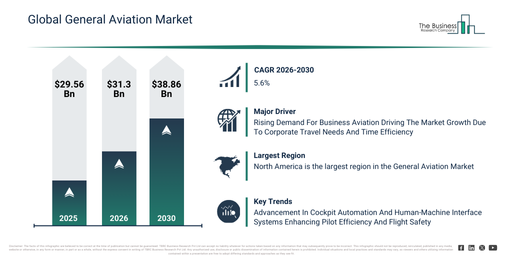
The general aviation market has shown significant expansion over recent years. This market is forecast to expand from $29.56 billion in 2025 to $31.3 billion by 2026, achieving a compound annual growth rate (CAGR) of 5.9%. Historical market growth can be attributed to a confluence of factors, including heightened demand for pilot training, which has propelled the expansion of flight schools and simulation services; an uptick in the utilization of turboprops and piston aircraft for regional and personal travel; the increasing availability of maintenance, repair, and overhaul services essential for supporting growing general aviation fleets; the emergence of aircraft leasing and financing alternatives that enhance accessibility for operators; and the broadening of emergency medical services and agricultural aviation, leading to greater aircraft utilization.
The general aviation market is projected to experience substantial growth over the coming years. This market is anticipated to reach $38.86 billion by 2030, demonstrating a compound annual growth rate (CAGR) of 5.6%. Factors contributing to this projected growth include the increased use of sophisticated flight simulators to improve pilot training, the growing need for general aviation aircraft that are fuel-efficient and have low emissions, the expansion of air taxi and on-demand mobility services driving greater fleet needs, increased investment in digital MRO platforms to boost aircraft maintenance efficiency, and the development of hybrid-electric and all-electric aircraft that are transforming future general aviation operations. Key trends during this period are expected to involve an increasing demand for business aviation and on-demand charter services, a surge in flight training activities due to worldwide pilot shortages, the modernization and replacement of older piston and turboprop aircraft, an increase in outsourced MRO contracts and comprehensive lifecycle support solutions, and the expanded use of general aviation for special missions, aerial surveying, and emergency medical services.
Download A Free Sample Report For Comprehensive Market Insights:
#General Aviation Market Growth Drivers And Industry Catalysts
The growing need for business aviation is anticipated to drive the general aviation market’s expansion moving forward. Business aviation, which involves companies or individuals utilizing aircraft for professional reasons rather than commercial airlines, provides greater adaptability, time savings, and access to isolated areas to boost corporate output and interconnectedness. The heightened demand for business aviation stems from expanding corporate travel requirements and the desire for efficiency in time utilization. General aviation facilitates business aviation by delivering adaptable, effective, and on-demand air travel options that improve corporate movement and reach to remote or unserved locations. For example, in October 2023, as per Honeywell International, Inc., a US-based manufacturing company, the Business Aviation Outlook forecasts up to 8,500 new business jet deliveries valued at $278 billion from 2024–2033, indicating an increase of 500 aircraft and 6% more flights year-on-year. Consequently, the rising demand for business aviation is propelling the general aviation market’s growth.
General Aviation Market Segments: Where Are The Largest Growth Opportunities?
The general aviation market covered in this report is segmented –
1) By Component: Avionics, Airframe, Landing Gears, Engine
2) By Type Of Aircraft: Fixed Wing, Rotorcraft, Light Sport Aircraft, Business Jets
3) By Application: Private Flying, Aircraft Charter, Flight Training, Aerial Surveying
4) By End User: Business, Sports, Recreational, Humanitarian Aid, Agriculture, Other End Users
Subsegments:
1) By Avionics: Flight Control Systems, Communication Systems, Navigation Systems, Monitoring Systems, Weather Systems, Surveillance Systems, In-flight Entertainment Systems, Mission Systems
2) By Airframe: Fuselage, Wings, Empennage, Flight Control Surfaces, Doors and Windows, Nacelles and Pylons
3) By Landing Gears: Main Landing Gear, Nose Or Tail Landing Gear, Shock Absorbers, Braking Systems, Retraction Systems, Steering Systems, Wheels and Tires
4) By Engine: Turboprop Engines, Turbofan Engines, Piston Engines, Engine Control Systems, Exhaust Systems, Fuel Systems, Ignition Systems
General Aviation Market Innovation Trends: Which Developments Are Transforming The Industry?
Key players within the general aviation market are prioritizing the development of advanced cockpit automation and human-machine interface systems to significantly reduce pilot workload and improve operational efficiency. These cockpit automation and human-machine interface systems integrate various features such as advanced avionics, intuitive touchscreen controls, autothrottle, and autonomous-landing capabilities, all aimed at streamlining flight operations, minimizing manual pilot interventions, and enhancing overall safety and mission flexibility. For instance, in October 2024, Textron Aviation, a US-based general aviation business unit, introduced the prototype of its Cessna Citation CJ4 Gen3 aircraft. This new model is equipped with the Garmin G3000 PRIME next-generation avionics suite, which includes Garmin Autothrottles and Garmin Emergency Autoland, specifically engineered to alleviate pilot workload and boost connectivity and responsiveness. The aircraft successfully performed its inaugural flight, lasting approximately 1 hour 47 minutes, during which comprehensive evaluations of its new avionics, propulsion, environmental, and flight-control systems were conducted. The design boasts a maximum range of 2,165 nautical miles, a maximum cruise speed of 451 knots true airspeed, seating capacity for up to 11 occupants, and a useful load of 6,930 pounds.
General Aviation Market Company Landscape And Strategic Competition
Major companies operating in the general aviation market are Raytheon Technologies Corporation, Honeywell Aerospace, GE Aerospace, Safran S.A., Rolls-Royce Holdings plc, Leonardo S.p.A., Liebherr Aerospace, Textron Inc., Dassault Aviation, Bombardier Inc., Garmin Ltd., Embraer S.A., GKN Aerospace, Piper Aircraft, Pilatus Aircraft Ltd, Cirrus Aircraft, Honda Aircraft Company, Robinson Helicopter Company, Epic Aircraft, CubCrafters Inc.
Access The Complete General Aviation Market Report:
General Aviation Market Largest Region By Revenue And Market Share
North America was the largest region in the general aviation market in 2025. Asia-Pacific is expected to be the fastest-growing region in the forecast period. The regions covered in the general aviation market report are Asia-Pacific, South East Asia, Western Europe, Eastern Europe, North America, South America, Middle East, Africa.
Access a Customized General Aviation Market Report for Deeper Competitive Insights
https://www.thebusinessresearchcompany.com/customise?id=25333&type=smp
The Business Research Company: https://www.thebusinessresearchcompany.com/
Americas: +1 310-496-7795
Asia: +44 7882 955267 & +91 8897263534
Europe: +44 7882 955267
Email us at: marketing@tbrc.info
Follow us on:
LinkedIn: https://in.linkedin.com/company/the-business-research-company
YouTube: https://www.youtube.com/channel/UC24_fI0rV8cR5DxlCpgmyFQ
Global Market Model: https://www.thebusinessresearchcompany.com/global-market-model

Wasay has over a decade of experience in market research, data modelling, and analytics, with prior experience at GlobalData and Decision Tree Consulting Services. At The Business Research Company , he leads research operations across syndicated studies, customized consulting engagements, and the Global Market Model platform. His professional experience includes supporting organizations such as Boston Consulting Group, KPMG, and Ernst & Young. Wasay holds a degree in Electronics and Communications Engineering, postgraduate management qualifications from International Management Institute Belgium and Indian School of Business and Entrepreneurship, and completed the Integrated Program in Business Analytics from Indian Institute of Management Indore.