
Enhanced with market attractiveness analysis, total addressable market evaluation, company benchmarking matrices, interactive Excel dashboards, expanded supply chain intelligence, emerging startup coverage, and detailed product insights, The Business Research Company’s 2026 market reports deliver more actionable and strategically valuable research.
Helicopter Simulator Market Forecast Highlighting Growth From $4.13 Billion To $5.72 Billion
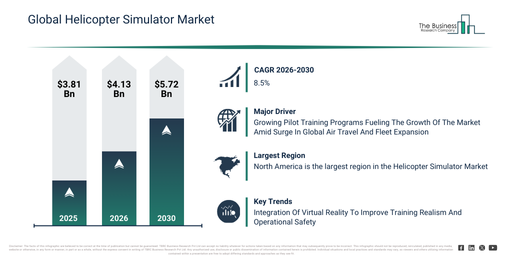
The helicopter simulator market size has shown robust growth over recent years. It is projected to expand from $3.81 billion in 2025 to $4.13 billion in 2026, at a compound annual growth rate (CAGR) of 8.6%. This historical growth can be linked to the increased adoption of full-flight simulators for economical pilot training, a heightened demand for maintenance training solutions to reduce operational downtime, an increase in military procurement of simulator-based mission rehearsal systems, advancements in visual systems and control loading hardware, and the expansion of commercial helicopter fleets stimulating demand for pilot training infrastructure.
The helicopter simulator market is projected to demonstrate significant expansion in the coming years, reaching a valuation of $5.72 billion by 2030, propelled by a compound annual growth rate (CAGR) of 8.5%. This growth during the forecast period is primarily driven by the integration of AI-enabled adaptive training modules into simulator platforms, the expanding utilization of augmented and virtual reality for immersive cockpit replication, increasing investments in simulator upgrades and software modernization initiatives, the wider deployment of connected training ecosystems featuring cloud-based data analytics, and the establishment of more simulator installations in emerging aviation training centers. Noteworthy trends anticipated during this period include the widespread integration of immersive simulation technologies, a rising demand for cost-effective pilot training solutions, the expansion of simulation-based military readiness programs, the increasing adoption of mixed reality flight training, and continuous advancements in high-fidelity helicopter flight dynamics modeling.
Download A Free Sample Report For Comprehensive Market Insights:
Helicopter Simulator Market Growth Drivers: What Factors Are Accelerating Expansion?
The expansion of pilot training programs is projected to boost the helicopter simulator market’s growth moving forward. These programs consist of structured educational and flight simulation courses developed to qualify new pilots and maintain certification levels for current aviators. Pilot training programs are growing due to an escalating demand for skilled pilots across both commercial and military aviation sectors, driven by increased air operations and fleet expansion. This surge has generated a continuous need for new pilots to meet operational and safety requirements. As a result, helicopter simulators are experiencing rising demand because expanding pilot training programs are increasingly relying on advanced, safe, and cost-effective simulation systems for efficiently preparing and certifying pilots. For instance, in May 2024, the Federal Aviation Administration (FAA), a U.S.-based government agency responsible for regulating civil aviation, indicated that the total number of active pilot certificates in the country saw an increase of 6.6% in 2023, reaching 806,939, reflecting a general rise in pilot training activities. Therefore, the broadening of pilot training programs is propelling the growth of the helicopter simulator market.
Helicopter Simulator Market Segment Performance And Strategic Opportunities
The helicopter simulator market covered in this report is segmented –
1) By Type: Fixed-Based Simulators, Full Motion Simulators, Virtual Reality Simulators, Augmented Reality Simulators
2) By Helicopter Type: Light Helicopters, Medium Helicopters, Heavy Helicopters, Unmanned Helicopters
3) By Technology: Software-Based Simulators, Hardware-Based Simulators, Mixed Reality Simulators
4) By Application: Commercial Training, Military Training, Research And Development, Entertainment And Gaming
5) By End -User: Aviation Schools, Military Organizations, Corporate Training Centers, Individual Users
Subsegments:
1) By Fixed-Based Simulators: Basic Training Simulators, Procedural Training Simulators, Cockpit Procedure Trainers, Part-Task Trainers
2) By Full Motion Simulators: Level D Full Flight Simulators, Level C Full Flight Simulators, Dynamic Flight Simulators, Advanced Motion Training Systems
3) By Virtual Reality Simulators: Immersive Head-Mounted Display Simulators, 360-Degree Visual Simulation Systems, Interactive Mission Training Simulators, Scenario-Based Virtual Reality Trainers
4) By Augmented Reality Simulators: Mixed Reality Cockpit Simulators, Heads-Up Display Training Systems, Real-World Integrated Simulation Platforms, Maintenance And Crew Training Simulators
#Helicopter Simulator Market Growth Trends: What Is Influencing The Future Outlook?
Leading companies in the helicopter simulator market are concentrating on integrating advanced technologies like virtual reality (VR) to elevate training realism, safety, and cost efficiency. VR represents an advanced technology that establishes a completely immersive three-dimensional setting through specialized headsets and motion tracking, enabling pilots to experience authentic cockpit visuals and interactions. For example, in March 2025, Loft Dynamics AG, a flight simulation technology company from Switzerland, launched the Airbus H145 VR Simulator, which is a virtual reality-based helicopter simulator crafted to emulate real-world flight conditions for pilot training. This system includes a full-scale replica cockpit, a six-degrees-of-freedom motion platform, and full-body pose tracking to provide exceptionally realistic flight experiences. The Airbus H145 VR Simulator boosts training efficiency, operational safety, and accessibility, while also lowering the cost and space demands linked with conventional full-flight simulators.
Helicopter Simulator Market Leading Companies: Who Holds Significant Market Presence?
Major companies operating in the helicopter simulator market are Berkshire Hathaway Inc., Airbus SE, RTX Corporation, Lockheed Martin Corporation, Thales S.A., L3Harris Technologies Inc., Textron Inc., Rheinmetall AG, Elbit Systems Ltd., Indra Sistemas S.A., CAE Incorporated, QinetiQ Group plc, Reiser Simulation And Training GmbH, Loft Dynamics AG, Redbird Flight Simulations Inc., Cicaré Helicópteros S.A., Entrol S.L., Ryan Aerospace Pty Ltd, ELITE Simulation Solutions AG, FLYIT Simulators Inc.
Access The Complete Helicopter Simulator Market Report:
Helicopter Simulator Market Geographic Distribution And Regional Opportunities
North America was the largest region in the helicopter simulator market in 2025. Asia-Pacific is expected to be the fastest-growing region in the forecast period. The regions covered in the helicopter simulator market report are Asia-Pacific, South East Asia, Western Europe, Eastern Europe, North America, South America, Middle East, Africa.
Access a Customized Helicopter Simulator Market Report for Deeper Competitive Insights
https://www.thebusinessresearchcompany.com/customise?id=29789&type=smp
The Business Research Company: https://www.thebusinessresearchcompany.com/
Americas: +1 310-496-7795
Asia: +44 7882 955267 & +91 8897263534
Europe: +44 7882 955267
Email us at: marketing@tbrc.info
Follow us on:
LinkedIn: https://in.linkedin.com/company/the-business-research-company
YouTube: https://www.youtube.com/channel/UC24_fI0rV8cR5DxlCpgmyFQ
Global Market Model: https://www.thebusinessresearchcompany.com/global-market-model

Wasay has over a decade of experience in market research, data modelling, and analytics, with prior experience at GlobalData and Decision Tree Consulting Services. At The Business Research Company , he leads research operations across syndicated studies, customized consulting engagements, and the Global Market Model platform. His professional experience includes supporting organizations such as Boston Consulting Group, KPMG, and Ernst & Young. Wasay holds a degree in Electronics and Communications Engineering, postgraduate management qualifications from International Management Institute Belgium and Indian School of Business and Entrepreneurship, and completed the Integrated Program in Business Analytics from Indian Institute of Management Indore.

