Market attractiveness scoring, total addressable market sizing, company benchmarking matrices, interactive Excel dashboards, deeper supply chain intelligence, emerging startup tracking, and granular product-level insights are among the key offerings featured in The Business Research Company’s 2026 market reports, designed to deliver more actionable and strategically valuable research.
High-Altitude Electromagnetic Pulse (EMP) Satellite Sensor Market Size Estimate For 2026 And Revenue Forecast Through 2030
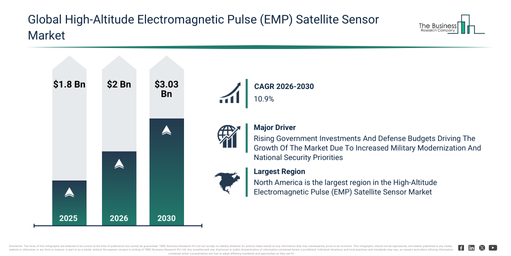
The high-altitude electromagnetic pulse (emp) satellite sensor market has experienced rapid expansion recently. This market is projected to expand from $1.8 billion in 2025 to reach $2 billion in 2026, demonstrating a compound annual growth rate (CAGR) of 11.1%. Historically, this growth was driven by several factors, including the initial deployment of satellite-based systems for nuclear detonation detection, advancements in electro-optical and auxiliary sensors, the broadening of satellite integration and calibration services, the creation of high-speed signal processing chips for EMP detection, and an increased emphasis on treaty monitoring alongside national security applications.
The high-altitude electromagnetic pulse (emp) satellite sensor market is anticipated to experience substantial expansion over the upcoming years. This market is projected to reach $3.03 billion in 2030, demonstrating a compound annual growth rate (CAGR) of 10.9%. Several factors contribute to this growth throughout the forecast period, including increasing demand for autonomous alerting systems, enhancements in satellite diagnostic tools and data interpretation services, the broadening of post-event reconstruction and simulation services, the adoption of advanced high-altitude EMP sensors, and increased government spending on nuclear threat detection and early warning systems. Key trends anticipated during the forecast period encompass sophisticated EMP waveform characterization technologies, advanced satellite-hardened electronic architectures, the expanding integration of multi-modal NUDET sensing payloads, greater utilization of high-speed radiation-tolerant signal processors, and the broadening of post-event reconstruction and forensic analysis tools.
Free High-Altitude Electromagnetic Pulse (EMP) Satellite Sensor Market Report Sample Available For Download:
Why Is Demand In The High-Altitude Electromagnetic Pulse (EMP) Satellite Sensor Market Expected To Keep Rising?
The expanding public spending by governments on defense and military activities is projected to stimulate the expansion of the high-altitude electromagnetic pulse (EMP) satellite sensor market in the future. These governmental financial commitments represent the distribution of national funds by countries to support military functions, acquire defense equipment, conduct research and development, and build strategic capacities to safeguard national security and military readiness. The increase in these investments and budgets is fueled by escalating geopolitical tensions and the necessity to update military capabilities to counter new dangers. Such funding supports the creation, deployment, and improvement of high-altitude EMP satellite sensors, thereby enhancing national security and shielding essential infrastructure from electromagnetic risks. For example, reports from the Stockholm International Peace Research Institute (SIPRI), an independent international research body based in Sweden that offers public analysis and information on conflict, arms control, disarmament, and military expenditure, indicated in February 2025 that worldwide defense expenditure reached USD 2.46 trillion in 2024, an increase from USD 2.24 trillion recorded in the previous year. Consequently, the surge in government investments and defense budgets is propelling the growth of the high-altitude electromagnetic pulse (EMP) satellite sensor market. The escalating dangers from cybersecurity are anticipated to boost the expansion of the high-altitude electromagnetic pulse (EMP) satellite sensor market in the coming years. These threats encompass harmful actions or assaults designed to illicitly access, harm, or disrupt digital infrastructure, networks, or information. The surge in cybersecurity threats is largely attributed to the rapid expansion of digital information and interconnected devices, which broadens potential targets for malicious entities. High-altitude EMP satellite sensors play a role in cybersecurity by identifying and tracking electromagnetic pulses capable of interfering with or damaging essential communication and information systems. For example, Check Point Software Technologies Ltd., a US-based firm offering cybersecurity solutions to businesses and governments, reported in February 2023 that cyberattacks rose by 38% in 2022 compared to the previous year, with organizations facing an average of 1,168 attacks every week. Thus, the growing cybersecurity threats are a key factor driving the high-altitude electromagnetic pulse (EMP) satellite sensor market.
How Is The High-Altitude Electromagnetic Pulse (EMP) Satellite Sensor Market Divided Across Segments And Subsegments?
The high-altitude electromagnetic pulse (emp) satellite sensor market covered in this report is segmented –
1) By Sensor Type: Active Sensors, Passive Sensors, Hybrid Sensors
2) By Platform: Satellites, Unmanned Aerial Vehicles, Manned Aircraft, Other Platforms
3) By Frequency Range: Low Frequency, Medium Frequency, High Frequency
4) By Application: Military And Defense, Aerospace, Space Research, Communication, Other Applications
5) By End-User: Government, Commercial, Research Organizations
Subsegments:
1) By Active Sensors: Radar-Based Sensors, Lidar-Based Sensors, Laser Sensors
2) By Passive Sensors: Optical Sensors, Infrared Sensors, Magnetic Field Sensors, Electric Field Sensors
3) By Hybrid Sensors: Combined Radar-Optical Sensors, Combined Infrared-Magnetic Sensors, Multi-Modal Electromagnetic Pulse (EMP) Sensors
High-Altitude Electromagnetic Pulse (EMP) Satellite Sensor Market Major Players: Companies At The Forefront Of The Industry
Major companies operating in the high-altitude electromagnetic pulse (emp) satellite sensor market are Lockheed Martin Corporation, Northrop Grumman Corporation, BAE Systems plc, L3Harris Technologies Inc., Los Alamos National Laboratory, Teledyne Technologies Incorporated, Sandia National Laboratories, General Atomics Electromagnetic Systems, Curtiss-Wright Corporation, Johns Hopkins University Applied Physics Laboratory, Lawrence Livermore National Security LLC, Mercury Systems Inc., Air Force Research Laboratory, Southwest Research Institute, Applied Research Associates Inc., Epirus Inc., NexTek LLC, Massachusetts Institute of Technology Lincoln Laboratory, Leidos Inc., Emprimus Inc.
Read More About The High-Altitude Electromagnetic Pulse (EMP) Satellite Sensor Market In The Full Report:
High-Altitude Electromagnetic Pulse (EMP) Satellite Sensor Market Regional Share Analysis For 2025
North America was the largest region in the high-altitude electromagnetic pulse (EMP) satellite sensor market in 2025. Asia-Pacific is expected to be the fastest-growing region in the forecast period. The regions covered in the high-altitude electromagnetic pulse (emp) satellite sensor market report are Asia-Pacific, South East Asia, Western Europe, Eastern Europe, North America, South America, Middle East, Africa.
Reach Out To Our Team:
The Business Research Company: https://www.thebusinessresearchcompany.com/
Americas: +1 310-496-7795
Asia: +44 7882 955267 & +91 8897263534
Europe: +44 7882 955267
Email us at: marketing@tbrc.info
Follow us on:
LinkedIn: https://in.linkedin.com/company/the-business-research-company
YouTube: https://www.youtube.com/channel/UC24_fI0rV8cR5DxlCpgmyFQ
Global Market Model: https://www.thebusinessresearchcompany.com/global-market-model

Wasay has over a decade of experience in market research, data modelling, and analytics, with prior experience at GlobalData and Decision Tree Consulting Services. At The Business Research Company , he leads research operations across syndicated studies, customized consulting engagements, and the Global Market Model platform. His professional experience includes supporting organizations such as Boston Consulting Group, KPMG, and Ernst & Young. Wasay holds a degree in Electronics and Communications Engineering, postgraduate management qualifications from International Management Institute Belgium and Indian School of Business and Entrepreneurship, and completed the Integrated Program in Business Analytics from Indian Institute of Management Indore.