
With a focus on actionable insights and strategic value, The Business Research Company’s 2026 market reports include market attractiveness scoring, total addressable market sizing, company benchmarking matrices, interactive Excel dashboards, deeper supply chain intelligence, emerging startup tracking, and granular product-level insights.
Hypersonic Defense Systems Market Size Analysis: Historical Growth And Future Revenue Projections
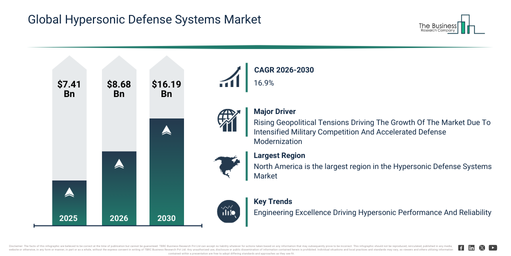
The hypersonic defense systems market has experienced swift expansion in recent years. Its size is expected to grow from $7.41 billion in 2025 to $8.68 billion in 2026, reflecting a compound annual growth rate (CAGR) of 17.2%. This historical growth can be attributed to the escalating development of hypersonic weapons, which has stimulated early research into interceptors and radar. Additionally, increased defense budgets have supported programs for high-speed threat detection, alongside the adoption of advanced sensors and tracking systems to monitor maneuverable targets. The market’s expansion further stems from the broadening of command and control modernization initiatives and the early integration of directed energy concepts into missile defense architectures.
The hypersonic defense systems market size is anticipated to undergo significant expansion over the next few years. It is projected to achieve a value of $16.19 billion by 2030, exhibiting a compound annual growth rate (CAGR) of 16.9%. This forecasted growth can be linked to the rapid evolution of multi-layered defense networks designed for hypersonic interception, escalating investments in advanced radar and over-the-horizon tracking technologies, the market introduction of enhanced kill vehicle and interceptor designs, accelerated development cycles influenced by geopolitical competition, and the integration of AI-based decision support systems to boost interception accuracy. Prominent trends for the upcoming period encompass heightened investment in hypersonic threat detection networks, swift creation of multi-layered interceptor architectures, the broadening of high-speed tracking and targeting technologies, increasing adoption of directed energy interception systems, and the incorporation of space-based surveillance for hypersonic monitoring.
Preview The Hypersonic Defense Systems Market Report With A Free Sample:
Hypersonic Defense Systems Market Drivers: What Is Fueling Demand Through 2030?
Future expansion of the hypersonic defense systems market is anticipated to be spurred by increasing geopolitical tensions. These tensions represent disputes or disagreements among nations or regions stemming from political, economic, or territorial issues. The escalation of geopolitical tensions often arises from competition for natural resources, as countries vie for access to energy, minerals, and water, which in turn leads to disputes and strained international ties. Furthermore, the existence of hypersonic defense systems themselves exacerbates geopolitical tensions because their advanced attributes, such as remarkable speed, agility, and offensive capabilities, supported by innovations like scramjet engines, hypersonic glide vehicles, and sophisticated guidance systems, intensify military rivalry, create strategic unpredictability, and compel countries to hasten defense modernization, accumulate armaments, and develop anti-hypersonic technologies. For example, data from Armed Conflict Location and Event Data (ACLED), a US-based crisis mapping and conflict data organization, revealed in December 2024 that global conflicts have doubled over the past five years, with fatalities in these conflicts increasing by 30% from 179,099 deaths in 2023 to 233,597 in 2024. Consequently, the uptick in geopolitical tensions is a key factor propelling the expansion of the hypersonic defense systems market.
Hypersonic Defense Systems Market Segmentation Analysis: Core Categories And Subcategories
The hypersonic defense systems market covered in this report is segmented –
1) By Type: Interceptor Systems, Tracking And Surveillance Systems, Command and Control Systems, Directed Energy Defense Systems, Launch Support And Engagement Systems
2) By Component: Interceptor Missiles, Radar Systems, Command and Control Systems, Tracking And Sensor Systems, Other Defense Components
3) By Platform: Land-Based, Naval, Airborne, Space-Based
4) By Speed: Mach 5–Mach 10 Threat Class, Above Mach 10 Threat Class
5) By End-User: Military, Homeland Security, Research And Defense Agencies
Subsegments:
1) By Interceptor Systems: Glide Phase Interceptors, Terminal Phase Interceptors, Boost Phase Interceptors, Hit-to-Kill Interceptors, Directed Energy Intercept Systems
2) By Tracking And Surveillance Systems: Space-Based Infrared Tracking Systems, Over-the-Horizon Radar Systems, Ground-Based Early Warning Radars, Airborne Tracking Sensors, Multi-Domain Integrated Sensor Networks
3) By Command and Control Systems: Integrated Battle Management Systems, Real-Time Data Fusion Systems, Fire Control Systems, Network-Centric Engagement Systems, Secure Communication And Decision Support Systems
4) By Directed Energy Defense Systems: High-Energy Laser Systems, High-Power Microwave Systems, Particle Beam Defense Systems, Counter-Hypersonic Energy Weapons, Experimental Directed Energy Platforms
5) By Launch Support And Engagement Systems: Ground Launch Platforms, Naval Vertical Launch Systems, Airborne Launch Platforms, Mobile Engagement Platforms, Autonomous Engagement Systems
Which Trends Will Define The Hypersonic Defense Systems Market Through 2030?
Leading companies within the hypersonic defense systems market are concentrating on developing innovative products, specifically multi-mission missiles, aimed at boosting adaptability, extending engagement reach, and offering quick response options against developing aerial and missile dangers. Such a missile is defined as a flexible weapon system capable of executing various functions, including air-to-air, surface-to-air, or surface-to-surface operations, all from a unified, adaptable platform. An example of this is Lockheed Martin Corporation, a US-based aerospace, defense, and security firm, which introduced its Mako hypersonic missile in April 2024 at the Navy League’s Sea-Air-Space exposition in Maryland, signifying a considerable leap forward in future strike capabilities. This air-launched, multi-mission weapon represents a pioneering design, intended for deployment from the internal weapon bays of stealth aircraft like the F-35 and F-22, while also being compatible with other U.S. military aircraft and naval systems. After seven years of development, Mako attains speeds greater than Mach 5 and ensures superior maneuverability, accuracy, and resilience against sophisticated air-defense systems, thereby supporting adaptable operations across aerial, terrestrial, and naval environments.
Hypersonic Defense Systems Market Major Companies And Industry Participants
Major companies operating in the hypersonic defense systems market are Boeing Company, Lockheed Martin Corporation, China Aerospace Science and Technology Corporation (CASC), General Dynamics Corporation, Northrop Grumman Corporation, China Aerospace Science and Industry Corporation (CASIC), Mitsubishi Heavy Industries, BAE Systems plc, Safran S.A., Thales Group, L3Harris Technologies Inc., Leonardo S.p.A., Leidos Holdings Inc., Saab AB, Kongsberg Gruppen ASA, Rafael Advanced Defense Systems Ltd., QinetiQ, Aerojet Rocketdyne Holdings Inc., Defence Research and Development Organisation India (DRDO), Honeywell Aerospace, Almaz-Antey, Raytheon Technologies Corporation, NPO Mashinostroyenia.
Buy The Full Hypersonic Defense Systems Global Market Report 2026:
Hypersonic Defense Systems Market Geographic Analysis: Which Region Accounts For The Biggest Share?
North America was the largest region in the hypersonic defense systems market in 2025. The regions covered in the hypersonic defense systems market report are Asia-Pacific, South East Asia, Western Europe, Eastern Europe, North America, South America, Middle East, Africa.
Reach Out To Our Team:
The Business Research Company: https://www.thebusinessresearchcompany.com/
Americas: +1 310-496-7795
Asia: +44 7882 955267 & +91 8897263534
Europe: +44 7882 955267
Email us at: marketing@tbrc.info
Follow us on:
LinkedIn: https://in.linkedin.com/company/the-business-research-company
YouTube: https://www.youtube.com/channel/UC24_fI0rV8cR5DxlCpgmyFQ
Global Market Model: https://www.thebusinessresearchcompany.com/global-market-model

Wasay has over a decade of experience in market research, data modelling, and analytics, with prior experience at GlobalData and Decision Tree Consulting Services. At The Business Research Company , he leads research operations across syndicated studies, customized consulting engagements, and the Global Market Model platform. His professional experience includes supporting organizations such as Boston Consulting Group, KPMG, and Ernst & Young. Wasay holds a degree in Electronics and Communications Engineering, postgraduate management qualifications from International Management Institute Belgium and Indian School of Business and Entrepreneurship, and completed the Integrated Program in Business Analytics from Indian Institute of Management Indore.


