
Enhanced with market attractiveness analysis, total addressable market evaluation, company benchmarking matrices, interactive Excel dashboards, expanded supply chain intelligence, emerging startup coverage, and detailed product insights, The Business Research Company’s 2026 market reports deliver more actionable and strategically valuable research.
Immersive Reality For Defense Market Size Forecast: How Large Could The Market Become By 2030?
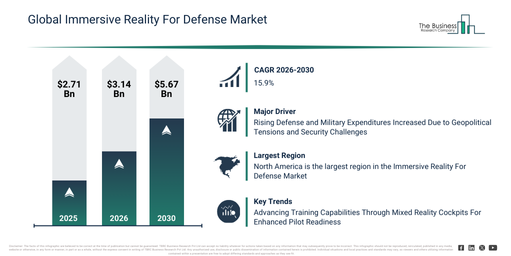
The immersive reality for defense market size has shown rapid expansion in recent years. It is forecast to increase from $2.71 billion in 2025 to $3.14 billion in 2026, achieving a compound annual growth rate (CAGR) of 16.0%. This historical growth can be attributed to several factors including elevated investment in military training and simulation initiatives, continuous advancements in virtual, augmented, and mixed reality technologies, an escalating demand for authentic and secure combat training environments, the increasing integration of immersive technologies for improved situational awareness and mission preparation, and the expansion of defense budgets that support technological integration.
The immersive reality for defense market size is anticipated to experience substantial growth in the coming years, reaching $5.67 billion by 2030 with a compound annual growth rate (CAGR) of 15.9%. This expansion throughout the forecast period stems from factors such as the integration of AI and machine learning for adaptive training and real-time decision support, the creation of collaborative and networked VR/AR/MR systems for joint operations, the increasing uptake of wearable and portable immersive devices, the broader application of immersive reality for remote maintenance and battlefield support, and the penetration into emerging defense markets through modernized military training programs. Noteworthy trends during this time include a heightened demand for realistic, high-fidelity battlefield simulation environments, a rise in the adoption of immersive tools for remote maintenance and repair in defense operations, an expansion of immersive training for medical and trauma response in military contexts, an increasing reliance on VR/AR systems for mission rehearsal and strategic planning, and deeper integration of immersive systems into soldier-wearable platforms.
Download A Free Sample Report For Comprehensive Market Insights:
Immersive Reality For Defense Market Expansion Supported By Key Demand Factors
Increasing outlays on defense and military are anticipated to boost the expansion of the immersive reality for defense market in the future. These expenditures signify that governments and defense bodies are dedicating substantial and consistent funds towards procurement, training, and research and development (R&D) to enhance military capabilities. Governments are boosting their spending mainly due to escalating geopolitical tensions and various regional conflicts. The immersive reality for defense sector directly addresses this need by providing cost-effective, high-fidelity training, faster R&D cycles, and scalable mission rehearsal, all of which are top priorities for defense purchasers. For example, data from April 2025 by the Stockholm International Peace Research Institute (SIPRI), a global security research institute based in Sweden, indicated that global military expenditure hit $2,718 billion in 2024. This represented a 9.4% real-term rise from 2023, constituting the sharpest annual increase seen since the conclusion of the Cold War. Consequently, the increased spending on defense and military is projected to fuel the expansion of the immersive reality for defense market.
Immersive Reality For Defense Market Categorization By Product Type And Application
The immersive reality for defense market covered in this report is segmented –
1) By Component: Hardware, Software, Services
2) By Technology: Virtual Reality (VR), Augmented Reality (AR), Mixed Reality (MR)
3) By Application: Training And Simulation, Medical Training And Healthcare Support, Maintenance And Repair, Combat Operations
Subsegments:
1) By Hardware: Head-Mounted Displays, Simulators, Sensors, Cameras, Wearables
2) By Software: Simulation Software, Immersive Applications, Three-Dimensional Visualization Tools, Artificial Intelligence/Machine Learning Integration, Data Integration Software, Collaboration Tools
3) By Service: Training And Simulation Services, System Integration Services, Maintenance And Support Services, Consulting And Customization, Content Creation, Cybersecurity Services
Immersive Reality For Defense Market Trends Reshaping Industry Growth
Major companies involved in the immersive reality market for defense are concentrating on technological advancements, including mixed reality cockpits, to bolster pilot training, refine situational awareness, streamline mission planning, and facilitate realistic combat simulations. Mixed reality cockpits are sophisticated simulation environments that integrate virtual and augmented reality to deliver pilots immersive, interactive, and real-time operational training experiences. For instance, in January 2025, Vertex Solutions LLC, a US-based technology company, supplied its first upgraded reconfigurable enhanced immersive training device (eITD), configured as a T-38, to the U.S. Air Force’s Detachment 24 (DET 24) at the 19th Air Force (19AF). This significant event marks the integration of mixed reality (MR) cockpits into the Air Force’s Fighter Bomber Fundamentals curriculum, transforming advanced pilot training with immersive and adaptive simulation technology.
Immersive Reality For Defense Market Company Landscape And Strategic Competition
Major companies operating in the immersive reality for defense market are EON Reality Inc., Lockheed Martin Corporation, Honeywell International Inc., Thales Group, HCL Technologies Limited, CAE Inc., AVEVA Group PLC, Barco NV, Vertex Solutions LLC, Magic Leap Inc., Varjo Technologies Oy, Bohemia Interactive Simulations s.r.o., Vection Technologies Ltd, Indra Sistemas S.A., HTX Labs Inc., Red Six Aerospace Inc., VRgineers Inc., Blippar Ltd., SimX Inc., Imagine 4D Inc., VRMADA LLC.
Access The Complete Immersive Reality For Defense Market Report:
Immersive Reality For Defense Market Geographic Distribution And Regional Opportunities
North America was the largest region in the immersive reality for defense market in 2025. The regions covered in the immersive reality for defense market report are Asia-Pacific, South East Asia, Western Europe, Eastern Europe, North America, South America, Middle East, Africa.
Access a Customized Immersive Reality For Defense Market Report for Deeper Competitive Insights
https://www.thebusinessresearchcompany.com/customise?id=22011&type=smp
The Business Research Company: https://www.thebusinessresearchcompany.com/
Americas: +1 310-496-7795
Asia: +44 7882 955267 & +91 8897263534
Europe: +44 7882 955267
Email us at: marketing@tbrc.info
Follow us on:
LinkedIn: https://in.linkedin.com/company/the-business-research-company
YouTube: https://www.youtube.com/channel/UC24_fI0rV8cR5DxlCpgmyFQ
Global Market Model: https://www.thebusinessresearchcompany.com/global-market-model

Wasay has over a decade of experience in market research, data modelling, and analytics, with prior experience at GlobalData and Decision Tree Consulting Services. At The Business Research Company , he leads research operations across syndicated studies, customized consulting engagements, and the Global Market Model platform. His professional experience includes supporting organizations such as Boston Consulting Group, KPMG, and Ernst & Young. Wasay holds a degree in Electronics and Communications Engineering, postgraduate management qualifications from International Management Institute Belgium and Indian School of Business and Entrepreneurship, and completed the Integrated Program in Business Analytics from Indian Institute of Management Indore.

