
With a focus on actionable insights and strategic value, The Business Research Company’s 2026 market reports include market attractiveness scoring, total addressable market sizing, company benchmarking matrices, interactive Excel dashboards, deeper supply chain intelligence, emerging startup tracking, and granular product-level insights.
In-Situ Resource Utilization (ISRU) Market Size Snapshot: 2026 Valuation, 2030 Projection And Key Growth Factors
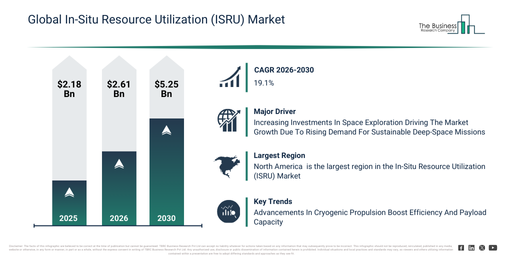
The in-situ resource utilization (isru) market size has shown rapid expansion in recent years. It is anticipated to increase from $2.18 billion in 2025 to $2.61 billion in 2026, achieving a compound annual growth rate (CAGR) of 19.7%. The expansion observed historically can be attributed to advancements in spaceborne resource extraction and processing technologies, a heightened emphasis on sustainable long-duration space missions, the establishment of in-orbit propellant and oxygen production systems, increasing investments in robotic and automated ISRU equipment, and a growing interest from space agencies in reducing their dependence on Earth-supplied consumables.
The in-situ resource utilization (isru) market size is projected to experience substantial growth in the coming years. It is anticipated to expand to $5.25 billion by 2030, exhibiting a compound annual growth rate (CAGR) of 19.1%. This growth during the forecast period can be attributed to several factors: the expansion of commercial lunar and planetary exploration missions, the adoption of advanced autonomous ISRU systems for mining and processing, the integration of in-situ manufactured metals and materials for on-site construction, increasing investment in remote monitoring and operation services for ISRU, and collaborations between space agencies and private companies for sustainable extraterrestrial resource utilization. Furthermore, major trends foreseen in this period include the development of advanced water extraction and oxygen production systems, robotics-enabled mining and material processing in extraterrestrial environments, the automation of fuel generation and storage systems for long-duration missions, the integration of additive manufacturing for on-site construction and part fabrication, and the deployment of sensor networks and monitoring systems for resource mapping and utilization.
Get A No-Cost Sample Of The In-Situ Resource Utilization (ISRU) Market Study:
Major Factor Fueling The In-Situ Resource Utilization (ISRU) Market Through 2030
Future expansion of the in-situ resource utilization (ISRU) market is anticipated to be driven by rising investments in space exploration. Space exploration encompasses the examination of outer space via astronomical observation, satellites, spacecraft, and human missions extending beyond Earth. The primary impetus behind increased space exploration funding stems from the pursuit of financial benefits, with countries and private entities seeking to generate revenue from endeavors like satellite markets, space tourism, asteroid mining, and the commercialization of emerging space technologies. Such increased funding in space exploration accelerates the advancement of in-situ resource utilization (ISRU) technologies by supporting research and infrastructure development, which facilitates the extraction and application of local materials like lunar ice and martian soil for purposes including fuel, water, and construction. An illustrative example is the UK’s commitment, announced in June 2024 by the New Zealand Ministry of Foreign Affairs and Trade, to allocate approximately USD 12.5 billion (£10 billion) to space programs over a ten-year span starting in 2023, including about USD 3.75 billion (£3 billion) specifically earmarked in the 2023 spending review. Consequently, the growing financial commitments to space exploration are propelling the expansion of the in-situ resource utilization (ISRU) market.
In-Situ Resource Utilization (ISRU) Market Segment Landscape: Main Categories And Subcategories Covered
The in-situ resource utilization (isru) market covered in this report is segmented –
1) By Product: Resource, Technology
2) By Application: Space Exploration, Lunar Missions, Planetary Missions, Asteroid Mining, Other Applications
3) By End-User: Government Space Agencies, Commercial Space Companies, Research Institutions
Subsegments:
1) By Resource: Water Extraction, Oxygen Production, Fuel Generation, Soil Analysis, Mineral Processing
2) By Technology: Additive Manufacturing, Robotics, Automation Systems, Sensors, Power Systems
How Are Emerging Trends Influencing The In-Situ Resource Utilization (ISRU) Market’s Growth Path?
Leading firms within the in-situ resource utilization (ISRU) market are prioritizing cutting-edge technologies, including water electrolyzers, to obtain and transform lunar or Martian water into hydrogen and oxygen, essential for fuel, life support, and various other crucial mission assets. These water electrolyzers function by employing electricity to separate water into its constituent hydrogen and oxygen gases, serving purposes such as fuel, energy storage, or life-support systems. An example of this is the launch in January 2025 by SpaceX, an aerospace manufacturer and space transport entity based in the US, of Hakuto-R Mission 2. This mission carried a “water electrolyzer” payload, specifically engineered by ispace, Inc., a Japanese lunar exploration company, to convert lunar water into hydrogen and oxygen. The objective of this particular launch is to showcase in-situ resource utilization (ISRU) technology, transforming lunar resources into valuable materials for subsequent fuel and life-support infrastructure.
In-Situ Resource Utilization (ISRU) Market Leading Players And Key Industry Participants In 2026
Major companies operating in the in-situ resource utilization (isru) market are Airbus SE, Northrop Grumman Corporation, Space Exploration Technologies Corp., Blue Origin L.P., Hanwha Systems Co. Ltd., Sierra Nevada Corporation, European Space Agency, China National Space Administration, Fleet Space Technologies Pty Ltd., Honeybee Robotics Ltd., Astrobotic Technology Inc., Paragon Space Development Corporation, Astronika Sp. z o.o., OffWorld Inc., ispace Inc., Masten Space Systems Inc., Lunar Resources Company, TransAstra Corporation, Maana Electric S.A., High Frontier Mining Corporation
Check Out The Full In-Situ Resource Utilization (ISRU) Market Report 2026:
In-Situ Resource Utilization (ISRU) Market By Geography: Revenue Leaders Among Global Regions
North America was the largest region in the in-situ resource utilization (ISRU) market in 2025. Asia-Pacific is expected to be the fastest-growing region in the forecast period. The regions covered in the in-situ resource utilization (isru) market report are Asia-Pacific, South East Asia, Western Europe, Eastern Europe, North America, South America, Middle East, Africa.
Reach Out To Our Team:
The Business Research Company: https://www.thebusinessresearchcompany.com/
Americas: +1 310-496-7795
Asia: +44 7882 955267 & +91 8897263534
Europe: +44 7882 955267
Email us at: marketing@tbrc.info
Follow us on:
LinkedIn: https://in.linkedin.com/company/the-business-research-company
YouTube: https://www.youtube.com/channel/UC24_fI0rV8cR5DxlCpgmyFQ
Global Market Model: https://www.thebusinessresearchcompany.com/global-market-model

Wasay has over a decade of experience in market research, data modelling, and analytics, with prior experience at GlobalData and Decision Tree Consulting Services. At The Business Research Company , he leads research operations across syndicated studies, customized consulting engagements, and the Global Market Model platform. His professional experience includes supporting organizations such as Boston Consulting Group, KPMG, and Ernst & Young. Wasay holds a degree in Electronics and Communications Engineering, postgraduate management qualifications from International Management Institute Belgium and Indian School of Business and Entrepreneurship, and completed the Integrated Program in Business Analytics from Indian Institute of Management Indore.


