Designed to make market research more actionable and strategically valuable, The Business Research Company’s 2026 market reports feature market attractiveness scoring, total addressable market sizing, company benchmarking matrices, interactive Excel dashboards, deeper supply chain intelligence, emerging startup tracking, and granular product-level insights.
How Fast Is The Infrared Night Vision Goggles Market Growing? Market Size, CAGR And Forecast Insights
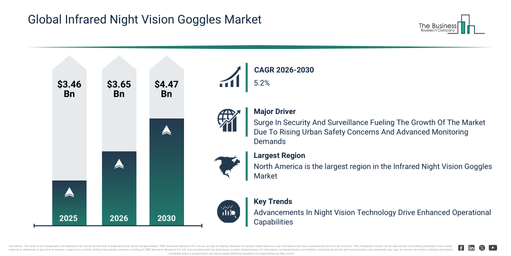
The market for infrared night vision goggles has experienced significant growth recently. This market is projected to expand from $3.46 billion in 2025 to reach $3.65 billion by 2026, exhibiting a compound annual growth rate (CAGR) of 5.5%. Historically, this growth was driven by factors such as the rising military adoption of infrared equipment for night operations, the introduction of initial uncooled thermal imaging technologies, increased demand from law enforcement for low-light surveillance solutions, improvements in CCD sensor performance enhancing image clarity, and the broadening of defense modernization initiatives that integrate night-vision systems.
The infrared night vision goggles market is projected to experience robust expansion over the coming years. By 2030, this market is anticipated to reach a valuation of $4.47 billion, demonstrating a compound annual growth rate (CAGR) of 5.2%. This growth trajectory is fueled by several factors, including an escalating demand for lightweight and user-friendly night-vision goggles, the increasing adoption of tri-spectrum imaging for improved situational awareness, a rise in requirements for border security and critical infrastructure surveillance, continuous technological progress leading to higher-resolution thermal imaging, and the expansion of civilian and commercial uses like outdoor safety and search-and-rescue missions. Key trends during this period encompass the increasing uptake of multispectral and tri-spectrum night vision systems, a heightened need for compact, lightweight, and durable infrared goggles, greater incorporation of uncooled thermal sensors for cost reduction, innovations in CCD/CMOS sensor-based digital night vision technology, and the broadening of civilian and outdoor applications for low-light visibility instruments.
Unlock Infrared Night Vision Goggles Market Insights With A Free Sample Report:
Infrared Night Vision Goggles Market Momentum: Key Driver Expected To Boost Growth Through 2030
The escalating requirements for security and surveillance are anticipated to boost the infrared night vision goggles market going forward. Security and surveillance encompass the systems and practices employed to observe, safeguard, and guarantee the safety of individuals, property, and data. The surge in security and surveillance needs stems from increasing urban safety concerns, as higher crime rates and threats to public safety compel authorities to adopt more advanced monitoring systems. Infrared night vision goggles enhance security and surveillance by allowing personnel to detect and monitor activities in complete darkness, improving visibility in low-light or nighttime conditions where standard cameras or human sight prove ineffective. For instance, in September 2024, IronmongeryDirect, a UK-based online retailer specializing in ironmongery, indicated that 64% of UK local authorities intensified surveillance, with 50 councils doubling their CCTV and the average rising to 391 cameras per council. Furthermore, in January 2024, Comparitech, a UK-based software company, reported that cities average 11 cameras per 1,000 people, with Atlanta leading at over 124 per 1,000. Therefore, the growing security and surveillance needs are driving the expansion of the infrared night vision goggles market.
Infrared Night Vision Goggles Market Segments: A Category-By-Category Overview
The infrared night vision goggles market covered in this report is segmented –
1) By Product Type: Intensified Night Vision Goggles, Thermal Imaging Goggles, Digital Night Vision Goggles, Multispectral Goggles
2) By Technology: First Generation (Gen 1), Second Generation (Gen 2), Third Generation (Gen 3), Fourth Generation (Gen 4)
3) By Price Range: Economical (Under $500), Mid-Range ($500 – $1,500), High-End ($1,500 and above)
4) By Application: Military And Defense, Law Enforcement And Security, Aerospace And Aviation, Hunting And Outdoor Activities, Surveillance And Reconnaissance
5) By End-User: Government And Military Personnel, Security Agencies, Outdoor Enthusiasts, Commercial Users, Research And Development Institutions
Subsegments:
1) By Intensified Night Vision Goggles: Generation 1 (Gen 1), Generation 2 (Gen 2), Generation 3 (Gen 3), Generation 4 (Gen 4)
2) By Thermal Imaging Goggles: Cooled Thermal Imaging Goggles, Uncooled Thermal Imaging Goggles
3) By Digital Night Vision Goggles: Complementary Metal-Oxide-Semiconductor (CMOS) Sensor-based Goggles, Charge-Coupled Device (CCD) Sensor-based Goggles
4) By Multispectral Goggles: Dual-Spectrum Goggles, Tri-Spectrum Goggles, Hyperspectral Goggles
Which Emerging Trends Are Gaining Traction In The Infrared Night Vision Goggles Market?
Leading companies in the infrared night vision goggles market are concentrating on advanced solutions, particularly revolutionary night vision technologies, to improve image clarity, extend detection ranges, enhance durability in tough environments, and embed augmented reality features for superior situational awareness and real-time data connectivity. These revolutionary night vision solutions involve cutting-edge technologies that considerably boost visibility, detection, and the user experience in low-light or no-light conditions. For example, in September 2023, Thermoteknix Systems Ltd., a UK-based optical products manufacturer, launched the FNVG-AR, a lightweight fused binocular night vision goggle combining advanced 16 mm white phosphor tubes with a high-resolution thermal imager. This innovative device features optical sensor fusion and is uniquely ITAR-free, ensuring its wide accessibility. It integrates smoothly with battle management systems to deliver live blue force tracking, navigation data, and real-time video from ISR or targeting assets. The FNVG-AR significantly enhances situational awareness for dismounted soldiers while minimizing their exposure and detection risks. This introduction signifies a major progression in night vision technology for military applications.
Infrared Night Vision Goggles Market Key Participants: Prominent Companies At A Glance
Major companies operating in the infrared night vision goggles market are Raytheon Technologies Corporation, Northrop Grumman Corporation, BAE Systems plc, Thales Group, L3Harris Technologies Inc., Elbit Systems Ltd., Leonardo DRS Inc., Hensoldt AG, Orpha Optics Technology Co. Ltd., Excelitas Technologies Corp., FLIR Systems Inc., ATN Corporation, Bushnell Corporation, Newcon Optik, American Technologies Network Corp., Night Vision Devices Inc., Armasight Inc., Firefield, LUNA OPTICS, Dedal-NV.
Get Detailed Infrared Night Vision Goggles Market Forecasts In The Complete Report:
Top Region In The Infrared Night Vision Goggles Market: A Global Perspective
North America was the largest region in the infrared night vision goggles market in 2025. Asia-Pacific is expected to be the fastest-growing region in the forecast period. The regions covered in the infrared night vision goggles market report are Asia-Pacific, South East Asia, Western Europe, Eastern Europe, North America, South America, Middle East, Africa.
Reach Out To Our Team:
The Business Research Company: https://www.thebusinessresearchcompany.com/
Americas: +1 310-496-7795
Asia: +44 7882 955267 & +91 8897263534
Europe: +44 7882 955267
Email us at: marketing@tbrc.info
Follow us on:
LinkedIn: https://in.linkedin.com/company/the-business-research-company
YouTube: https://www.youtube.com/channel/UC24_fI0rV8cR5DxlCpgmyFQ
Global Market Model: https://www.thebusinessresearchcompany.com/global-market-model

Wasay has over a decade of experience in market research, data modelling, and analytics, with prior experience at GlobalData and Decision Tree Consulting Services. At The Business Research Company , he leads research operations across syndicated studies, customized consulting engagements, and the Global Market Model platform. His professional experience includes supporting organizations such as Boston Consulting Group, KPMG, and Ernst & Young. Wasay holds a degree in Electronics and Communications Engineering, postgraduate management qualifications from International Management Institute Belgium and Indian School of Business and Entrepreneurship, and completed the Integrated Program in Business Analytics from Indian Institute of Management Indore.