Built to provide research that’s more actionable and strategically valuable, The Business Research Company’s 2026 market reports include market attractiveness analysis, total addressable market sizing, company benchmarking matrices, interactive Excel dashboards, broader supply chain intelligence, emerging startup tracking, and in-depth product insights.
Joint Compounds Market CAGR Outlook And Future Development
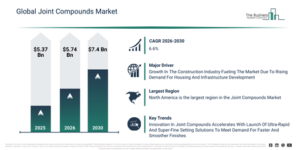
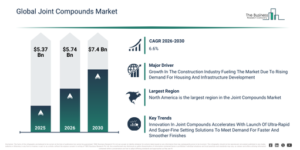
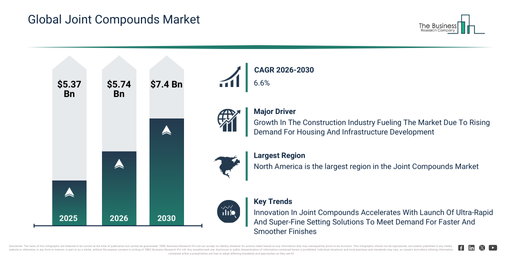
The joint compounds market has experienced robust growth in recent years. It is forecasted to grow from $5.37 billion in 2025 to $5.74 billion in 2026, with a compound annual growth rate (CAGR) of 6.9%. The expansion observed historically can be attributed to an increase in residential and commercial drywall installation activities, a greater adoption of ready-mixed joint compounds for more rapid application, the creation of lightweight formulations to enhance handling efficiency, the proliferation of renovation and remodeling projects, and advancements in gypsum processing technologies that improve product consistency.
The joint compounds market is projected to experience substantial growth in the coming years, reaching $7.4 billion by 2030, with a compound annual growth rate (CAGR) of 6.6%. This anticipated growth during the forecast period is driven by several factors, including increasing demand for environmentally compliant low-dust and low-VOC joint compounds, the growing use of high-performance setting-type compounds for quicker construction cycles, expanding construction projects in developing economies, the rising application of automated taping and finishing tools to optimize compound use, and the creation of specialized formulations for improved crack resistance and durability. Key trends expected within this period encompass a growing preference for ready-mixed and all-purpose joint compounds to minimize on-site preparation, increased adoption of lightweight compounds for easier handling and reduced worker strain, a surge in demand for small-pack joint compounds for DIY and repair projects, the expansion of specialized formulations like moisture-resistant, high-strength, and crack-resistant types, and a rapid rise in joint compound consumption in emerging markets fueled by urbanization and the increase in drywall construction.
Get A Free Sample Report With In-Depth Market Insights:
Joint Compounds Market Demand Drivers Opening New Revenue Streams
The expanding construction industry is projected to drive the growth of the joint compounds market. This sector, responsible for planning, designing, constructing, and maintaining buildings, infrastructure, and other physical structures across residential, commercial, and industrial segments, is witnessing growth fueled by population increase necessitating more housing and public facilities. Joint compounds play a crucial role in construction by enabling the smooth finishing of drywall installations through filling joints, seams, and screw holes. For instance, data from March 2025 by the Bureau of Labor Statistics, a US-based government agency, indicates that the construction industry is anticipated to expand by 4.7% between 2023 and 2033, surpassing the 4.0% growth projected for all industries. This expansion is forecasted to generate approximately 380,100 new jobs, increasing total employment in the construction sector to nearly 8.4 million by 2033, thereby confirming the growing construction industry as a significant driver for the joint compounds market.
Joint Compounds Market Segmentation: How Does The Market Break Down By Category?
The joint compounds market covered in this report is segmented –
1) By Product: Ready-Mixed Joint Compound, Setting-Type Joint Compound, All-Purpose Joint Compound, Lightweight Joint Compound
2) By Packaging Size: Small Packs (Up To 5 Kg), Medium Packs (6-15 Kg), Bulk (15 Kg And Above)
3) By Distribution Channel: Offline Or Retail Stores, Online Platforms
4) By Application: Drywall Joints, Ceiling Joints, Corner Bead, Texturing, Other Applications
5) By End Use: Residential Construction, Commercial Construction, Institutional Construction, Industrial Construction
Subsegments:
1) By Ready-Mixed Joint Compound: Taping Compound, Topping Compound, All-Purpose Ready-Mixed, Lightweight Ready-Mixed, Low Dust Formulation, Specialized Finishing Compounds
2) By Setting-Type Joint Compound: Quick-Set Compound, Mid-Set Compound, Extended-Set Compound, Moisture-Resistant Formulation, High-Strength Setting Compound
3) By All-Purpose Joint Compound: Interior Use All-Purpose, Exterior Use All-Purpose, Sandable All-Purpose, Mold And Mildew Resistant, Crack-Resistant All-Purpose
4) By Lightweight Joint Compound: Lightweight All-Purpose, Lightweight Topping, Lightweight Taping, Dust-Control Lightweight, Ultra-Lightweight Formula
Joint Compounds Market Trends Powering Strategic Industry Growth
Leading companies within the joint compounds market are concentrating on introducing innovative solutions, such as super-fine setting joint compounds, to address the increasing demand for quicker project completion, improved ease of use, and uniform finishes in both residential and commercial construction. These super-fine setting joint compounds represent advanced formulations crafted to significantly accelerate drying periods while providing a smoother, more refined surface outcome compared to traditional ready-mix or standard gypsum-based compounds. For instance, in February 2025, Pladur Gypsum S.A., a Spain-based manufacturer of gypsum products, launched two new joint compounds, Pasta Pladur ST2 Superfina and Pasta Pladur ST30. The ST2 Superfina is a powdered compound designed for manual joint treatment in cold and humid climates, featuring a consistent 120-minute set time and easy sandability suitable for Q1–Q3 finish levels. Conversely, the ST30 delivers ultra-rapid setting in just 30 minutes and a superior fine finish, making it ideal for same-day minor repairs while offering excellent workability and sanding ease. These additions underscore Pladur’s commitment to sustainability, energy efficiency, and ergonomic application methods.
Joint Compounds Market Competitive Overview And Top Companies
Major companies operating in the joint compounds market are Dow Inc., Compagnie de Saint-Gobain, Henkel AG & Co. KGaA, PPG Industries Inc., National Gypsum Company, Sika AG, USG Corporation, Etex NV, ASG Group, ParexGroup Limited, Pidilite Industries Limited, DAP Products Inc., Knauf Gips KG, Holcim Ltd., Zawawi Minerals LLC, Freeman Products Inc., Wacker Chemie AG, Mapei S.p.A., Solid Products Inc., Mada Gypsum Company, VANS Gypsum Private Limited.
View The Full Joint Compounds Market Report:
Joint Compounds Market Largest Region: Which Geography Holds The Highest Market Share?
North America was the largest region in the joint compounds market in 2025. Asia-Pacific is expected to be the fastest-growing region in the forecast period. The regions covered in the joint compounds market report are Asia-Pacific, South East Asia, Western Europe, Eastern Europe, North America, South America, Middle East, Africa.
Reach Out To Our Team:
The Business Research Company: https://www.thebusinessresearchcompany.com/
Americas: +1 310-496-7795
Asia: +44 7882 955267 & +91 8897263534
Europe: +44 7882 955267
Email us at: marketing@tbrc.info
Follow us on:
LinkedIn: https://in.linkedin.com/company/the-business-research-company
YouTube: https://www.youtube.com/channel/UC24_fI0rV8cR5DxlCpgmyFQ
Global Market Model: https://www.thebusinessresearchcompany.com/global-market-model

Wasay has over a decade of experience in market research, data modelling, and analytics, with prior experience at GlobalData and Decision Tree Consulting Services. At The Business Research Company , he leads research operations across syndicated studies, customized consulting engagements, and the Global Market Model platform. His professional experience includes supporting organizations such as Boston Consulting Group, KPMG, and Ernst & Young. Wasay holds a degree in Electronics and Communications Engineering, postgraduate management qualifications from International Management Institute Belgium and Indian School of Business and Entrepreneurship, and completed the Integrated Program in Business Analytics from Indian Institute of Management Indore.