Market attractiveness scoring, total addressable market sizing, company benchmarking matrices, interactive Excel dashboards, deeper supply chain intelligence, emerging startup tracking, and granular product-level insights are among the key offerings featured in The Business Research Company’s 2026 market reports, designed to deliver more actionable and strategically valuable research.
Light Detection And Ranging (LiDAR) Drone Market Size Estimate For 2026 And Revenue Forecast Through 2030
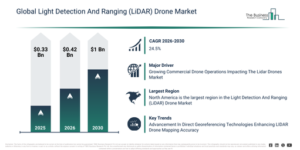
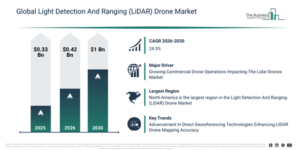
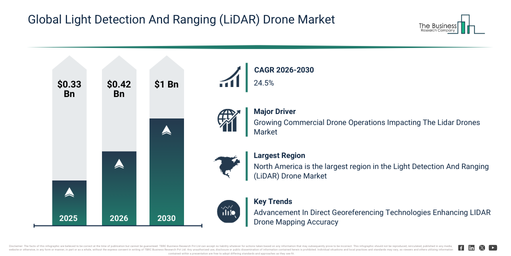
The light detection and ranging (lidar) drone market has experienced substantial growth over recent years. This market is projected to expand from $0.33 billion in 2025 to $0.42 billion in 2026, demonstrating a compound annual growth rate (CAGR) of 24.4%. Historically, this expansion has been driven by factors such as the increased integration of unmanned aerial vehicles (UAVs) in surveying and mapping, a heightened need for accurate geospatial data in construction and infrastructure projects, technological improvements in lidar sensors enhancing precision and operational effectiveness, governmental programs supporting smart city and infrastructure evolution, and the expanding application of drones across forestry, agriculture, and environmental monitoring.
The light detection and ranging (lidar) drone market is anticipated to undergo significant growth in the coming years, with its size expected to reach $1 billion in 2030, demonstrating a compound annual growth rate (CAGR) of 24.5%. This projected expansion over the forecast period is largely attributed to the increasing applications of lidar drones in autonomous vehicle mapping and navigation, the integration of artificial intelligence and machine learning for improved data processing, rising investment in monitoring renewable energy and utility infrastructure, a growing demand for rapid disaster assessment and emergency response solutions, the growth in commercial drone services, and the miniaturization of lidar sensors for cost-effective implementation. Notable trends during this period include the incorporation of high-resolution lidar sensors into drones, the diversification of lidar drone applications into areas like precision agriculture, the development of hybrid and multi-rotor drone designs suitable for various terrains, the adoption of lidar drones for mapping, surveying, and environmental monitoring tasks, and enhancements in data processing and analytics software specifically for lidar point cloud data.
Free Light Detection And Ranging (LiDAR) Drone Market Report Sample Available For Download:
Why Is Demand In The Light Detection And Ranging (LiDAR) Drone Market Expected To Keep Rising?
The increasing application of drones in commercial sectors is projected to advance the light detection and ranging (LiDAR) drone market. This commercial application involves deploying unmanned aerial vehicles (UAVs) across various industries, utilizing their abilities to perform tasks more efficiently, safely, and affordably than conventional approaches. LiDAR drones find growing commercial use because they can efficiently collect high-resolution elevation data for sectors like agriculture, forestry, construction, and environmental monitoring. For example, in May 2024, the International Trade Administration, a US government agency, reported that VUL (Association of Unmanned Aviation) forecasts a 40% rise in the worldwide count of commercially deployed drones from 2022 to 2030. Consequently, the expanding deployment of drones for commercial applications is fueling the expansion of the light detection and ranging (LiDAR) drone market.
How Is The Light Detection And Ranging (LiDAR) Drone Market Divided Across Segments And Subsegments?
The light detection and ranging (lidar) drone market covered in this report is segmented –
1) By Product: Fixed Wing Drone, Rotary Wing Drone
2) By LiDAR Type: Topographic, Bathymetric
3) By Range: Short, Medium, Long
4) By Application: Mapping And Cartography, Surveillance, Environment, Exploration And Detection, Precision Agriculture, Other Applications
Subsegments:
1) By Fixed Wing Drone: Fixed Wing Drone, Small Fixed Wing Drones, Medium Fixed Wing Drones, Large Fixed Wing Drones, Hybrid Fixed Wing Drones (Vertical Takeoff And Landing)
2) By Rotary Wing Drone: Rotary Wing Drone, Single Rotor Drones, Multi-Rotor Drones (Quadcopters, Hexacopters, Octocopters), Coaxial Rotor Drones, Hybrid Rotary Wing Drones
Light Detection And Ranging (LiDAR) Drone Market Trends Reshaping Customer Demand And Business Strategies
Leading firms within the light detection and ranging (LiDAR) drone market are concentrating on creating novel solutions, including real-time and post-mission direct georeferencing, to enhance mapping precision, data efficacy, and workflow automation for aerial surveying. These techniques, real-time and post-mission direct georeferencing, involve accurately ascertaining the geographic location and alignment of LiDAR data during or following a flight, thereby removing the requirement for ground control points and boosting mapping efficiency. As an illustration, in September 2024, Trimble Inc., a US-based software company, introduced its APX RTX portfolio, which is specifically tailored for UAV mapping sensors. This portfolio facilitates centimeter-level mapping accuracy across varied environments without the need for base stations, rendering it perfectly suited for original equipment manufacturers (OEMs) and UAV payload integrators.
Light Detection And Ranging (LiDAR) Drone Market Major Players: Companies At The Forefront Of The Industry
Major companies operating in the light detection and ranging (lidar) drone market are Trimble Navigation Ltd., Sick AG, Topcon Positioning Systems Inc., Leica Geosystems AG, FARO Technologies Inc, MicroDrones GmbH, UMS Skeldar, Teledyne Optech, Velodyne LiDAR Inc., 3D Robotics Inc., Routescene Ltd., Benewake Co. Ltd., Delair SAS, GreenValley International, YellowScan Inc., Geodetics Inc., Phoenix LiDAR Systems, LiDARUSA, SABRE Advanced 3D Surveying Systems, Cepton Technologies Inc, Hoverfly Technologies Inc., Riegl Measurement System, SZ DJI Technology company Ltd., Beijing SureStar Technology Co. Ltd.
Read More About The Light Detection And Ranging (LiDAR) Drone Market In The Full Report:
Light Detection And Ranging (LiDAR) Drone Market Regional Share Analysis For 2025
North America was the largest region in the light detection and ranging (LiDAR) drone market in 2025. Asia-Pacific is expected to be the fastest-growing region in the forecast period. The regions covered in the light detection and ranging (lidar) drone market report are Asia-Pacific, South East Asia, Western Europe, Eastern Europe, North America, South America, Middle East, Africa.
Reach Out To Our Team:
The Business Research Company: https://www.thebusinessresearchcompany.com/
Americas: +1 310-496-7795
Asia: +44 7882 955267 & +91 8897263534
Europe: +44 7882 955267
Email us at: marketing@tbrc.info
Follow us on:
LinkedIn: https://in.linkedin.com/company/the-business-research-company
YouTube: https://www.youtube.com/channel/UC24_fI0rV8cR5DxlCpgmyFQ
Global Market Model: https://www.thebusinessresearchcompany.com/global-market-model

Wasay has over a decade of experience in market research, data modelling, and analytics, with prior experience at GlobalData and Decision Tree Consulting Services. At The Business Research Company , he leads research operations across syndicated studies, customized consulting engagements, and the Global Market Model platform. His professional experience includes supporting organizations such as Boston Consulting Group, KPMG, and Ernst & Young. Wasay holds a degree in Electronics and Communications Engineering, postgraduate management qualifications from International Management Institute Belgium and Indian School of Business and Entrepreneurship, and completed the Integrated Program in Business Analytics from Indian Institute of Management Indore.