Backed by market attractiveness analysis, total addressable market sizing, company benchmarking matrices, interactive Excel dashboards, wider supply chain intelligence, emerging startup coverage, and detailed product-level insights, The Business Research Company’s 2026 market reports are designed to offer research that is more actionable and strategically valuable than ever.
Low Altitude Defense Radar Market Size Forecast: How Big Could The Market Get By 2030?
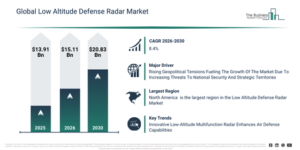
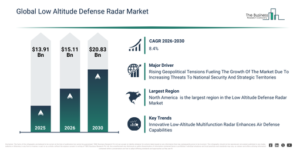
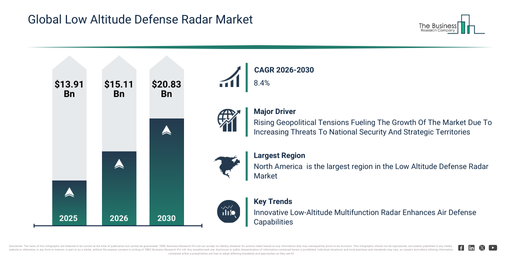
The low altitude defense radar market size has seen significant expansion in recent years. This market is expected to expand from $13.91 billion in 2025 to $15.11 billion in 2026, demonstrating a compound annual growth rate (CAGR) of 8.6%. The historical growth of this market can be linked to several factors, including rising threats from low-flying UAVs, improvements in radar signal processing technology, the adoption of ground and maritime surveillance radars, government investments in border security, and integration with existing air defense networks.
The low altitude defense radar market is projected to experience substantial expansion in the coming years. By 2030, this market is anticipated to reach $20.83 billion, demonstrating a compound annual growth rate (CAGR) of 8.4%. Factors driving this growth over the forecast period include the increasing demand for counter-drone capabilities, the emergence of compact mobile radar units, the incorporation of AI-enabled threat detection systems, the broadening of applications in battlefield and urban security, and the modernization of existing radar infrastructure. Key trends identified for the forecast timeframe encompass the integration of AI-based threat detection, the adoption of multi-sensor fusion for comprehensive low-altitude monitoring, the development of portable and quickly deployable radar systems, the integration of counter-drone and UAV defense mechanisms, and improvements in situational awareness for tactical operations.
Get A Free Sample Report With In-Depth Market Insights:
Low Altitude Defense Radar Market Growth Backed By Core Demand Fundamentals
The low-altitude defense radar market is anticipated to expand due to increasing geopolitical tensions. These tensions involve conflicts, disagreements, or competitions among nations or areas stemming from political, economic, land, or strategic concerns. Escalating geopolitical tensions are frequently rooted in territorial disputes, which jeopardize national sovereignty and control over key strategic areas. low-altitude defense radar improves national security frameworks by offering prompt detection and tracking of airborne threats at low altitudes, thereby becoming essential for safeguarding vital infrastructure and populated regions. This technology cuts down response times through swift threat evaluation and interception, boosting defense readiness and situational awareness. For example, in October 2024, data from the U.S. Department of Homeland Security, a federal agency based in the U.S., indicated that migrant encounters at the US-Canada border surpassed 181,000 in 2024, showing a 6.5% rise from 170,000 in 2023. Consequently, the heightened geopolitical tensions are fueling the expansion of the low-altitude defense radar market.
Low Altitude Defense Radar Market Segment Performance And Emerging Opportunities
The low altitude defense radar market covered in this report is segmented –
1) By Component: Hardware, Software, Services
2) By Platform: Ground-Based, Airborne, Naval
3) By Range: Short Range, Medium Range, Long Range
4) By Application: Surveillance, Threat Detection, Target Tracking
5) By End User: Military, Aerospace, Defense Contractors
Subsegments:
1) By Hardware: Antenna Systems, Transmitter Units, Receiver Units, Signal Processors, Power Supply Units, Cooling Systems
2) By Software: Radar Signal Processing Software, Target Tracking Software, Threat Analysis Software, Simulation And Modeling Software, Control And Monitoring Software
3) By Services: Installation Services, Maintenance Services, Training Services, Consulting Services, Upgradation Services
Low Altitude Defense Radar Market Growth Trends Reshaping The Competitive Landscape
Leading firms within the low-altitude defense radar market are concentrating on creating novel solutions, like low-altitude multifunction radar, aimed at enhancing the detection, tracking, and understanding of threats from UAVs and aircraft flying at low altitudes. A low-altitude multifunction radar is defined as a radar system capable of executing various functions, including surveillance, tracking, and identifying targets, to identify and address dangers present at low altitudes. An example is the launch by Aselsan A.S., a defense electronics firm located in Turkey, of its new low-altitude ALP Radar in December 2023. This system incorporates sophisticated AESA S-band technology, offers a range exceeding 200 km, and can be quickly deployed on a mobile 8×8 platform. Its design enables the detection and tracking of fighter jets, helicopters, UAVs, cruise missiles, and ballistic threats across low, medium, and high altitudes. The radar addresses crucial deficiencies in air defense, offering support for both early warning and close-range C-RAM operations. Furthermore, its specialized weapon-locating mode facilitates the computation of firing and impact points, thereby assisting counter-fire missions and boosting the airspace security for Turkey’s armed forces.
Low Altitude Defense Radar Market Key Players: Which Companies Lead Industry Competition?
Major companies operating in the low altitude defense radar market are Airbus Defense And Space SA, Raytheon Technologies Corporation, Lockheed Martin Corporation, General Dynamics Corporation, Northrop Grumman Corporation, Honeywell International Inc., BAE Systems plc, Thales SA, L3Harris Technologies Inc., Leonardo SpA, Rheinmetall AG, Viettel Group, Indra Sistemas SA, Israel Aerospace Indsutries Ltd., Saab AB, Hensoldt AG, Hanwha Systems, ASELSAN AS, RADA Electronic Industries Ltd., Weibel Scientific A/S, Retia AS
View The Full Low Altitude Defense Radar Market Report:
Low Altitude Defense Radar Market Geographic Landscape: Which Region Dominates Industry Growth?
North America was the largest region in the low-altitude defense radar market in 2025. Asia-Pacific is expected to be the fastest-growing region in the forecast period. The regions covered in the low altitude defense radar market report are Asia-Pacific, South East Asia, Western Europe, Eastern Europe, North America, South America, Middle East, Africa.
Reach Out To Our Team:
The Business Research Company: https://www.thebusinessresearchcompany.com/
Americas: +1 310-496-7795
Asia: +44 7882 955267 & +91 8897263534
Europe: +44 7882 955267
Email us at: marketing@tbrc.info
Follow us on:
LinkedIn: https://in.linkedin.com/company/the-business-research-company
YouTube: https://www.youtube.com/channel/UC24_fI0rV8cR5DxlCpgmyFQ
Global Market Model: https://www.thebusinessresearchcompany.com/global-market-model

Wasay has over a decade of experience in market research, data modelling, and analytics, with prior experience at GlobalData and Decision Tree Consulting Services. At The Business Research Company , he leads research operations across syndicated studies, customized consulting engagements, and the Global Market Model platform. His professional experience includes supporting organizations such as Boston Consulting Group, KPMG, and Ernst & Young. Wasay holds a degree in Electronics and Communications Engineering, postgraduate management qualifications from International Management Institute Belgium and Indian School of Business and Entrepreneurship, and completed the Integrated Program in Business Analytics from Indian Institute of Management Indore.