Through market attractiveness analysis, total addressable market evaluation, company benchmarking matrices, interactive Excel dashboards, expanded supply chain intelligence, emerging startup coverage, and detailed product insights, The Business Research Company’s 2026 market reports provide more actionable and strategically valuable research.
Low-Orbit Satellite Constellation Market Growth From $6.37 Billion In 2026 To $11.31 Billion By 2030 At A CAGR Of 15.43%
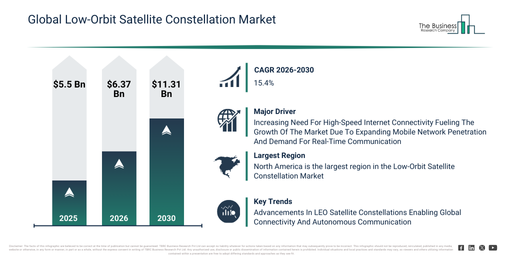
The size of the low-orbit satellite constellation market has experienced rapid expansion in recent times. This market is projected to expand from $5.5 billion in 2025 to $6.37 billion by 2026, demonstrating a compound annual growth rate (CAGR) of 15.8%. Historically, this expansion has been driven by factors such as the initial deployment of low-earth orbit satellites for worldwide communication trials, innovations in miniaturized satellite buses that facilitate extensive constellations, a growing uptake of VSAT and remote connectivity offerings, the creation of reusable launch vehicles leading to reduced launch expenses, and an escalating need for low-latency communication options across various commercial industries.
The low-orbit satellite constellation market is projected for significant expansion in the coming years. This market is anticipated to reach a valuation of $11.31 billion by 2030, exhibiting a compound annual growth rate (CAGR) of 15.4%. Factors driving this growth during the forecast period include the proliferation of mega-constellation initiatives aimed at providing global broadband, a surge in demand for user terminals and antennas specifically designed for LEO networks, the expansion of real-time tracking and IoT connectivity uses, progress in propulsion and communication payload technologies enhancing constellation efficiency, and increased capital expenditure in launch capabilities to facilitate swift constellation deployment. Key trends anticipated over the forecast period encompass the swift expansion of commercial LEO broadband networks, advancements in miniaturized satellite technologies, a heightened need for real-time Earth observation and monitoring, increased funding for reusable and economical launch systems, and the incorporation of inter-satellite links to ensure uninterrupted global coverage.
Download A Free Sample Report For Comprehensive Market Insights:
#Low-Orbit Satellite Constellation Market Demand Drivers Creating New Revenue Opportunities
The escalating demand for high-speed internet connectivity is projected to stimulate the expansion of the low-orbit satellite constellation market. Internet connectivity refers to the capacity of devices to access and exchange information via the internet across diverse networks and technologies. The expanding reach of internet connectivity is largely attributable to the growth of mobile networks, which provide more extensive and cost-effective access to online services, especially in isolated and underserviced territories. High-speed internet connectivity enhances low-orbit satellite constellations by facilitating rapid data transmission and low-latency communication. This supports real-time applications, extends coverage to remote zones, and boosts the overall efficiency of global connectivity solutions. For example, in 2023, data from the International Telecommunication Union, a Switzerland-based organization of the United Nations, revealed that the number of internet users grew from 5.1 billion (64% penetration) in 2022 to 5.4 billion (67% penetration) in 2023. Therefore, the increasing need for high-speed internet connectivity is serving as a key driver for the growth of the low-orbit satellite constellation market.
#Low-Orbit Satellite Constellation Market Segment Landscape And Growth Potential
The low-orbit satellite constellation market covered in this report is segmented –
1) By Component: Satellite, Ground Station, Launch Services, Other Components
2) By Application: Commercial, Defense, Government, Other Applications
3) By End-User: Telecommunications, Aerospace And Defense, Maritime, Other End Users
Subsegments:
1) By Satellite: Communication Satellites, Earth Observation Satellites, Navigation Satellites, Imaging Satellites, Scientific or Research Satellites, Technology Demonstration Satellites, CubeSats or NanoSats
2) By Ground Station: Telemetry, Tracking and Command Systems, Antenna Systems, Network Control Centers, Data Reception and Processing Units, Ground-Based Infrastructure Software, Remote Ground Terminals
3) By Launch Services: Dedicated Launch Vehicles, Rideshare Launch Services, Small Satellite Launch Vehicles, Reusable Launch Systems, Launch Integration Services
4) By Other Components: Onboard Propulsion Systems, Power Systems, Communication Payloads, Thermal Control Systems, Attitude and Orbit Control Systems, Satellite Bus Platforms, Inter-satellite Link Systems
#Low-Orbit Satellite Constellation Market Growth Trends: What Is Influencing The Future Outlook?
Leading firms within the Low-Orbit Satellite Constellation market are concentrating on creating novel solutions, including low Earth orbit (LEO) satellite constellations featuring Vehicle-2-Everything (V2X) connectivity, in response to the growing need for worldwide real-time communication, assistance for autonomous driving, and smooth IoT integration. These LEO satellites function at altitudes ranging from 300 and 2,000 kilometers, providing considerably reduced latency and enhanced data transfer rates when contrasted with conventional geostationary satellites, located at significantly greater distances from Earth. As an example, in September 2024, Geespace, a satellite technology firm based in China, deployed 10 LEO satellites for its ‘Geely Future Mobility Constellation’ (GEESATCOM) from the Taiyuan Satellite Launch Center. The design of these satellites aims to deliver 24/7 global communication coverage, presently covering 90% of the Earth’s surface, and to support uses like autonomous driving, intelligent connectivity, and satellite services requiring mid-to-low speeds. This constellation employs a phased deployment approach, with its initial phase targeting 72 satellites to cater to over 200 million users across the globe; subsequent phases are planned to facilitate direct-to-cell communication and high-speed broadband. This particular launch signifies the inaugural instance of a Chinese commercial aerospace enterprise providing global LEO satellite communication services, thereby establishing Geespace as a significant rival to systems such as SpaceX’s Starlink.
Low-Orbit Satellite Constellation Market Key Companies And Competitive Benchmarking
Major companies operating in the low-orbit satellite constellation market are Airbus SE, Lockheed Martin Corporation, Northrop Grumman Corporation, BAE Systems plc, Thales Group, L3Harris Technologies Inc., Leonardo S.p.A., SpaceX, OneWeb Communications Ltd., Surrey Satellite Technology Ltd, E-Space Inc., Kymeta Corporation, EnduroSat S.à r.l., GomSpace A/S, Muon Space Inc., NanoAvionics Corp, Starlink Satellite Communications Private Limited, Loft Orbital Solutions Inc., Astrocast SA, HawkEye 360 Inc.
Access The Complete Low-Orbit Satellite Constellation Market Report:
Low-Orbit Satellite Constellation Market Regional Analysis: Which Region Leads By Revenue?
North America was the largest region in the low-orbit satellite constellation market in 2025. The regions covered in the low-orbit satellite constellation market report are Asia-Pacific, South East Asia, Western Europe, Eastern Europe, North America, South America, Middle East, Africa.
Access a Customized Low-Orbit Satellite Constellation Market Report for Deeper Competitive Insights
https://www.thebusinessresearchcompany.com/customise?id=25386&type=smp
The Business Research Company: https://www.thebusinessresearchcompany.com/
Americas: +1 310-496-7795
Asia: +44 7882 955267 & +91 8897263534
Europe: +44 7882 955267
Email us at: marketing@tbrc.info
Follow us on:
LinkedIn: https://in.linkedin.com/company/the-business-research-company
YouTube: https://www.youtube.com/channel/UC24_fI0rV8cR5DxlCpgmyFQ
Global Market Model: https://www.thebusinessresearchcompany.com/global-market-model

Wasay has over a decade of experience in market research, data modelling, and analytics, with prior experience at GlobalData and Decision Tree Consulting Services. At The Business Research Company , he leads research operations across syndicated studies, customized consulting engagements, and the Global Market Model platform. His professional experience includes supporting organizations such as Boston Consulting Group, KPMG, and Ernst & Young. Wasay holds a degree in Electronics and Communications Engineering, postgraduate management qualifications from International Management Institute Belgium and Indian School of Business and Entrepreneurship, and completed the Integrated Program in Business Analytics from Indian Institute of Management Indore.