Designed to make market research more actionable and strategically valuable, The Business Research Company’s 2026 market reports feature market attractiveness scoring, total addressable market sizing, company benchmarking matrices, interactive Excel dashboards, deeper supply chain intelligence, emerging startup tracking, and granular product-level insights.
How Big Is The Lunar Energy Harvesting Market In 2026, And How Fast Will It Grow?
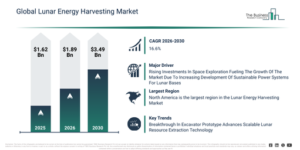
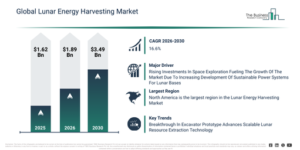
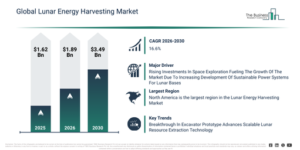
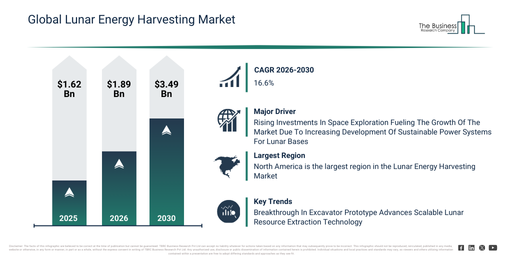
The lunar energy harvesting market has experienced rapid growth in recent years. It is projected to expand from $1.62 billion in 2025 to $1.89 billion in 2026, achieving a compound annual growth rate (CAGR) of 16.7%. Historical growth can be ascribed to advancements in lunar exploration programs, the early development of lunar surface power prototypes, initial investments in space-based renewable energy research, the emergence of commercial space logistics providers, and foundational progress in radiation-hardened power electronics.
The lunar energy harvesting market is projected to experience swift expansion over the coming years. By 2030, this market is anticipated to reach $3.49 billion, demonstrating a compound annual growth rate (CAGR) of 16.6%. This expansion during the forecast period is primarily driven by factors such as the growing establishment of lunar habitats and research bases, increased capital allocation towards extensive lunar solar infrastructure, progress in self-governing lunar power systems and rovers, the broadening scope of global partnerships for lunar energy initiatives, and an escalating need for highly efficient lunar energy storage technologies. Key developments expected in the forecast period involve a greater uptake of modular lunar power systems, the innovation of energy storage and conversion methods utilizing lunar regolith, the establishment of common standards for lunar power interfaces and microgrid communications, the proliferation of commercial “lunar energy-as-a-service” operational models, and the incorporation of lunar surface power grids into broader cislunar infrastructure.
Download A Free Lunar Energy Harvesting Market Sample Report With Size And Forecast Data:
Lunar Energy Harvesting Market Growth Driver: The Key Factor Behind Rising Demand
Increased investments in space exploration are anticipated to propel the growth of the lunar energy harvesting market. Space exploration involves the scientific investigation and discovery of outer space using advanced technology to study celestial objects and cosmic phenomena beyond Earth. This upward trend in investment is due to expanding commercial opportunities, as private companies increasingly recognize space-based technologies and services as profitable ventures with long-term returns. The growing investments in space exploration support the demand for lunar energy harvesting by accelerating the establishment of permanent lunar bases, which necessitate sustainable and localized power sources, such as solar farms or helium-3 extraction systems, to operate independently from Earth. For instance, in March 2025, the UK government announced that, between 2022 and 2024, the country received contracts totaling $1.135 billion (£844 million) through the European Space Agency (ESA), as reported by the House of Commons Library. Therefore, the rising investments in space exploration are driving the expansion of the lunar energy harvesting market.
Lunar Energy Harvesting Market Segmentation: Key Segments And Subsegments Covered
The lunar energy harvesting market covered in this report is segmented –
1) By Technology: Solar Power, Nuclear Power, Regolith-Based Power, Other Technologies
2) By Application: Space Missions, Lunar Bases, Satellite Operations, Other Applications
3) By End-User: Government, Commercial, Research Institutions, Other End-Users
Subsegments:
1) By Solar Power: Photovoltaic Solar Panels, Concentrated Solar Power Systems, Dust-Resistant Solar Coatings, Solar Energy Storage Systems, Solar Tracking Systems
2) By Nuclear Power: Fission Reactors, Radioisotope Thermoelectric Generators (RTGs), Heat-To-Electricity Conversion Systems, Radiation Shielding Technologies, Compact Nuclear Reactor Modules
3) By Regolith-Based Power: Thermoelectric Generators Using Regolith, Regolith-Based Thermal Storage Systems, In-Situ Regolith Processing Technologies, Microwave Sintering Systems, Regolith-To-Fuel Conversion Units
4) By Other Technologies: Wireless Power Transmission Systems, Electromagnetic Beaming Technologies, Dynamic Power Systems, Hybrid Energy Systems, Energy Distribution And Control Units
Lunar Energy Harvesting Market Trends: Key Developments Shaping 2026 And Beyond
Key companies within the lunar energy harvesting market are concentrating their efforts on creating sophisticated advancements, such as lunar regolith excavators, to build dependable, high-volume excavation capacities essential for large-scale resource recovery on the Moon. These specialized machines are designed to effectively remove and manage substantial quantities of lunar soil in the challenging conditions of space, facilitating the retrieval of valuable native resources like helium-3. An illustrative example occurred in May 2025, when Interlune Corporation, a US-based space resources startup, introduced its Interlune Excavator. This full-scale prototype is built to continuously handle 100 metric tons of lunar regolith hourly, emphasizing effective operation and flexibility for challenges on the lunar surface. Its compact structure reduces energy consumption, mechanical stress, and the spread of dust, signifying a notable progression in extraterrestrial excavation techniques.
Leading Companies Operating In The Lunar Energy Harvesting Market
Major companies operating in the lunar energy harvesting market are Boeing, Lockheed Martin, Airbus, Northrop Grumman, Thales Alenia Space, Blue Origin, SpaceX, Sierra Nevada Corporation, Maxar Technologies, Intuitive Machines, Astrobotic Technology, iSpace, Masten Space Systems, Moon Express, OrbitBeyond, NASA Advanced Energy Division (contract ecosystem), Interlune, Shackleton Energy Company, Honeybee Robotics, Redwire Space, Ball Aerospace, Rocket Lab, ispace Europe, Lunar Outpost, Teledyne Brown Engineering
Access The Full Lunar Energy Harvesting Market Research Report:
Lunar Energy Harvesting Market Regional Analysis: Largest Region And Key Geographies Covered
North America was the largest region in the lunar energy harvesting market in 2025. Asia-Pacific is expected to be the fastest-growing region in the forecast period. The regions covered in the lunar energy harvesting market report are Asia-Pacific, South East Asia, Western Europe, Eastern Europe, North America, South America, Middle East, Africa.
Reach Out To Our Team:
The Business Research Company: https://www.thebusinessresearchcompany.com/
Americas: +1 310-496-7795
Asia: +44 7882 955267 & +91 8897263534
Europe: +44 7882 955267
Email us at: marketing@tbrc.info
Follow us on:
LinkedIn: https://in.linkedin.com/company/the-business-research-company
YouTube: https://www.youtube.com/channel/UC24_fI0rV8cR5DxlCpgmyFQ
Global Market Model: https://www.thebusinessresearchcompany.com/global-market-model

Wasay has over a decade of experience in market research, data modelling, and analytics, with prior experience at GlobalData and Decision Tree Consulting Services. At The Business Research Company , he leads research operations across syndicated studies, customized consulting engagements, and the Global Market Model platform. His professional experience includes supporting organizations such as Boston Consulting Group, KPMG, and Ernst & Young. Wasay holds a degree in Electronics and Communications Engineering, postgraduate management qualifications from International Management Institute Belgium and Indian School of Business and Entrepreneurship, and completed the Integrated Program in Business Analytics from Indian Institute of Management Indore.