With a focus on actionable insights and strategic value, The Business Research Company’s 2026 market reports include market attractiveness scoring, total addressable market sizing, company benchmarking matrices, interactive Excel dashboards, deeper supply chain intelligence, emerging startup tracking, and granular product-level insights.
How Large Could The Marine Vessels Market Become By 2030 At A 3.7% CAGR?
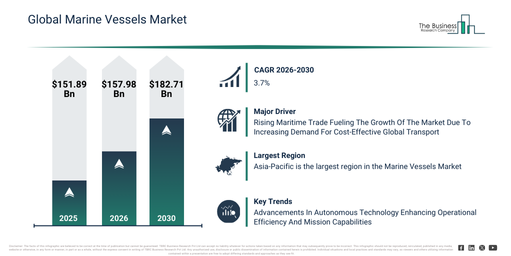
The marine vessels market size has seen steady expansion over the past few years. This market is projected to expand from $151.89 billion in 2025 to $157.98 billion in 2026, demonstrating a compound annual growth rate (CAGR) of 4.0%. Historically, this growth stemmed from factors such as increased global trade boosting demand for cargo and tanker ships, innovations in shipbuilding technology and materials, expansions in naval and defense fleets, greater demand for passenger and cruise vessels, and the escalation of offshore and industrial maritime operations necessitating specialized craft.
The marine vessels market is anticipated to show consistent growth in the coming years, expanding to $182.71 billion by 2030, at a compound annual growth rate (CAGR) of 3.7%. This growth in the forecast period can be attributed to factors such as the development of energy-efficient and environmentally friendly marine vessels, the increasing adoption of autonomous and smart ship technologies, a rising demand for multipurpose and hybrid-powered vessels, expansion into emerging markets with developing maritime infrastructure, and the integration of advanced navigation, communication, and safety systems into new vessels. Notable trends for this period include a growing demand for larger and more fuel-efficient vessel designs, increased production of specialized vessels for offshore industries, the ongoing modernization of naval fleets across various regions, expanding global trade stimulating demand for cargo ship manufacturing, and growth in passenger tourism boosting the deployment of cruise and ferry vessels.
Get A Free Marine Vessels Market Sample With 2030 Forecast Insights:
Marine Vessels Market Outlook: Key Driver Supporting Long-Term Growth
The marine vessels market is anticipated to experience growth in the coming years due to the increasing demand for maritime transport. This form of transport involves the movement of cargo and people aboard ships navigating through oceans and waterways. The surge in maritime transport is a result of growing global trade demands, offering a cost-effective and efficient means to convey large volumes of goods across international markets. Marine vessels are vital in supporting the demand for maritime transport, as they provide the necessary capacity and infrastructure to efficiently transport vast quantities of goods over long distances. For example, in July 2025, the European Commission, a Belgium-based executive branch of the European Union (EU), reported that 61.9% of the total goods handled at major EU ports in the third quarter of 2024 originated from inward movements. This figure represented an increase of 0.2% from the preceding quarter and 0.3% from the corresponding period of the previous year. Therefore, the escalating demand for maritime transport will drive the expansion of the marine vessels market.
Segmentation Of The Marine Vessels Market: Key Categories Explained
The marine vessels market covered in this report is segmented –
1) By Ship Type: Container Ships, Passenger Ships, Bulk Carriers, Tankers, Offshore Ships, Specialty Vessel, General Cargo Ship, Other Ship Types
2) By Solution: Line Fit, Retro Fit
3) By Propulsion Type: Diesel, Gas Turbine, Nuclear, Hybrid, Other Propulsion Types
4) By Material: Steel, Aluminum, Composites, Other Materials
5) By Application: Commercial Shipping, Military Operations, Recreational Boating, Fishing, Offshore Oil And Gas, Search And Rescue, Research And Survey, Tourism
Subsegments:
1) By Container Ships: Feeder Container Ships, Feedermax Container Ships, Panamax Container Ships, Post-Panamax Container Ships, New Panamax Container Ships, Ultra Large Container Ships (ULCS)
2) By Passenger Ships: Cruise Ships, Ferries, High-Speed Passenger Vessels (HSPVs), River Passenger Ships, Expedition Ships
3) By Bulk Carriers: Handysize Bulk Carriers, Handymax Bulk Carriers, Supramax Bulk Carriers, Panamax Bulk Carriers, Capesize Bulk Carriers, Very Large Ore Carriers (VLOC)
4) By Tankers: Crude Oil Tankers, Product Tankers, Chemical Tankers, Liquefied Natural Gas (LNG) Carriers, Liquefied Petroleum Gas (LPG) Carriers, Asphalt Tankers
5) By Offshore Ships: Platform Supply Vessels (PSV), Anchor Handling Tug Supply (AHTS) Vessels, Offshore Support Vessels (OSV), Diving Support Vessels (DSV), Subsea Construction Vessels (SCV), Seismic Survey Vessels
6) By Specialty Vessels: Research Vessels, Icebreakers, Cable Layers, Dredgers, Firefighting Vessels, Salvage Vessels
7) By General Cargo Ship: Multi-Purpose Cargo Ships, Reefer Ships, Roll-On Or Roll-Off (Ro-Ro) Cargo Ships, Heavy Lift Ships, Break Bulk Cargo Ships
8) By Other Ship Types: Naval Ships, Yachts and Mega Yachts, Fishing Vessels, Patrol Boats, Tugboats
Marine Vessels Market Evolving Trends: What Businesses Should Know
Leading companies in the marine vessels market are directing their efforts towards creating sophisticated solutions, such as autonomous unmanned surface vessels (USVs), designed to execute intricate operations in dangerous or distant marine locations. An autonomous unmanned surface vessel (USV) refers to a waterborne craft that operates on the water’s surface without a crew, utilizing advanced sensors, navigation systems, and artificial intelligence to complete tasks independently. For example, in January 2025, ACUA Ocean, a UK-based maritime cleantech startup, unveiled the USV Pioneer, an autonomous unmanned surface vessel (USV). This vessel is distinctively engineered for the rapid deployment of equipment and technology, fulfilling the requirement for quicker procurement cycles than conventional vessels. It offers superior seakeeping stability, guaranteeing more consistent operations in demanding sea conditions. Unlike smaller monohull USVs, it delivers enhanced operational endurance, permitting longer missions without breaks. Additionally, the vessel is prepared to gather data and deploy a variety of sensor and system payloads, making it exceptionally versatile for numerous maritime applications.
Who Competes In The Marine Vessels Market? Major Companies Listed
Major companies operating in the marine vessels market are A.P. Moller-Maersk AS, CMA CGM, Mediterranean Shipping Company (MSC), China State Shipbuilding Corporation (CSSC), Hapag-Lloyd AG, Mitsubishi Heavy Industries Ltd., Kawasaki Heavy Industries Ltd., Huntington Ingalls Industries Inc., FINCANTIERI S.p.A., HD Hyundai Heavy Industries Co. Ltd., Yang Ming Ltd., Hitachi Zosen Corporation, Ocean Network Express Pte. Ltd., Imabari Shipbuilding Co. Ltd., MITSUI E&S Holdings Co. Ltd., Japan Marine United Corporation, Namura Shipbuilding Co. Ltd., Tidewater Inc., Seacor Holdings Inc., Sasaki Shipbuilding Co. Ltd., Edison Chouest Offshore, Cochin Shipyard Ltd., Onomichi Dockyard Co. Ltd., Oshima Shipbuilding Co. Ltd., Shin Kurushima Dockyard Co. Ltd.
Read The Complete Marine Vessels Market Forecast Report Through 2030:
Marine Vessels Market Regional Ranking: Which Geography Comes First?
Asia-Pacific was the largest region in the marine vessels market in 2025. North America is expected to be the fastest-growing region in the forecast period. The regions covered in the marine vessels market report are Asia-Pacific, South East Asia, Western Europe, Eastern Europe, North America, South America, Middle East, Africa.
Reach Out To Our Team:
The Business Research Company: https://www.thebusinessresearchcompany.com/
Americas: +1 310-496-7795
Asia: +44 7882 955267 & +91 8897263534
Europe: +44 7882 955267
Email us at: marketing@tbrc.info
Follow us on:
LinkedIn: https://in.linkedin.com/company/the-business-research-company
YouTube: https://www.youtube.com/channel/UC24_fI0rV8cR5DxlCpgmyFQ
Global Market Model: https://www.thebusinessresearchcompany.com/global-market-model

Wasay has over a decade of experience in market research, data modelling, and analytics, with prior experience at GlobalData and Decision Tree Consulting Services. At The Business Research Company , he leads research operations across syndicated studies, customized consulting engagements, and the Global Market Model platform. His professional experience includes supporting organizations such as Boston Consulting Group, KPMG, and Ernst & Young. Wasay holds a degree in Electronics and Communications Engineering, postgraduate management qualifications from International Management Institute Belgium and Indian School of Business and Entrepreneurship, and completed the Integrated Program in Business Analytics from Indian Institute of Management Indore.