Featuring market attractiveness scoring, total addressable market sizing, company benchmarking matrices, interactive Excel dashboards, deeper supply chain intelligence, emerging startup tracking, and granular product-level insights, The Business Research Company’s 2026 market reports are built to deliver research that is both more actionable and more strategically valuable.
Maritime Cybersecurity Market Growth Analysis: How Will Revenue Trend Over The Forecast Period?
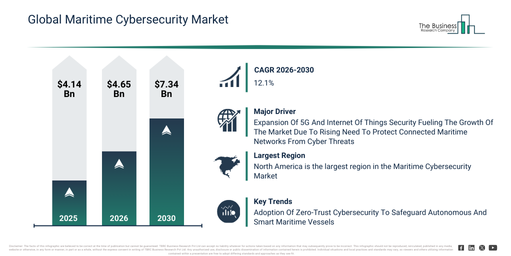
The maritime cybersecurity market size has expanded significantly in recent years. It is projected to increase from $4.14 billion in 2025 to $4.65 billion in 2026, achieving a compound annual growth rate (CAGR) of 12.3%. The historical market growth is due to several factors: the escalating digitalization of shipboard and port operations, which introduced new cyber risk exposures; the increasing occurrence of cyberattacks targeting maritime logistics and navigation systems; early regulatory efforts that fostered fundamental cybersecurity compliance across fleets; the widespread adoption of connected operational technologies, which spurred the demand for protective solutions; and a rising industry awareness of vulnerabilities within vessel communication and control systems.
The maritime cybersecurity sector anticipates considerable expansion over the coming years. This market is projected to reach $7.34 billion by 2030, exhibiting a compound annual growth rate (CAGR) of 12.1%. This projected expansion stems from several factors: stricter international cybersecurity rules mandating constant risk evaluation and oversight; greater uptake of sophisticated threat detection and incident response solutions within maritime settings; the proliferation of autonomous and remotely operated vessels which demand strong cyber defenses; increased funding for secure maritime communication infrastructure and encryption; and a growing need for managed cybersecurity services to uphold continuous compliance and operational stability. Key developments expected during this timeframe involve an escalating need for OT-IT convergence security, a heightened emphasis on the cyber resilience of maritime supply chains, an increase in cybersecurity compliance and regulatory obligations, the broadened provision of managed security services for maritime ports and vessels, and the incorporation of cyber risk insurance criteria.
Get A Free Sample Report With In-Depth Market Insights:
Maritime Cybersecurity Market Expansion Drivers: What’s Shaping Future Growth?
The advancement of 5G and internet of things security is anticipated to drive the future expansion of the maritime cybersecurity market. This security encompasses the full safeguarding of fast, low-delay 5G networks and the extensive collection of connected internet of things devices against digital threats, guaranteeing safe data transfer and device verification. The rise in 5G and internet of things security is fueled by the quick proliferation of connected devices and a surge in cyberattacks targeting vital infrastructure, leading industries and governments to allocate resources towards sophisticated security protocols to protect confidential information. Maritime cybersecurity facilitates the adoption of 5G and the internet of things through its role in shielding ship-based and offshore networks that rely on satellite-connected 5G for live data communication, as well as by securing automated internet of things applications utilized in navigation and cargo monitoring. As an illustration, a report from Ericsson, a telecommunications firm based in Sweden, indicated in November 2024 that by 2030, 5G networks are expected to manage 80% of all mobile data traffic, marking a substantial rise from 34% in 2024. Consequently, the broadening of 5G and internet of things security is propelling the expansion of the maritime cybersecurity market.
Maritime Cybersecurity Market Segments: Where Is Growth Concentrated?
The maritime cybersecurity market covered in this report is segmented –
1) By Types: Endpoint Security, Application Security, Cloud Security, Other Types
2) By Threats: System Disruption Threat, Data Breaches And Information Threat, Ransomware Attacks, Network Segmentation Threat, Other Threat Types
3) By Deployment Model: On Premise, Cloud Based
4) By Application: Threat Detection And Prevention, Cyber Incident Response, Cybersecurity Compliance
5) By End User: Port Authorities, Shipping Companies And Transportation, Maritime Insurers, Other End Users
Subsegments:
1) By Endpoint Security: Antivirus And Anti-Malware, Endpoint Detection And Response, Mobile Device Security, Universal Serial Bus (USB) And Peripheral Control, Host Intrusion Prevention Systems
2) By Application Security: Web Application Firewalls, Secure Code Development, Runtime Application Self-Protection, Application Programming Interface Security, Application Vulnerability Scanning
3) By Cloud Security: Cloud Access Security Brokers, Cloud Encryption, Cloud Security Posture Management, Identity And Access Management, Virtual Firewalls For Cloud Environments
4) By Other Types: Network Security, Intrusion Detection And Prevention Systems, Security Information And Event Management, Multi-Factor Authentication, Data Loss Prevention
Maritime Cybersecurity Market Strategic Trends: What Defines The Next Growth Phase?
Major companies operating in the maritime cybersecurity market are concentrating on advanced solutions, such as zero-trust-based cybersecurity technologies, to support digital transformation in the maritime sector. These zero-trust-based cybersecurity technologies function on the premise of never trust, always verify, thereby demanding stringent identity verification for every user and device connecting to a network. For instance, in December 2024, Rakuten Symphony, a Japan-based provider of lifecycle-based cybersecurity solutions, introduced Rakuten Maritime. This comprehensive enterprise service aims to meet the increasing global demand for cybersecurity and digital transformation in the sector, offering industry-leading technologies to safeguard autonomous vessels and smart ships. As global shipping companies and shipowners accelerate the adoption of autonomous technologies and develop smart ships, cyberattacks targeting these vessels have also increased.
Maritime Cybersecurity Market Key Participants And Competitive Landscape
Major companies operating in the maritime cybersecurity market are Airbus SE, International Business Machines Corporation, Northrop Grumman Corporation, BAE Systems plc, Thales Group, Leonardo S.p.A., Wärtsilä Oyj Abp, Elbit Systems Ltd., SAAB AB, Smiths Group plc, DNV AS, Terma A/S, Kongsberg Digital AS, ABS Group of Companies Inc., HGH Infrared Systems, Otorio Ltd., Nettitude Ltd., Westminster Group Plc, Maritime Cyber Solutions Limited, Cydome Security Ltd.
View The Full Maritime Cybersecurity Market Report:
Maritime Cybersecurity Market Largest Region: Which Geography Holds The Biggest Share?
North America was the largest region in the maritime cybersecurity market in 2025. The regions covered in the maritime cybersecurity market report are Asia-Pacific, South East Asia, Western Europe, Eastern Europe, North America, South America, Middle East, Africa.
Reach Out To Our Team:
The Business Research Company: https://www.thebusinessresearchcompany.com/
Americas: +1 310-496-7795
Asia: +44 7882 955267 & +91 8897263534
Europe: +44 7882 955267
Email us at: marketing@tbrc.info
Follow us on:
LinkedIn: https://in.linkedin.com/company/the-business-research-company
YouTube: https://www.youtube.com/channel/UC24_fI0rV8cR5DxlCpgmyFQ
Global Market Model: https://www.thebusinessresearchcompany.com/global-market-model

Wasay has over a decade of experience in market research, data modelling, and analytics, with prior experience at GlobalData and Decision Tree Consulting Services. At The Business Research Company , he leads research operations across syndicated studies, customized consulting engagements, and the Global Market Model platform. His professional experience includes supporting organizations such as Boston Consulting Group, KPMG, and Ernst & Young. Wasay holds a degree in Electronics and Communications Engineering, postgraduate management qualifications from International Management Institute Belgium and Indian School of Business and Entrepreneurship, and completed the Integrated Program in Business Analytics from Indian Institute of Management Indore.